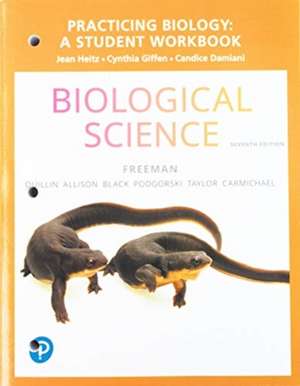
Practicing Biology
Autor Scott Freeman, Kim Quillin, Lizabeth Allison, Michael Black, Greg Podgorski, Emily Taylor, Jeff Carmichaelen Limba Engleză Paperback – 27 iul 2019
Aplicabilitatea practică a conceptelor biologice este elementul central al volumului Practicing Biology, aflat acum la ediția a 7-a. Găsim în acest caiet de lucru o metodologie riguroasă care transformă teoria în experiență directă, pornind de la premisa că studenții învață biologia cel mai eficient prin exercițiu aplicat. Structura este concepută pentru a sprijini diferite stiluri de învățare, utilizând activități de modelare și cartografiere care permit identificarea rapidă a lacunelor în înțelegerea principiilor fundamentale.
Organizarea volumului urmează o progresie logică, fiind împărțit în patru unități esențiale. Primele două unități explorează originile moleculare, evoluția vieții și funcțiile celulare, incluzând secțiuni detaliate despre metabolism și fotosinteză. Ultimele două unități se concentrează pe structura genelor, biotehnologie și procesele evolutive prin selecție naturală. Această ediție rafinează instrumentele de lucru pentru a se alinia cerințelor curriculare actuale, punând accent pe 'BioSkills'.
Putem afirma că acest volum completează organic lucrarea fundamentală a autorului, Biological Science, păstrând abordarea centrată pe student și pe dezvoltarea gândirii critice. Cititorii familiarizați cu Understanding Biology ISE de Kenneth Mason vor aprecia în acest volum focalizarea intensă pe activități de tip 'workbook', care transformă conceptele abstracte în exerciții de rezolvare de probleme. Spre deosebire de manualele tradiționale, care pot fi uneori dense în detalii descriptive, Practicing Biology se concentrează pe mecanismele de funcționare și pe conexiunile dintre sisteme, oferind o structură narativă tehnică, dar accesibilă.
Preț: 392.37 lei
Carte disponibilă
Livrare economică 30 octombrie-13 noiembrie
Specificații
ISBN-10: 0135276950
Pagini: 416
Dimensiuni: 213 x 274 x 23 mm
Greutate: 0.68 kg
Ediția:7th edition
Editura: Pearson Education
De ce să citești această carte
Această resursă este esențială pentru studenții la biologie care doresc să treacă de la memorarea pasivă la înțelegerea activă. Prin cele 416 pagini de activități practice, cititorul câștigă abilități analitice și de modelare necesare în laborator și examene. Este un instrument de lucru care transformă biologia dintr-o materie teoretică într-o disciplină exploratorie, fiind ideal pentru pregătirea seminariilor și a examenelor de profil.
Despre autor
Scott Freeman a fost un educator dedicat, cunoscut pentru abordarea sa inovatoare în predarea științelor biologice. Deși parcursul său academic a inclus cercetări în economie monetară la University of Texas, contribuția sa majoră în domeniul educației rămâne seria de manuale de biologie publicate la Pearson Education. Lucrarea sa, Biological Science, a revoluționat modul în care biologia este predată la nivel universitar, punând accent pe învățarea bazată pe descoperire și pe dezvoltarea competențelor de cercetare. Scott Freeman a promovat constant ideea că succesul academic depinde de implicarea activă a studentului în procesul de învățare.
Descriere scurtă
Notă biografică
Lizabeth A. Allison is Chancellor Professor of Biology at the College of William & Mary. She received her PhD in Zoology from the University of Washington, specializing in molecular and cellular biology. Before coming to William & Mary, she spent eight years as a faculty member at the University of Canterbury in New Zealand. Liz teaches introductory biology for majors and upper division molecular biology courses. She has mentored graduate students and more than 120 undergraduate research students, many of them coauthoring papers with her on intracellular trafficking of the thyroid hormone receptor in normal and cancer cells. The recipient of numerous awards, including a State Council for Higher Education in Virginia (SCHEV) Outstanding Faculty Award in 2009, Liz received one of the three inaugural Arts Shouland Sciences Faculty Awards for Teaching Excellence in 2011, and a Plumeri Award for Faculty Excellence in 2012. In addition to her work on this text, she is author of Fundamental Molecular Biology, now in its second edition, with a third edition under way.
Lead Author; Chapters 1, 33, 48 and BioSkills
laalli@wm.edu
Michael Black received his PhD in Microbiology and Immunology from Stanford University School of Medicine as a Howard Hughes Predoctoral Fellow. After graduation, he studied cell biology as a Burroughs Wellcome Postdoctoral Fellow at the MRC Laboratory of Molecular Biology in Cambridge, England. His current research focuses on the use of molecules to identify and track the transmission of microbes in the environment. Michael is a professor of Cell and Molecular Biology at California Polytechnic State University in San Luis Obispo, where he teaches introductory and advanced classes for majors in cell biology and microbiology. In addition to his teaching and research activities, Michael serves as the director of the Undergraduate Biotechnology Lab, where he works alongside undergraduate technicians to integrate research projects and inquiry-based activities into undergraduate classes.
Chapters 2-12
mblack@calpoly.edu
Greg Podgorski received his PhD in Molecular and Cellular Biology from Penn State University and has been a postdoctoral fellow at the Max Plank Institute for Biochemistry and Columbia University. His research interests are in biology education, developmental genetics, and computational biology. Greg's most recent work has been in mathematical modeling of how patterns of different cell types emerge during development and how tumors recruit new blood vessels in cancer. Greg has been teaching at Utah State University for more than 20 years in courses that include introductory biology for majors and nonmajors, genetics, cell biology, developmental biology, and microbiology, and he has offered courses in nonmajors biology in Beijing and Hong Kong. He has won teaching awards at Utah State University and has been recognized by the National Academies as a Teaching Fellow and a Teaching Mentor.
Chapters 13-21
greg.podgorski@usu.edu
Kim Quillin received her BA in Biology at Oberlin College summa cum laude and her PhD in Integrative Biology from the University of California, Berkeley, as a National Science Foundation Graduate Fellow. Kim has worked in the trenches with Scott Freeman on every edition of Biological Science, starting with the ground-up development of the illustrations in the first edition in 1999 and expanding her role in each edition. Kim currently serves as the Curriculum Coordinator for Introductory Biology for Salisbury University (SU), a member of the University System of Maryland, where she is actively involved in the ongoing student-centered reform of the course for biology majors. She also serves as the Curriculum Facilitator for the biology department, focusing on programmatic review and alignment of the SU biology curriculum to the Vision and Change core concepts and competencies.
Chapters 22-25, 30-32, 49-54
kxquillin@salisbury.edu
Jeff Carmichael received his BS in Biology from Slippery Rock University in Pennsylvania and his PhD in Plant Biology from the University of Georgia. As an undergraduate student, he spent some time studying enzyme kinetics through a fellowship at Oak Ridge National Laboratory in Tennessee. His graduate work focused on sexual reproduction in an intriguing group of seed plants. He has been teaching and coordinating Introductory Biology at the University of North Dakota (UND) for more than 20 years. He also works with the campus-wide Teaching Transformation and Development Academy, where he helps other faculty members incorporate evidence-based best teaching practices in their courses. He has received excellence in teaching awards at UND and as a graduate student in Georgia.
Chapters 26-29 and 34-38
Jeffrey.Carmichael@und.edu
Emily Taylor earned a BA in English at the University of California, Berkeley. She then earned a PhD in Biological Sciences from Arizona State University, where she conducted research in the field of environmental physiology as a National Science Foundation Graduate Research Fellow. She is currently a professor of Biological Sciences at the California Polytechnic State University in San Luis Obispo. Her student-centered research program focuses on the endocrine and reproductive physiology of free-ranging reptiles, especially rattlesnakes. She teaches numerous undergraduate and graduate courses, including introductory biology, anatomy and physiology, endocrinology, and herpetology, and received the California Faculty Association's Distinguished Educator Award in 2010 and Cal Poly's Distinguished Teaching Award in 2012.
Chapters 39-47
etaylor@calpoly.edu
Cuprins
- Biology: The Study of Life BioSkills
- Water and Carbon: The Chemical Basis of Life
- Protein Structure and Function
- Nucleic Acids and an RNA World
- An Introduction to Carbohydrates
- Lipids, Membranes, and the First Cells
- Inside the Cell
- Energy and Enzymes: An Introduction to Metabolism
- Cellular Respiration and Fermentation
- Photosynthesis
- Cell-Cell Interactions
- The Cell Cycle
- Meiosis
- Mendel and the Gene
- DNA and the Gene: Synthesis and Repair
- How Genes Work
- Transcription, RNA Processing, and Translation
- Control of Gene Expression in Bacteria
- Control of Gene Expression in Eukaryotes
- The Molecular Revolution: Biotechnology, Genomics, and New Frontiers
- Genes, Development, and Evolution
- Evolution by Natural Selection
- Evolutionary Processes
- Speciation
- Phylogenies and the History of Life
- Bacteria and Archaea
- Diversification of Eukaryotes
- Green Algae and Land Plants
- Fungi
- An Introduction to Animals
- Protostome Animals
- Deuterostome Animals
- Viruses
- Plant Form and Function
- Water and Sugar Transport in Plants
- Plant Nutrition
- Plant Sensory Systems, Signals, and Responses
- Flowering Plant Reproduction and Development
- Animal Form and Function
- Water and Electrolyte Balance in Animals
- Animal Nutrition
- Gas Exchange and Circulation
- Animal Nervous Systems
- Animal Sensory Systems
- Animal Movement
- Chemical Signals in Animals
- Animal Reproduction and Development
- The Immune System in Animals
- An Introduction to Ecology
- Behavioral Ecology
- Population Ecology
- Community Ecology
- Ecosystems and Global Ecology
- Biodiversity and Conservation Biology