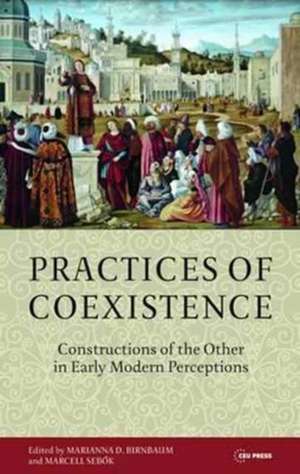
Practices of Coexistence: Constructions of the Other in Early Modern Perceptions
Editat de Marianna D. Birnbaum, Marcell Sebőken Limba Engleză Hardback – 15 iun 2017
Preț: 662.35 lei
Preț vechi: 727.85 lei
-9%
Puncte Express: 994
Carte disponibilă
Livrare economică 27 octombrie-10 noiembrie
Livrare prin curier în România Termenul estimat este afișat lângă disponibilitate.
Transport gratuit pentru acest produs Plată online sau ramburs, în funcție de opțiunile comenzii.
Retur gratuit în 14 zile Comandă securizată și suport în română.
Specificații
ISBN-13: 9789633861493
ISBN-10: 9633861497
Pagini: 242
Dimensiuni: 152 x 229 x 18 mm
Greutate: 0.61 kg
Ediția:1
Editura: Amsterdam University Press
Colecția Central European University Press
Locul publicării:Oxford, United Kingdom
ISBN-10: 9633861497
Pagini: 242
Dimensiuni: 152 x 229 x 18 mm
Greutate: 0.61 kg
Ediția:1
Editura: Amsterdam University Press
Colecția Central European University Press
Locul publicării:Oxford, United Kingdom
Public țintă
AcademicNotă biografică
Marianna D. Birnbaum is Research Professor in the Department of Germanic Languages at UCLA. She is also involved in the Medieval Studies Department’s programs at the Central European University, Budapest.
Marcell Sebok is Assistant Professor at the Department of Medieval Studies of Central European University.
Marcell Sebok is Assistant Professor at the Department of Medieval Studies of Central European University.
Cuprins
Introduction, The Good Fowler as a World Conqueror: Images of Suleyman the Magnificent in Early Modern Hungarian Literary Practice, Repercussions of a Murder: The Death of Sehzade Mustafa on the Early Modern English Stage, Constructing a Self-Image in the Image of the Other: Pope Pius II's Letter to Sultan Mehmed II, Topography of a Society: Muslims, Dwellers, and Customs of Algiers in Antonio de Sosa's Topographia, e Historia General de Argel, The Ragusan Image of Venice and the Venetian Image of Ragusa in the Early Modern Period, All Moldavian Eyes on Ottomans: Perceptions and Representations at the End of the Fifteenth Century, List of Contributors, Index
Descriere
The essays in this book provide interesting contributions to the ongoing debate concerning the representation of differing cultures, i.e., the “image of the Other” in the early modern period .