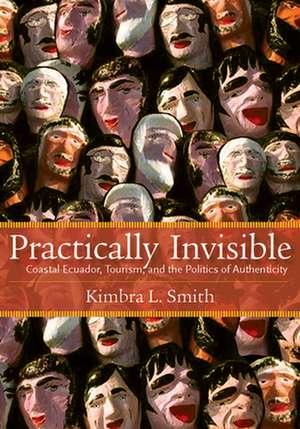
Practically Invisible: Coastal Ecuador, Tourism, and the Politics of Authenticity
Autor Kimbra Smithen Limba Engleză Hardback – 11 noi 2015
Thus came a nearly inevitable shock, as the daily rhythms of life--rising before dawn to prepare for a long day of maintaining livestock and crops; returning for a late lunch and siesta; joining in a game of soccer followed by dinner in the evening--transformed forever in favor of a new tourist industry and the compromises required to support it. As Practically Invisible demonstrates, for Agua Blancans, becoming a supposedly "authentic" version of their own indigenous selves required performing their culture for outsiders, thus becoming these performances within the minds of these visitors. At the heart of this story, then, is a delicate balancing act between tradition and survival, a performance experienced by countless indigenous groups.
Preț: 461.34 lei
Preț vechi: 599.14 lei
-23%
Puncte Express: 692
Preț estimativ în valută:
81.68€ • 95.10$ • 70.95£
81.68€ • 95.10$ • 70.95£
Carte tipărită la comandă
Livrare economică 23 februarie-09 martie
Preluare comenzi: 021 569.72.76
Specificații
ISBN-13: 9780826520562
ISBN-10: 0826520561
Pagini: 256
Dimensiuni: 178 x 254 x 23 mm
Greutate: 0.66 kg
Editura: Vanderbilt University Press
Colecția Vanderbilt University Press
ISBN-10: 0826520561
Pagini: 256
Dimensiuni: 178 x 254 x 23 mm
Greutate: 0.66 kg
Editura: Vanderbilt University Press
Colecția Vanderbilt University Press
V-ar putea interesa
-
 HyperborealJoan Naviyuk KanePreț: 96.31 lei
 -
 Going NativeTom HarmerPreț: 194.45 lei
 -
 Preț: 136.50 lei
 -
 Greet the DawnS. D. NelsonPreț: 108.72 lei
 -
 The Wrath of CochiseTerry MortPreț: 110.43 lei
 -
 The Girl Who Sang to the BuffaloKent NerburnPreț: 107.78 lei
 -
 A Brief Guide to Native American Myths and LegendsLewis SpencePreț: 88.53 lei
 -
 Our Greatest Challenge: Aboriginal Children & Human RightsHannah McGlade-18%Preț: 171.57 lei209.05 lei
 -
 Liberating Aboriginal People from ViolenceStephanie JarrettPreț: 229.34 lei
Notă biografică
Kimbra L. Smith is Associate Professor of Anthropology at the University of Colorado at Colorado Springs.
Recenzii
"Smith reveals the power of dominant racial geographies in Ecuador, which imagine the country's Pacific coast to be devoid of indigenous peoples, and thoughtfully explores how Agua Blancans' cultural performances and daily practices contest this invisibility. Smith weaves together descriptions of local performances of indigeneity for outside audiences, stories that circulate within the community, and day-to-day practices to demonstrate how Agua Blancans have been transformed by and in turn have transformed dominant languages of indigeneity and invisibility within their specific local context."
--Maximilian Viatori, author of One State, Many Nations: Indigenous Rights Struggles in Ecuador
--Maximilian Viatori, author of One State, Many Nations: Indigenous Rights Struggles in Ecuador
Descriere
Becoming indigenous again, for the survival of their community