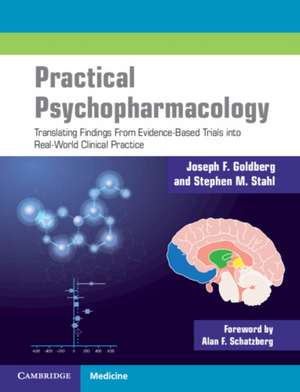
Practical Psychopharmacology: Translating Findings From Evidence-Based Trials into Real-World Clinical Practice
Autor Joseph F. Goldberg, Stephen M. Stahl Cuvânt înainte de Alan F. Schatzbergen Limba Engleză Paperback – 28 apr 2021
Pregătirea pentru examenul de rezidențiat, pentru board-ul de specialitate sau pentru certificările periodice necesită mai mult decât memorarea unor clase de medicamente; solicită capacitatea de a traduce datele clinice în decizii terapeutice personalizate. În Practical Psychopharmacology, notăm cu interes o schimbare de paradigmă necesară în psihiatria contemporană. Autorii Joseph F. Goldberg și Stephen M. Stahl abordează onest realitatea polifarmaciei, oferind un cadru riguros pentru gestionarea pacienților cu tulburări severe care nu răspund la protocoalele standard.
Descoperim aici o metodologie precisă, denumită „bespoke psychopharmacology”, care prioritizează nevoile individualizate ale pacientului în detrimentul algoritmilor rigizi. Găsim în această carte o structură didactică impecabilă, unde formatul color și tabelele comparative facilitează o învățare rapidă, esențială în pregătirea examenelor profesionale. Lucrarea completează Fundamentals of Clinical Psychopharmacology prin accentul pus pe rezolvarea cazurilor clinice complexe și pe mecanismele circuitelor neuronale, acolo unde manualele teoretice se opresc la mecanismele de acțiune moleculară.
Această ediție publicată de Cambridge University Press se integrează organic în opera autorilor, continuând direcțiile din Clinical Reasoning and Decision-Making in Psychiatry. Dacă lucrarea anterioară punea bazele procesului logic, volumul de față aplică acest raționament direct asupra medicației psihotrope. Este o resursă clinică ce transformă incertitudinea practicii zilnice într-o strategie bazată pe dovezi, fiind indispensabilă oricărui specialist care urmărește o abordare modernă a psihopatologiei.
Preț: 484.13 lei
Preț vechi: 509.61 lei
-5%
Carte disponibilă
Livrare economică 18 mai-01 iunie
Livrare express 02-08 mai pentru 67.18 lei
Specificații
ISBN-10: 1108450741
Pagini: 610
Dimensiuni: 190 x 247 x 26 mm
Greutate: 1.32 kg
Ediția:Nouă
Editura: Cambridge University Press
Colecția Cambridge University Press
Locul publicării:Cambridge, United Kingdom
De ce să citești această carte
Această resursă este esențială pentru psihiatrii și rezidenții care doresc să stăpânească arta prescrierii în cazuri de polifarmacie. Cititorul câștigă o metodologie clară pentru a naviga între studiile clinice ideale și realitatea complexă a pacienților cronici. Este un ghid practic care oferă siguranță în luarea deciziilor terapeutice dificile, fundamentând fiecare alegere pe neuroștiințe și date clinice solide.
Despre autor
Joseph F. Goldberg este un expert recunoscut în psihofarmacologie și managementul tulburărilor afective, fiind renumit pentru capacitatea de a sintetiza datele de cercetare în ghiduri clinice aplicabile. Stephen M. Stahl este profesor de psihiatrie la University of California, San Diego și un autor prolific în domeniul neuroștiințelor, lucrările sale fiind puncte de referință la nivel mondial. Împreună, aceștia combină rigoarea academică a Cambridge University Press cu experiența vastă de cabinet, oferind perspective inovatoare asupra modului în care agenții farmacologici interacționează cu circuitele cerebrale pentru a trata patologii psihiatrice complexe.
Descriere scurtă
Cuprins
Recenzii
'The translation of clinical research findings into practice is fraught. The methodology of many trials is imperfect, complex, and opaque and hard to generalise to real world patients. Many critical questions are poorly answered by the extant evidence. The basic neuroscience is extraordinarily complex. This book is a Rosetta stone for translating this evidence into practice in providing a critical bridge for practising clinicians in distilling and interpreting the evidence into clear and coherent pragmatic management and prescribing recommendations. Written by two of the world's premier authorities, it is infused with a rare synergy of clinical wisdom and neuroscience expertise and is an essential resource for any practising prescriber of psychotropic agents.' Michael Berk, NHMRC Senior Principal Research Fellow; Alfred Deakin Professor of Psychiatry, School of Medicine, Deakin University and Barwon Health; Director, IMPACT, the Institute for Mental and Physical Health and Clinical Translation
'Drs. Goldberg and Stahl have reminded us that they are scientific artisans by creating a pragmatic, patient-centered set of guiding principles in clinical psychopharmacology. The emergence of newer psychopharmacologic treatments and expansion of indications for previously available agents has provided hope for identifying therapeutic avenues for patients to improve their general wellbeing, but also can feel daunting, overwhelming, and a source of entropy. Consequently, it is not uncommon for clinicians at point of care to be genuinely perplexed as to which treatments and capabilities are 'promising rather than prime-time'. The authors have deftly synthesized the scientific literature and have produced a book that is comprehensive, concise, and an invaluable source of decision support at the point of care for multidisciplinary practitioners who provide care to persons with mental disorders.' Roger S. McIntyre, Professor of Psychiatry and Pharmacology and Head, Mood Disorders Psychopharmacology Unit, University of Toronto, Canada