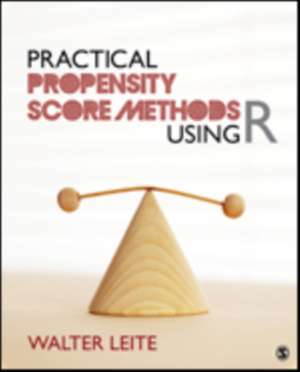
Practical Propensity Score Methods Using R
Autor Walter L. Leiteen Limba Engleză Paperback – 5 feb 2017
Preț: 656.58 lei
Preț vechi: 852.69 lei
-23%
Puncte Express: 985
Carte disponibilă
Livrare economică 11-25 noiembrie
Livrare express 28 octombrie-03 noiembrie pentru 28.89 lei
Livrare prin curier în România Termenul estimat este afișat lângă disponibilitate.
Transport gratuit pentru acest produs Plată online sau ramburs, în funcție de opțiunile comenzii.
Retur gratuit în 14 zile Comandă securizată și suport în română.
Specificații
ISBN-13: 9781452288888
ISBN-10: 1452288887
Pagini: 224
Dimensiuni: 187 x 232 x 14 mm
Greutate: 0.39 kg
Ediția:1
Editura: SAGE Publications
Colecția Sage Publications, Inc
Locul publicării:Thousand Oaks, United States
ISBN-10: 1452288887
Pagini: 224
Dimensiuni: 187 x 232 x 14 mm
Greutate: 0.39 kg
Ediția:1
Editura: SAGE Publications
Colecția Sage Publications, Inc
Locul publicării:Thousand Oaks, United States
V-ar putea interesa
-
 Preț: 468.95 lei
 -
 Multilevel Modeling in Plain LanguageKaren RobsonPreț: 315.46 lei
 -
 Robustness Tests for Quantitative ResearchEric NeumayerPreț: 449.83 lei
 -
 Understanding Nursing and Healthcare ResearchPatricia CroninPreț: 362.26 lei
 -
 Seven Steps to a Comprehensive Literature ReviewAnthony J. OnwuegbuziePreț: 434.42 lei
 -
 Doing Surveys OnlineVera ToepoelPreț: 426.77 lei
 -
 Using Software in Qualitative ResearchChristina Silver-19%Preț: 399.06 lei492.66 lei
 -
 The Science of EvaluationRay Pawson-8%Preț: 481.92 lei523.82 lei
 -
 Development FieldworkRegina Scheyvens-23%Preț: 613.90 lei797.27 lei
 -
 Researching OrganizationsMatthew Jones-27%Preț: 676.13 lei926.21 lei
 -
 Doing Research in EducationIoanna Palaiologou-23%Preț: 443.69 lei576.22 lei
 -
 Situational AnalysisAdele E. E. Clarke-11%Preț: 619.62 lei696.20 lei
 -
 The SAGE Handbook of Qualitative ResearchNorman K. Denzin-27%Preț: 943.18 lei1292.02 lei
 -
 -22%Preț: 655.20 lei839.99 lei
 -
 Principles & Methods of Statistical AnalysisJerome Frieman-26%Preț: 866.37 lei1170.76 lei
 -
 -23%Preț: 656.50 lei852.60 lei
 -
 -19%Preț: 501.20 lei618.76 lei
 -
 Constructing Survey DataGiampietro Gobo-15%Preț: 560.58 lei659.51 lei
Recenzii
“This book offers a comprehensive, accessible, and timely treatment of propensity score analysis and its application for estimating treatment effects from observational data with varying levels of complexity. Both novice and advanced users of this methodology will appreciate the breadth and depth of the practical knowledge that Walter Leite offers, and the useful examples he provides.”
“Clearly written and technically sound, this text should be a staple for researchers and methodologists alike. Not only is the text an excellent resource for understanding propensity score analysis, but the author has recognized the messiness of real data, and helps the reader understand and appropriately address issues such as missing data and complex samples. This is extremely refreshing.”
“This book provides an overview of propensity score analysis. The author’s introduction situates propensity score analysis within Rubin’s Causal Model and Campbell’s Framework. This text will be good for the advanced user with previous knowledge of the R language, complex survey design, and missing data.”
“This book provides an excellent definition of propensity scores and the sequential steps required in its application.”
“It is a well-crafted practical book on propensity score methods and features the free software R. I believe many students will like it.”
“With the use of examples consisting of real survey data, Practical Propensity Score Methods Using R provides a wide range of detailed information on how to reduce bias in research studies that seek to test treatment effects in situations where random assignment was not implemented.”
In general, the book is well-crafted and focuses on practical implementation of propensity score methods featuring the free software R. Even though there is room for improvement that could be addressed in a second edition, we believe that it is a useful book for researchers and graduate students, and therefore, many readers will find it beneficial.
“Clearly written and technically sound, this text should be a staple for researchers and methodologists alike. Not only is the text an excellent resource for understanding propensity score analysis, but the author has recognized the messiness of real data, and helps the reader understand and appropriately address issues such as missing data and complex samples. This is extremely refreshing.”
“This book provides an overview of propensity score analysis. The author’s introduction situates propensity score analysis within Rubin’s Causal Model and Campbell’s Framework. This text will be good for the advanced user with previous knowledge of the R language, complex survey design, and missing data.”
“This book provides an excellent definition of propensity scores and the sequential steps required in its application.”
“It is a well-crafted practical book on propensity score methods and features the free software R. I believe many students will like it.”
“With the use of examples consisting of real survey data, Practical Propensity Score Methods Using R provides a wide range of detailed information on how to reduce bias in research studies that seek to test treatment effects in situations where random assignment was not implemented.”
In general, the book is well-crafted and focuses on practical implementation of propensity score methods featuring the free software R. Even though there is room for improvement that could be addressed in a second edition, we believe that it is a useful book for researchers and graduate students, and therefore, many readers will find it beneficial.
Cuprins
Preface
Acknowledgments
About the Author
Chapter 1. Overview of Propensity Score Analysis
Learning Objectives
1.1 Introduction
1.2 Rubin’s Causal Model
1.3 Campbell’s Framework
1.4 Propensity Scores
1.5 Description of Example
1.6 Steps of Propensity Score Analysis
1.7 Propensity Score Analysis With Complex Survey Data
1.8 Resources for Learning R
1.9 Conclusion
Study Questions
Chapter 2. Propensity Score Estimation
Learning Objectives
2.1 Introduction
2.2 Description of Example
2.3 Selection of Covariates
2.4 Dealing With Missing Data
2.5 Methods for Propensity Score Estimation
2.6 Evaluation of Common Support
2.7 Conclusion
Study Questions
Chapter 3. Propensity Score Weighting
Learning Objectives
3.1 Introduction
3.2 Description of Example
3.3 Calculation of Weights
3.4 Covariate Balance Check
3.5 Estimation of Treatment Effects With Propensity Score Weighting
3.6 Propensity Score Weighting With Multiple Imputed Data Sets
3.7 Doubly Robust Estimation of Treatment Effect With Propensity Score Weighting
3.8 Sensitivity Analysis
3.9 Conclusion
Study Questions
Chapter 4. Propensity Score Stratification
Learning Objectives
4.1 Introduction
4.2 Description of Example
4.3 Propensity Score Estimation
4.4 Propensity Score Stratification
4.5 Marginal Mean Weighting Through Stratification
4.6 Conclusion
Study Questions
Chapter 5. Propensity Score Matching
Learning Objectives
5.1 Introduction
5.2 Description of Example
5.3 Propensity Score Estimation
5.4 Propensity Score Matching Algorithms
5.5 Evaluation of Covariate Balance
5.6 Estimation of Treatment Effects
5.7 Sensitivity Analysis
5.8 Conclusion
Study Questions
Chapter 6. Propensity Score Methods for Multiple Treatments
Learning Objectives
6.1 Introduction
6.2 Description of Example
6.3 Estimation of Generalized Propensity Scores With Multinomial Logistic Regression
6.4 Estimation of Generalized Propensity Scores With Data Mining Methods
6.5 Propensity Score Weighting for Multiple Treatments
6.6 Estimation of Treatment Effect of Multiple Treatments
6.7 Conclusion
Study Questions
Chapter 7. Propensity Score Methods for Continuous Treatment Doses
Learning Objectives
7.1 Introduction
7.2 Description of Example
7.3 Generalized Propensity Scores
7.4 Inverse Probability Weighting
7.5 Conclusion
Study Questions
Chapter 8. Propensity Score Analysis With Structural Equation Models
Learning Objectives
8.1 Introduction
8.2 Description of Example
8.3 Latent Confounding Variables
8.4 Estimation of Propensity Scores
8.5 Propensity Score Methods
8.6 Treatment Effect Estimation With Multiple-Group Structural Equation Models
8.7 Treatment Effect Estimation With Multiple-Indicator and Multiple-Causes Models
8.8 Conclusion
Study Questions
Chapter 9. Weighting Methods for Time-Varying Treatments
Learning Objectives
9.1 Introduction
9.2 Description of Example
9.3 Inverse Probability of Treatment Weights
9.4 Stabilized Inverse Probability of Treatment Weights
9.5 Evaluation of Covariate Balance
9.6 Estimation of Treatment Effects
9.7 Conclusion
Study Questions
Chapter 10. Propensity Score Methods With Multilevel Data
Learning Objectives
10.1 Introduction
10.2 Description of Example
10.3 Estimation of Propensity Scores With Multilevel Data
10.4 Propensity Score Weighting
10.5 Treatment Effect Estimation
10.6 Conclusion
Study Questions
References
Index
Acknowledgments
About the Author
Chapter 1. Overview of Propensity Score Analysis
Learning Objectives
1.1 Introduction
1.2 Rubin’s Causal Model
1.3 Campbell’s Framework
1.4 Propensity Scores
1.5 Description of Example
1.6 Steps of Propensity Score Analysis
1.7 Propensity Score Analysis With Complex Survey Data
1.8 Resources for Learning R
1.9 Conclusion
Study Questions
Chapter 2. Propensity Score Estimation
Learning Objectives
2.1 Introduction
2.2 Description of Example
2.3 Selection of Covariates
2.4 Dealing With Missing Data
2.5 Methods for Propensity Score Estimation
2.6 Evaluation of Common Support
2.7 Conclusion
Study Questions
Chapter 3. Propensity Score Weighting
Learning Objectives
3.1 Introduction
3.2 Description of Example
3.3 Calculation of Weights
3.4 Covariate Balance Check
3.5 Estimation of Treatment Effects With Propensity Score Weighting
3.6 Propensity Score Weighting With Multiple Imputed Data Sets
3.7 Doubly Robust Estimation of Treatment Effect With Propensity Score Weighting
3.8 Sensitivity Analysis
3.9 Conclusion
Study Questions
Chapter 4. Propensity Score Stratification
Learning Objectives
4.1 Introduction
4.2 Description of Example
4.3 Propensity Score Estimation
4.4 Propensity Score Stratification
4.5 Marginal Mean Weighting Through Stratification
4.6 Conclusion
Study Questions
Chapter 5. Propensity Score Matching
Learning Objectives
5.1 Introduction
5.2 Description of Example
5.3 Propensity Score Estimation
5.4 Propensity Score Matching Algorithms
5.5 Evaluation of Covariate Balance
5.6 Estimation of Treatment Effects
5.7 Sensitivity Analysis
5.8 Conclusion
Study Questions
Chapter 6. Propensity Score Methods for Multiple Treatments
Learning Objectives
6.1 Introduction
6.2 Description of Example
6.3 Estimation of Generalized Propensity Scores With Multinomial Logistic Regression
6.4 Estimation of Generalized Propensity Scores With Data Mining Methods
6.5 Propensity Score Weighting for Multiple Treatments
6.6 Estimation of Treatment Effect of Multiple Treatments
6.7 Conclusion
Study Questions
Chapter 7. Propensity Score Methods for Continuous Treatment Doses
Learning Objectives
7.1 Introduction
7.2 Description of Example
7.3 Generalized Propensity Scores
7.4 Inverse Probability Weighting
7.5 Conclusion
Study Questions
Chapter 8. Propensity Score Analysis With Structural Equation Models
Learning Objectives
8.1 Introduction
8.2 Description of Example
8.3 Latent Confounding Variables
8.4 Estimation of Propensity Scores
8.5 Propensity Score Methods
8.6 Treatment Effect Estimation With Multiple-Group Structural Equation Models
8.7 Treatment Effect Estimation With Multiple-Indicator and Multiple-Causes Models
8.8 Conclusion
Study Questions
Chapter 9. Weighting Methods for Time-Varying Treatments
Learning Objectives
9.1 Introduction
9.2 Description of Example
9.3 Inverse Probability of Treatment Weights
9.4 Stabilized Inverse Probability of Treatment Weights
9.5 Evaluation of Covariate Balance
9.6 Estimation of Treatment Effects
9.7 Conclusion
Study Questions
Chapter 10. Propensity Score Methods With Multilevel Data
Learning Objectives
10.1 Introduction
10.2 Description of Example
10.3 Estimation of Propensity Scores With Multilevel Data
10.4 Propensity Score Weighting
10.5 Treatment Effect Estimation
10.6 Conclusion
Study Questions
References
Index
Descriere
This practical book uses a step-by-step analysis of realistic examples to help students understand the theory and code for implementing propensity score analysis with the R statistical language.