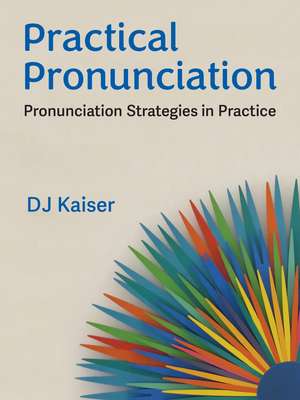
Practical Pronunciation: Pronunciation Strategies in Practice: Michigan Series In English For Academic & Professional Purposes
Autor DJ Kaiseren Limba Engleză Paperback – 17 aug 2026
CEFR Level: C1
Key Features
- A series of 210 audio recordings provides opportunities for learners to listen for key aspects of pronunciation and practice items from the book on their own.
- Twenty-nine videos provide short explanations and visual demonstrations of many of the strategies included throughout the book.
- Recommendations on ways to integrate digital tools into pronunciation exploration and practice provide learners and teachers with multiple ways to customize pronunciation practice to meet varied professional speaking contexts, academic goals, and personal interests.
- Practice items and exercises incorporate higher-frequency words from the Corpus of Contemporary American English.
- A glossary and several quick-reference charts make it easy to look up or clarify key terms and linguistic terminology or to visually review consonant and vowel charts.
Din seria Michigan Series In English For Academic & Professional Purposes
-
 Preț: 192.84 lei
 -
 Preț: 150.24 lei
 -
 Preț: 155.28 lei
 -
 Preț: 175.80 lei
 -
 Preț: 223.80 lei
 -
 Preț: 221.12 lei
 - nou
 Preț: 254.88 lei
 -
Preț: 345.41 lei
Nou
Puncte Express: 518
Carte indisponibilă temporar
Doresc să fiu notificat când acest titlu va fi disponibil:
Se trimite...
Specificații
ISBN-13: 9780472040155
ISBN-10: 0472040154
Pagini: 320
Ilustrații: 79 tables, 144 figures
Dimensiuni: 210 x 279 x 23 mm
Greutate: 0.79 kg
Editura: UNIVERSITY OF MICHIGAN PRESS
Colecția University of Michigan Press ELT
Seria Michigan Series In English For Academic & Professional Purposes
ISBN-10: 0472040154
Pagini: 320
Ilustrații: 79 tables, 144 figures
Dimensiuni: 210 x 279 x 23 mm
Greutate: 0.79 kg
Editura: UNIVERSITY OF MICHIGAN PRESS
Colecția University of Michigan Press ELT
Seria Michigan Series In English For Academic & Professional Purposes
Cuprins
Contents
List of Figures and Tables: ix
Acknowledgments: xi
Introduction: 1
Unit 1: Sounds, Word Stress, and Phrase Rhythm: 17
Lesson 1: The Sounds of North American English: 18
Lesson 2: Word Stress: Identifying Strong Syllables: 43
Lesson 3: The Basics of Rhythm: Rhythm Patterns: 65
Lesson 4: Predicting Stress Placement and Rhythm Patterns: 86
Unit 2: The Phrase Focus Syllable and Noun Constructions: 109
Lesson 5: The Phrase Focus Syllable: 110
Lesson 6: Noun Units: Compound Nouns and Noun Strings: 130
Lesson 7: The Phrase Focus Syllable on Function Words: 150
Unit 3: Stress and Intonation: 167
Lesson 8: The Basics of Melody and Intonation: 168
Lesson 9: Intonation in Questions: Part I: 196
Lesson 10: Intonation in Questions: Part II: 222
Lesson 11: Non- Final Rising Intonation: 244
Lesson 12: Highlighting Information with Stress and Intonation: 259
Quick Reference Charts: 279
Glossary: 283
Bibliography: 295
Index: 299
List of Figures and Tables: ix
Acknowledgments: xi
Introduction: 1
Unit 1: Sounds, Word Stress, and Phrase Rhythm: 17
Lesson 1: The Sounds of North American English: 18
Lesson 2: Word Stress: Identifying Strong Syllables: 43
Lesson 3: The Basics of Rhythm: Rhythm Patterns: 65
Lesson 4: Predicting Stress Placement and Rhythm Patterns: 86
Unit 2: The Phrase Focus Syllable and Noun Constructions: 109
Lesson 5: The Phrase Focus Syllable: 110
Lesson 6: Noun Units: Compound Nouns and Noun Strings: 130
Lesson 7: The Phrase Focus Syllable on Function Words: 150
Unit 3: Stress and Intonation: 167
Lesson 8: The Basics of Melody and Intonation: 168
Lesson 9: Intonation in Questions: Part I: 196
Lesson 10: Intonation in Questions: Part II: 222
Lesson 11: Non- Final Rising Intonation: 244
Lesson 12: Highlighting Information with Stress and Intonation: 259
Quick Reference Charts: 279
Glossary: 283
Bibliography: 295
Index: 299
Recenzii
“This comprehensive, research-based coverage of North American English segmentals and suprasegmentals promises to become an instant classic. Its well conceived tables and figures, as well as its accompanying audio and video files and sidebars on digital tools, greatly facilitate the journey of advanced second language learners toward increased comprehensibility and intelligibility.”
“DJ Kaiser provides an accessible book on teaching and learning pronunciation that is certain to be welcomed by experienced and novice teachers. This extensive collection of established pronunciation teaching techniques includes both traditional and contemporary approaches and a wide range of physicalizations to help master suprasegmentals. The book furnishes many, many activities to choose from, and the book builds knowledge from chapter to chapter so that learners can continue to expand their understanding of important areas of pronunciation.”
“DJ Kaiser provides an accessible book on teaching and learning pronunciation that is certain to be welcomed by experienced and novice teachers. This extensive collection of established pronunciation teaching techniques includes both traditional and contemporary approaches and a wide range of physicalizations to help master suprasegmentals. The book furnishes many, many activities to choose from, and the book builds knowledge from chapter to chapter so that learners can continue to expand their understanding of important areas of pronunciation.”
Descriere
An essential reference book on English pronunciation, written in accessible language with practical strategies to promote autonomous learning