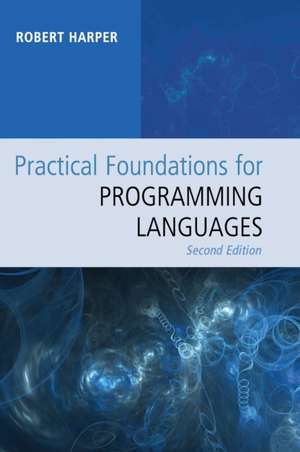
Practical Foundations for Programming Languages
Autor Robert Harperen Limba Engleză Hardback – 7 apr 2017
Observăm că metodologia propusă de Robert Harper în această a doua ediție a lucrării Practical Foundations for Programming Languages se bazează pe o rigoare matematică elementară pentru a defini concepte complexe prin semantica statică și dinamică. Suntem de părere că abordarea prin sisteme de tipuri și semantică operațională structurală (SOS) transformă studiul limbajelor de programare dintr-o simplă analiză sintactică într-o disciplină inginerească precisă. Structura cărții urmărește o progresie logică, pornind de la judecăți și reguli de bază, trecând prin funcții totale și tipuri polimorfe, până la subiecte avansate precum dispeceratul dinamic, starea mutabilă și execuția paralelă. Dacă Theories of Programming Languages de John C. Reynolds v-a oferit cadrul teoretic fundamental, această carte oferă instrumentele practice necesare pentru implementarea efectivă și verificarea formală a sistemelor software. În contextul operei sale anterioare, observăm o evoluție naturală: dacă în The Little Typer autorul explora frumusețea tipurilor dependente pas cu pas, iar în Types in Compilation sublinia importanța acestora pentru robustețea sistemelor, volumul de față sintetizează aceste idei într-un manual cuprinzător pentru arhitectura limbajelor moderne. Credem că includerea capitolului despre rafinarea tipurilor și a exercițiilor practice consolidează acest titlu ca o resursă esențială pentru cei care doresc să înțeleagă nu doar cum funcționează un limbaj, ci și cum pot fi demonstrate matematic proprietățile acestuia, precum siguranța tipurilor sau corectitudinea execuției în medii distribuite.
Preț: 547.32 lei
Preț vechi: 684.15 lei
-20%
Carte tipărită la comandă
Livrare economică 28 noiembrie-12 decembrie
Specificații
ISBN-10: 1107150302
Pagini: 514
Dimensiuni: 183 x 260 x 32 mm
Greutate: 1.08 kg
Ediția:Revizuită
Editura: Cambridge University Press
Locul publicării:New York, United States
V-ar putea interesa
-
 Introduction Functional ProgrammingRichard Bird-13%Preț: 552.00 lei634.49 lei
 -
 Essentials of Programming LanguagesDaniel P. Friedman-26%Preț: 559.85 lei758.63 lei
 -
 Types and Programming LanguagesBenjamin C. Pierce-21%Preț: 616.11 lei776.93 lei
 -
 Structure and Interpretation of Computer Programs, second editionGerald Jay Sussman-20%Preț: 552.11 lei690.14 lei
 -
 Friedman, D: Little TyperDaniel P. Friedman-21%Preț: 374.82 lei474.62 lei
 -
 -34%Preț: 254.52 lei384.22 lei
 -
 -30%Preț: 300.39 lei428.53 lei
 -
 -20%Preț: 574.25 lei717.80 lei
 -
 Programming Language PragmaticsMichael Scott-40%Preț: 488.02 lei808.04 lei
 -
 Computer Architecture: A Quantitative ApproachJohn L. Hennessy-39%Preț: 534.37 lei882.55 lei
 -
 CompilersAlfred V. Aho-20%Preț: 629.07 lei786.34 lei
 -
 Concepts of Programming Languages, Global EditionRobert Sebesta-20%Preț: 546.38 lei682.97 lei
 -
 Learn You a Haskell for Great GoodMiran Lipovaca-35%Preț: 231.79 lei355.64 lei
 -
 -20%Preț: 365.67 lei457.09 lei
 -
 The Hardware HackerAndrew Bunnie Huang-33%Preț: 95.88 lei142.55 lei
 -
 System Programming in Linux: A Hands-On IntroductionStewart Weiss-35%Preț: 481.65 lei739.15 lei
 -
 The Rust Programming Language, 3rd EditionCarol Nichols-20%Preț: 314.53 lei393.16 lei
 -
 -20%Preț: 329.60 lei412.00 lei
 -
 -20%Preț: 332.10 lei415.13 lei
De ce să citești această carte
Recomandăm această carte inginerilor software și cercetătorilor care doresc să stăpânească fundamentele matematice ale limbajelor de programare. Cititorul câștigă o înțelegere profundă a sistemelor de tipuri și a semanticii operaționale, instrumente critice pentru proiectarea de limbaje noi sau pentru verificarea formală a codului critic. Este un ghid tehnic riguros care transformă teoria abstractă în metode aplicabile direct în implementare și design de sistem.
Despre autor
Robert Harper este un distins cercetător în domeniul informaticii la Carnegie Mellon University, fiind recunoscut la nivel internațional pentru contribuțiile sale fundamentale în teoria tipurilor și proiectarea limbajelor de programare. Expertiza sa se reflectă în dezvoltarea limbajului Standard ML și în numeroase lucrări de referință care explorează intersecția dintre logică, tipuri și compilare. Activitatea sa academică este dublată de o abordare practică, Harper fiind un susținător al utilizării sistemelor de tipuri riguroase pentru construirea de sisteme software robuste și sigure.
Descriere scurtă
Cuprins
Recenzii
Review of previous edition: 'Starting with a mathematically simple framework and organizing principles that give type systems a central role, Bob Harper's magnum opus reveals the theory of programming languages as a coherent scientific subject with both breadth and elegance. His enormous experience, pithy views, and great good taste are evident throughout a book that deserves to become a classic.' Andrew Pitts, University of Cambridge
Review of previous edition: 'This book offers an excellent introduction to a wide range of programming language concepts. They are all uniformly and carefully explained, using techniques that are very useful in practice for both analysis and implementation of programming languages. The book is authored by one of the most prominent researchers in type theory for programming languages. The presentation is very effective and based on the author's years of experience teaching the material.' Lars Birkedal, IT University of Copenhagen