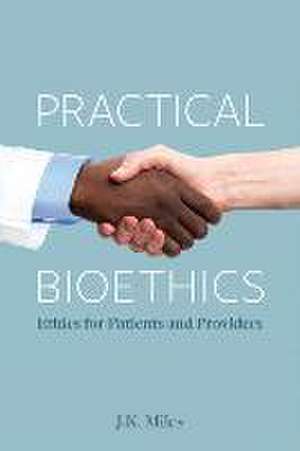
Practical Bioethics: Ethics for Patients and Providers
Autor J.K. Milesen Limba Engleză Paperback – 30 mai 2023
Preț: 429.17 lei
Preț vechi: 451.76 lei
-5%
Puncte Express: 644
Carte disponibilă
Livrare economică 09-23 noiembrie
Livrare express 24-30 octombrie pentru 146.72 lei
Livrare prin curier în România Termenul estimat este afișat lângă disponibilitate.
Transport gratuit pentru acest produs Plată online sau ramburs, în funcție de opțiunile comenzii.
Retur gratuit în 14 zile Comandă securizată și suport în română.
Specificații
ISBN-13: 9781554813711
ISBN-10: 1554813719
Pagini: 432
Dimensiuni: 152 x 229 x 20 mm
Greutate: 0.6 kg
Editura: BROADVIEW PR
Colecția Broadview Press
Locul publicării:Peterborough, Canada
ISBN-10: 1554813719
Pagini: 432
Dimensiuni: 152 x 229 x 20 mm
Greutate: 0.6 kg
Editura: BROADVIEW PR
Colecția Broadview Press
Locul publicării:Peterborough, Canada
V-ar putea interesa
-
 It's Probably NothingNaga Munchetty-5%Preț: 171.43 lei180.45 lei
 -
 -25%Preț: 671.01 lei897.18 lei
 -
 -24%Preț: 548.17 lei725.54 lei
 -
 Bioethics: Passing the Boards, Providing Patient Care, and BeyondJeffrey W. Bulger-24%Preț: 606.62 lei797.00 lei
 -
 Medical Ethics: A Very Short IntroductionMichael Dunn-23%Preț: 58.42 lei76.17 lei
 -
 Legal Medicine: Health Care Law and Medical EthicsAmerican College of Legal Medicine-29%Preț: 1283.09 lei1796.47 lei
 -
 Kumar and Clark's Clinical MedicineDavid Randall-26%Preț: 487.97 lei658.70 leiRecomandat
 -
 -31%Preț: 221.67 lei320.80 lei
 -
 Medical Ethics, Law and Communication at a GlancePatrick DaveyPreț: 331.38 lei
 -
 Crash Course Medical Ethics and Sociology Updated Print + eBook editionAndrew Papanikitas-34%Preț: 178.20 lei268.74 lei
 -
 ABC of Clinical ProfessionalismNicola Cooper-5%Preț: 244.20 lei257.05 lei
 -
 Practical and Professional Ethics: Key ConceptsWade L. Robison-20%Preț: 167.38 lei209.08 lei
 -
 Social Sciences for Healthcare ProfessionalsChris Allen-5%Preț: 269.81 lei284.00 lei
 -
 Margin Over MissionJames Kelly-5%Preț: 153.16 lei161.22 lei
 -
 Practical Health PromotionJames Woodall-5%Preț: 170.96 lei179.96 lei
 -
 Bioethics: Legal and Clinical Case StudiesJoseph P DeMarco-22%Preț: 303.55 lei387.82 lei
 -
 What Your Doctor EatsCamilla Stokholm-5%Preț: 114.55 lei120.58 lei
 -
 Bioethical Issues in HealthcarePeter A. Clark-5%Preț: 999.12 lei1051.70 lei
 -
 The General Surgeon: Recollections from Four ContinentsMoshe Schein MD FACS FCS-17%Preț: 122.87 lei147.55 lei
 -
 Every Branch of the Healing ArtRonan Kelly-5%Preț: 283.66 lei298.59 lei
Recenzii
Practical Bioethics offers a mix of theory and readings, presented in a format that is succinct and approachable. Each chapter begins and ends with a case study, illustrating the core issues at play and emphasizing the practical nature of the dilemmas arising in medicine. Primary source texts are provided to flesh out the issues, and each of these is carefully edited and presented with interwoven explanatory comments to assist student readers. Throughout, J.K. Miles shows the importance of health-care ethics to us all, whether we be medical providers, patients, or both.
“Practical Bioethics has clearly been authored with an active and collaborative classroom in mind. It will be especially valuable to instructors who wish to provide their students with a balanced presentation of both secondary and primary sources, opening the door to conversation and exploration. This is a text aimed at not just presenting the central positions and arguments but also cultivating students’ critical thinking skills.” — Alex Feldt, University of Tennessee, Knoxville
“This is a comprehensive textbook designed with today’s students in mind. Each chapter contains an opening and closing case, ideal for promoting classroom discussion. J.K. Miles’s most novel contribution is the short asides embedded in each reading, which prompt further engagement while providing students with guideposts as they explore pivotal articles in the field. In the hands of a seasoned instructor, Practical Bioethics will do what many other texts do not: bring the exciting, dynamic field of bioethics alive for students.” — Deborah Barnbaum, Kent State University
“Practical Bioethics is aptly named: it is an eminently practical approach to the complex issues presented in clinical settings. It is also superbly designed: each chapter presents a case study, frames the conceptual issues at stake, provides balanced readings with helpful annotations to guide the reader, and ends with an ethics committee exercise. I have taught bioethics to undergraduate and graduate students for more than a decade, and in my opinion this text meets a longstanding need. In addition to serving ‘patients and practitioners,’ as the subtitle notes, it is also a superb platform for students.” — Matthew Hickey, Colorado State University
“Miles’s textbook provides an excellent guide to teaching bioethics, particularly, I think, to undergraduates and others without much formal philosophy training. The briefing on how to read bioethics papers combined with the scaffolding internal to each chapter makes the book as a whole a digestible and accessible and, perhaps more importantly, a truly thought-provoking introduction to bioethics in practice.” — Erica Bigelow, in Teaching Philosophy
“Practical Bioethics has clearly been authored with an active and collaborative classroom in mind. It will be especially valuable to instructors who wish to provide their students with a balanced presentation of both secondary and primary sources, opening the door to conversation and exploration. This is a text aimed at not just presenting the central positions and arguments but also cultivating students’ critical thinking skills.” — Alex Feldt, University of Tennessee, Knoxville
“This is a comprehensive textbook designed with today’s students in mind. Each chapter contains an opening and closing case, ideal for promoting classroom discussion. J.K. Miles’s most novel contribution is the short asides embedded in each reading, which prompt further engagement while providing students with guideposts as they explore pivotal articles in the field. In the hands of a seasoned instructor, Practical Bioethics will do what many other texts do not: bring the exciting, dynamic field of bioethics alive for students.” — Deborah Barnbaum, Kent State University
“Practical Bioethics is aptly named: it is an eminently practical approach to the complex issues presented in clinical settings. It is also superbly designed: each chapter presents a case study, frames the conceptual issues at stake, provides balanced readings with helpful annotations to guide the reader, and ends with an ethics committee exercise. I have taught bioethics to undergraduate and graduate students for more than a decade, and in my opinion this text meets a longstanding need. In addition to serving ‘patients and practitioners,’ as the subtitle notes, it is also a superb platform for students.” — Matthew Hickey, Colorado State University
“Miles’s textbook provides an excellent guide to teaching bioethics, particularly, I think, to undergraduates and others without much formal philosophy training. The briefing on how to read bioethics papers combined with the scaffolding internal to each chapter makes the book as a whole a digestible and accessible and, perhaps more importantly, a truly thought-provoking introduction to bioethics in practice.” — Erica Bigelow, in Teaching Philosophy
Cuprins
Acknowledgments
A Note to Readers
How Bioethics Journal Articles Work
Index
A Note to Readers
How Bioethics Journal Articles Work
- Identifying Arguments
- Responding to Arguments
- Academic Conversations
- Thought Experiments
- Opening Gambit: The Transposition of the Great Arteries
- What’s at Stake?
- What’s the Debate?
- Reading 1.1: W.D. Ross, “What Makes Right Actions Right?”
- Reading 1.2: John Stuart Mill, from Utilitarianism
- Reading 1.3: Stephen Toulmin, “How Medicine Saved the Life of Ethics”
- Ethics Committee: A Minor in a Research Trial
- Opening Gambit: Sophie’s Choice without the Nazis
- What’s at Stake?
- From Intuitions to Principles
- From Principles to Principlism
- From Principles to Theories
- What’s the Debate?
- Reading 2.1: Ruth Macklin, “Applying the Four Principles”
- Reading 2.2: E. Arries, “Virtue Ethics: An Approach to Moral Dilemmas in Nursing”
- Ethics Committee: Billy Likes to Eat Mud
- Opening Gambit: Prescribing Cebocap
- What’s at Stake?
- What Counts as Informed Consent?
- The Duty to Warn
- Paternalism
- What’s the Debate?
- Reading 3.1: Gerald Dworkin, “Paternalism”
- Reading 3.2: Aanand D. Naik et al., “Patient Autonomy for the Management of Chronic Conditions: A Two-Component Re-Conceptualization”
- Reading 3.3: Camilla Scanlan and Ian H. Kerridge, “Autonomy and Chronic Illness: Not Two Components but Many”
- Ethics Committee: The Anxious Patient
- Opening Gambit: Fruit from the Poisonous Tree?
- What’s at Stake?
- Nuremberg and Helsinki and Belmont: The Trend toward Beneficence
- Clinical Trials
- What’s the Debate?
- Reading 4.1: World Medical Association, “Declaration of Helsinki”
- Reading 4.2: National Commission for the Protection of Human Subjects of Biomedical and Behavioral Research, “The Belmont Report”
- Reading 4.3: Marcia Angell, “The Ethics of Clinical Research in the Third World”
- Reading 4.4: Baruch A. Brody, “Ethical Issues in Clinical Trials in Developing Countries”
- Reading 4.5: Christine Grady, “Money for Research Participation: Does It Jeopardize Informed Consent?”
- Reading 4.6: Mark Kuczewski, “Is Informed Consent Enough? Monetary Incentives for Research Participation and the Integrity of Biomedicine”
- Ethics Committee: African HIV Trials
- Opening Gambit: Mr. Perry Wants It ALL Unplugged
- What’s at Stake?
- Killing and Letting Die
- What’s the Debate?
- Reading 5.1: James Rachels, “Active and Passive Euthanasia”
- Reading 5.2: Daniel Callahan, “When Self-Determination Runs Amok”
- Reading 5.3: J. McMahan, “Killing, Letting Die, and Withdrawing Aid”
- Ethics Committee: A Chilly Reception
- Opening Gambit: Was the Drug Lottery Fair?
- What’s at Stake?
- Distributing Scarce Resources: Fairness vs. Equality
- Increasing the Supply of Scarce Resources: Nudging vs. Payment
- What’s the Debate?
- Reading 6.1: Leslie P. Scheunemann and Douglas B. White, “The Ethics and Reality of Rationing in Medicine”
- Reading 6.2: George Annas, “The Prostitute, the Playboy, and the Poet: Rationing Schemes for Organ Transplantation”
- Reading 6.3: Ezekiel J. Emanuel et al., “Fair Allocation of Scarce Medical Resources in the Time of COVID-19”
- Reading 6.4: Lynette Reid, “Triage of Critical Care Resources in COVID-19: A Stronger Role for Justice”
- Ethics Committee: Ira Harker Needs a Kidney
- Opening Gambit: Screening for the Breast Cancer Gene
- What’s at Stake?
- What’s the Debate?
- Reading 7.1: Julian Savulescu, “Procreative Beneficence: Why We Should Select the Best Children”
- Reading 7.2: Sarah E. Stoller, “Why We Are Not Morally Required to Select the Best Children: A Response to Savulescu”
- Reading 7.3: Rebecca Briscoe, “Ethical Considerations, Safety Precautions and Parenthood in Legalising Mitochondrial Donation”
- Reading 7.4: Katarina Lee, “Ethical Implications of Permitting Mitochondrial Replacement”
- Ethics Committee: Linda Huff Wants a Dwarf Child
- Opening Gambit: Duty to Vaccinate?
- What’s at Stake?
- Patient Rights
- Patient Obligations or Duties
- Doubled Agency
- What’s the Debate?
- Reading 8.1: Leonard C. Groopman et al., “The Patient’s Work”
- Reading 8.2: Susan M. Wolf et al., “Sources of Concern about the Patient Self-Determination Act”
- Reading 8.3: J.K. Miles, “Taking Patient Virtue Seriously”
- Ethics Committee: The Ashley Treatment
- Opening Gambit: Choosing for Two?
- What’s at Stake?
- What’s the Debate?
- Reading 9.1: Judith Jarvis Thomson, “A Defense of Abortion”
- Reading 9.2: Francis Beckwith, “Personal Bodily Rights, Abortion, and Unplugging the Violinist”
- Ethics Committee: Botched Abortion
Index