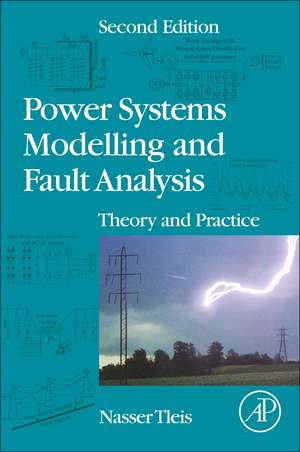
Power Systems Modelling and Fault Analysis: Theory and Practice
Autor Nasser Tleisen Limba Engleză Paperback – 11 iun 2019
Prin parcurgerea lucrării Power Systems Modelling and Fault Analysis, cititorul va dobândi capacitatea de a implementa modele matematice complexe și de a executa analize de defect în rețele electrice moderne, incluzând integrarea surselor regenerabile. Remarcăm efortul autorului Nasser Tleis de a echilibra rigoarea teoretică a componentelor simetrice cu cerințele pragmatice ale ingineriei de teren. Subliniem faptul că textul nu se limitează la configurații clasice, ci detaliază modelarea turbinelor eoliene și a sistemelor solare fotovoltaice, elemente esențiale în contextul tranziției energetice actuale.
Pe linia practică a volumului Power System Analysis de J. C. Das, dar cu un focus sporit pe standardele internaționale și pe tehnici specifice de depanare pentru utilități, această ediție a doua publicată de ELSEVIER SCIENCE servește drept ghid tehnic pentru calculul curenților de scurtcircuit. Structura celor 13 capitole indică o progresie logică: se pornește de la bazele teoretice ale defectelor, se trece prin modelarea detaliată a transformatoarelor și a liniilor aeriene multi-conductor, culminând cu strategii de control și limitare a curenților de defect de mare intensitate.
Reținem, de asemenea, includerea unor secțiuni dedicate evaluării capacității de întrerupere a disjunctoarelor în rețele cu constante de timp DC lungi, o problemă tehnică adesea insuficient documentată în literatura de specialitate. Spre deosebire de manualele introductive, această lucrare abordează analizele probabilistice și măsurarea parametrilor echipamentelor în condiții reale de exploatare, fiind un instrument de lucru indispensabil pentru inginerii care proiectează sau gestionează infrastructuri energetice de mare scară.
Preț: 789.08 lei
Preț vechi: 1131.55 lei
-30%
Carte tipărită la comandă
Livrare economică 20 noiembrie-04 decembrie
Specificații
ISBN-10: 012815117X
Pagini: 940
Dimensiuni: 152 x 229 mm
Greutate: 1.23 kg
Ediția:2
Editura: ELSEVIER SCIENCE
V-ar putea interesa
-
 Power Electronics HandbookMuhammad H. Rashid-29%Preț: 1300.73 lei1839.96 lei
 -
 Power System Analysis and Design, SI EditionAdam Birchfield-21%Preț: 583.43 lei739.88 lei
 -
 -9%Preț: 971.05 lei1067.09 lei
 -
 -23%Preț: 1129.04 lei1466.28 lei
 -
 Principles and Applications of Electrical Engineering ISEGiorgio Rizzoni-25%Preț: 395.45 lei527.08 lei
 -
 Electrical Machines, Drives and Power SystemsTheodore Wildi-11%Preț: 701.01 lei787.64 lei
 -
 Hughes Electrical and Electronic TechnologyEdward Hughes-9%Preț: 638.19 lei701.31 lei
 -
 ElectronicsNeil Storey-9%Preț: 553.60 lei608.36 lei
 -
 Electrical Power System EssentialsPieter Schavemaker-19%Preț: 600.33 lei741.15 lei
 -
 Analysis of Electric Machinery and Drive SystemsPaul C Krause-23%Preț: 769.47 lei999.32 lei
 -
 -23%Preț: 1294.93 lei1681.72 lei
 -
 The Electric Power Engineering Handbook - Five Volume SetLeonard L. Grigsby-9%Preț: 6897.54 lei7579.71 lei
 -
 Power System Dynamic Modelling and Analysis in Evolving NetworksBabak Badrzadeh-18%Preț: 2048.84 lei2498.58 lei
 -
 -11%Preț: 413.53 lei464.65 lei
 -
 The Essentials of Power System Dynamics and ControlHemanshu Roy Pota-15%Preț: 609.38 lei716.92 lei
 -
 -24%Preț: 758.55 lei998.09 lei
 -
 Springer Handbook of Power SystemsKonstantin O Papailiou-20%Preț: 2116.80 lei2646.01 lei
 -
 Application of Advance Techniques in Power and Energy SystemsPartha Sarathee Bhowmik-18%Preț: 1189.33 lei1450.40 lei
Public țintă
For the teaching of modern electrical power engineering at universities, graduate and practicing professional engineers by covering undocumented theoretical and practical knowledge and practical engineering problems and solutions.De ce să citești această carte
Această resursă este esențială pentru inginerii electricieni și studenții la master care doresc să stăpânească analiza defectelor în rețele complexe. Cititorul câștigă expertiză în modelarea noilor tehnologii (eolian, solar) și în aplicarea standardelor internaționale de siguranță. Este o investiție în competențe tehnice aplicabile imediat în proiectarea, planificarea și operarea sistemelor electroenergetice industriale și de transport.
Descriere scurtă
- Includes a fully up-to-date guide to the analysis and practical troubleshooting of short-circuit faults in electricity utilities and industrial power systems
- Presents sections on generators, transformers, substations, overhead powerlines and industrial systems
- Covers best-practice techniques, safety issues, power system planning and economics
Cuprins
2. Theory of symmetrical components and connection of phase sequence networks during faults
3. Modelling of multi-conductor overhead lines and cables
4 Analysis of natural unbalance of overhead transmission lines
5. Modelling of transformers, static power plant and static load
6. Modelling of ac rotating synchronous and induction machines
7. Modelling of wind-turbine generators, solar photovoltaic (PV) generators and inverter interfaced systems
8. Short-circuit analysis techniques in ac power systems
9. International standards for short-circuit analysis in ac power systems
10. Assessment of circuit-breaker current interruption capability in networks with long dc time constant
11. Network equivalents and practical short-circuit assessments in large scale ac power systems
12. Control and limitation of high short-circuit currents
13. An introduction to the analysis of short-circuit earth-return current and rise of earth potential
14. An introduction to the analysis of electrical interference from power lines to pipelines
Appendices
A.1 Analysis of distributed multi-conductor lines and cables
A.2 Typical data of power system equipment