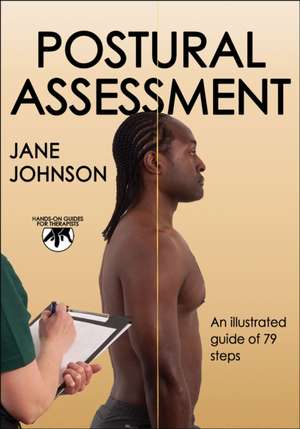
Postural Assessment
Autor Jane Johnsonen Limba Engleză Paperback – 8 dec 2011
Observăm adesea că evaluarea posturală este considerată o abilitate fundamentală, însă puține resurse reușesc să o prezinte într-un mod atât de accesibil și structurat pentru începători. Postural Assessment este concepută special pentru a demistifica acest proces complex, adresându-se studenților și terapeuților aflați la început de drum în fizioterapie, osteopatie sau instruire fitness. Remarcăm claritatea cu care Jane Johnson descompune analiza holistică a corpului în secțiuni ușor de asimilat, transformând o sarcină intimidantă într-o metodologie pas cu pas. Structura volumului urmărește o progresie logică: începe cu definirea posturii ideale și pregătirea mediului de lucru, continuând cu protocoale detaliate pentru vederile posterioară, laterală și anterioară. Un element distinctiv este includerea evaluării în poziție șezând, un aspect esențial în contextul stilului de viață sedentar actual. Apreciem în mod deosebit prezența celor peste 200 de ilustrații și fotografii care nu doar indică reperele anatomice, ci expun și variații posturale subtile pe care un ochi neformat le-ar putea omite. Complementar lucrării Posture de Sarah Curran, care oferă o perspectivă globală asupra factorilor psiho-sociologici, volumul de față se concentrează pe execuția tehnică și documentarea clinică imediată. Spre deosebire de Aston® Postural Assessment, care introduce o paradigmă alternativă de mecanică corporală, Jane Johnson rămâne ancorată în modelele standard de aliniament, oferind instrumente practice precum fișele de evaluare reproductibile. Această abordare pragmatică, susținută de secțiunile „What Your Findings Mean”, ghidează cititorul de la simpla observație la interpretarea clinică a dezechilibrelor musculare și fasciale.
Preț: 300.67 lei
Carte disponibilă
Livrare economică 20 iunie-04 iulie
Specificații
ISBN-10: 1450400965
Pagini: 176
Ilustrații: 206 Illustrations
Dimensiuni: 179 x 260 x 15 mm
Greutate: 0.44 kg
Editura: HUMAN KINETICS
V-ar putea interesa


De ce să citești această carte
Recomandăm această carte oricărui terapeut care dorește să identifice sursa durerii clienților săi prin analiza structurii corporale. Veți câștiga încredere în capacitatea de a observa abateri posturale fine și veți învăța să documentați corect progresul pacienților. Este un instrument de lucru esențial care transformă evaluarea vizuală dintr-o intuiție într-o competență profesională măsurabilă, susținută de ilustrații clare și întrebări de verificare.
Despre autor
Jane Johnson este fizioterapeut și terapeut de masaj sportiv, recunoscută pentru abilitatea sa de a preda tehnici complexe într-o manieră ușor de înțeles. Experiența sa clinică și didactică este reflectată în seria Hands-On Guides for Therapists, unde pune accent pe aplicația practică a cunoștințelor anatomice. Deși este o autoare versatilă, cu lucrări ce explorează și alte domenii, expertiza sa în kinetoterapie rămâne un pilon central pentru studenții și profesioniștii din domeniul sănătății care caută ghiduri metodice și riguros structurate.
Descriere scurtă
Descriere
Though postural assessment is a skill required by most therapists and useful for many health and fitness professionals, few resources offer a complete discussion of the topic to support practitioners in the task. Written for students and practitioners of massage therapy, physical therapy, osteopathy, chiropractic, sports medicine, athletic training, and fitness instruction, Postural Assessment is a guide to determining muscular or fascial imbalance and whether that imbalance contributes to a patient’s or client’s pain or dysfunction.
Jane Johnson, a practicing physiotherapist and sport massage therapist and instructor, breaks down the complex and holistic process of assessing posture into easy-to-assimilate sections. Johnson begins with a discussion of ideal posture and the factors affecting posture as well as how to provide the correct environment for postural assessment, necessary equipment, and the importance of documenting assessment findings. Then she details procedures for executing postural assessments from standing posterior, lateral, and anterior views as well as with the patient or client in a seated position.
The text features tips for improving assessment technique, and What Your Findings Mean sections provide readers—students in particular—with guidance for systematic analysis. Each chapter ends with five Quick Questions, with answers, to assist in gauging understanding of the topics covered.
Information in the text is enhanced with detailed illustrations that offer visual cues to learning postural assessment and identifying anatomical relationships. Line drawings illustrate bony landmarks used in the assessments, and numerous photos show both obvious and subtle postural variations. Reproducible illustrated postural assessment charts in the appendix provide space for recording observations during each step of the assessment.
Postural Assessment can assist practitioners in learning what posture reveals about the relationships among various body parts and in determining whether such relationships cause or contribute to pain or discomfort. As a resource for novices, Postural Assessment offers guidance in observing and identifying common postural forms and interpreting those observations.
Postural Assessment is part of the Hands-On Guides for Therapists series, which features specific tools for assessment and treatment that fall well within the realm of massage therapists but may be useful for other body workers, such as osteopaths and fitness instructors. The guides include full-color instructional photographs, Tips sections that aid in adjusting massage techniques, Client Talk boxes that present ideas for creatively applying techniques for various types of clients, and questions for testing knowledge and skill.
Cuprins
Chapter 1. Introduction to Postural Assessment
What Is Posture?
What Factors Affect Posture?
Is There an Ideal Posture?
Why Should I Do a Postural Assessment?
Who Should Have a Postural Assessment?
Where Can Postural Assessment Take Place?
When Should Postural Assessment Be Done?
Closing Remarks
Quick Questions
Chapter 2. Preparing for Postural Assessment
Equipment Required
Time Required
Postural Assessment Steps
Standard Alignments
Documenting Your Findings
Cautions and Safety Issues
Closing Remarks
Quick Questions
Part II. Carrying Out Postural Assessment
Chapter 3. Posterior Postural Assessment
Upper Body
Lower Body
Quick Questions
Chapter 4. Lateral Postural Assessment
Upper Body
Lower Body
Comparing Overall Posture
Quick Questions
Chapter 5. Anterior Postural Assessment
Upper Body
Lower Body
An Overall View: Body Shape
Quick Questions
Chapter 6. Seated Postural Assessment
Posterior View
Lateral View
Quick Questions