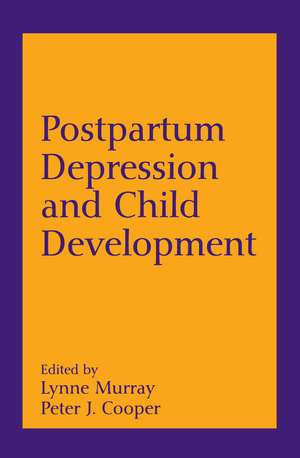
Postpartum Depression and Child Development
Editat de Lynne Murray, Peter J. Cooper, Eugene S. Paykel, Michael Rutteren Limba Engleză Paperback – 16 sep 1999
În ultimele decenii, înțelegerea clinică a perioadei postpartum a evoluat de la o perspectivă strict centrată pe simptomatologia mamei către un model sistemic, care recunoaște impactul profund al stării psihice materne asupra traiectoriei de dezvoltare a sugarului. Subliniem faptul că Postpartum Depression and Child Development survine într-un context în care datele indică o incidență de 10% a depresiei postnatale, transformând această afecțiune într-o problemă majoră de sănătate publică. Reținem că acest volum, editat de Lynne Murray și Peter J. Cooper, reprezintă prima sinteză de anvergură din ultimul deceniu care se concentrează pe mecanismele prin care depresia alterează interacțiunea mamă-copil.
Structura lucrării este riguros compartimentată pentru a ghida clinicianul de la fundamentele teoretice la implicațiile practice. După o introducere în natura tulburărilor depresive, volumul explorează „arhitectura” interacțiunilor timpurii, analizând efectele psihotoxice asupra reglării emoționale. Remarcăm profunzimea studiilor comparative care corelează depresia cu dezvoltarea cognitivă a copilului, oferind o perspectivă longitudinală asupra cronicității. Clinicienii care folosesc Postpartum Depression de Michael W. O'Hara ca referință pentru etiologia tulburării vor găsi în lucrarea de față completarea necesară pentru a înțelege consecințele directe asupra descendenților și modul în care cognițiile materne mediază aceste rezultate.
Această abordare academică completează opera anterioară a lui Lynne Murray, în special The Psychology of Babies, transpunând principiile dezvoltării infantile sănătoase în contextul patologiei clinice. Spre deosebire de ghidurile generale, acest volum oferă o bază de dovezi esențială pentru strategiile de tratament și intervenție timpurie, fiind un instrument indispensabil pentru psihologii clinicieni și psihiatrii pediatrici.
Preț: 303.30 lei
Preț vechi: 319.26 lei
-5%
Carte tipărită la comandă
Livrare economică 23 noiembrie-07 decembrie
Specificații
ISBN-10: 1572305177
Pagini: 322
Dimensiuni: 152 x 229 x 19 mm
Greutate: 0.52 kg
Ediția:New.
Editura: Guilford Publications
Colecția Guilford Press
V-ar putea interesa
-
 What Every Parent Needs to KnowMargot Sunderland-15%Preț: 124.83 lei147.70 lei
 -
 -17%Preț: 114.03 lei137.56 lei
 -
 Bowlby, D: Loss - Sadness and DepressionJohn Bowlby-29%Preț: 96.11 lei136.21 lei
 -
 -5%Preț: 448.01 lei471.58 lei
 -
 Handbook of Infant Mental Health, Fourth EditionCharles H. Zeanah Jr.,-5%Preț: 678.39 lei714.10 lei
 -
 -28%Preț: 50.48 lei70.00 lei
 -
 New Research on Postpartum DepressionAdrian I Rosenfield-27%Preț: 1464.93 lei1997.97 lei
 -
 -20%Preț: 97.14 lei120.92 lei
 -
 -30%Preț: 502.01 lei719.85 lei
 -
 The Complete Guide to PostpartumSophie WalkerPreț: 199.73 lei
 -
 -24%Preț: 94.24 lei124.66 lei
 -
 Why Postnatal Depression MattersMia Scotland-17%Preț: 52.77 lei63.24 lei
 -
 The Modern Midwife's Guide to the First YearMarie Louise-23%Preț: 99.72 lei129.39 lei
 -
 -29%Preț: 176.40 lei249.67 lei
 -
 -21%Preț: 49.91 lei63.09 lei
 -
 Parent Yourself FirstBryana KappadakunnelPreț: 121.63 lei
 -
 -20%Preț: 167.27 lei210.18 lei
 -
 -28%Preț: 141.11 lei197.20 lei
 -
 -21%Preț: 631.97 lei802.70 lei
Public țintă
Professional Practice & Development and UndergraduateDe ce să citești această carte
Această lucrare este esențială pentru specialiștii în sănătate mintală și pediatrie care doresc să înțeleagă nu doar diagnosticul matern, ci și riscurile de dezvoltare pentru copil. Cititorul câștigă acces la cercetări de ultimă oră despre reglarea emoțională și dezvoltarea cognitivă, oferind argumente clinice solide pentru implementarea unor protocoale de intervenție precoce care să protejeze relația mamă-copil și viitorul psihosocial al celui mic.
Despre autor
Lynne Murray este profesor de psihologie a dezvoltării și un cercetător de renume mondial, cunoscută pentru studiile sale asupra impactului psihopatologiei părinților asupra dezvoltării infantile. Alături de Peter J. Cooper, Michael Rutter și Eugene S. Paykel, ea a coordonat numeroase proiecte de cercetare care au definit standardele moderne în psihologia clinică perinatală. Expertiza sa este recunoscută internațional, fiind autoarea volumului premiat The Psychology of Babies. Activitatea sa se concentrează pe mecanismele fine ale interacțiunii timpurii, aducând o contribuție fundamentală în înțelegerea modului în care mediul social primar modelează arhitectura minții umane.
Descriere scurtă
Cuprins
Introduction to Postpartum Depressive Disorders
1. The Nature of Postpartum Depressive Disorders, O'HaraII. The Architecture of Mother Infant Interactions and the Implications for Postpartum Depression
2. Fragile Aspects of Early Social Integration, Papousek and Papousek
3. The Psychotoxic Effects of Maternal Depression on the Mutual Emotional Regulation ofMother Infant Interaction, Tronick and Weinberg
III. Comparative Studies of the Impact of Postpartum Depression on Child Development
4. Postpartum Depression and Cognitive Development, Hay
5. The Role of Infant and Maternal Factors in Postpartum Depression, Mother Infant Interactions, and Infant Outcome, Murray and Cooper
6. Maternal Cognitions as Mediators of Child Outcomes in the Context of Postpartum Depression, Teti and Gelfand
7. The Timing and Chronicity of Postpartum Depression, Campbell and Cohn
IV. The Treatment of Postpartum Depression and Associated Mother Infant Disturbances
8. The Impact of Psychological Treatments of Postpartum Depression on Maternal Mood and Infant Development, Cooper and Murray
9. The Treatment of Depressed Mothers and Their Infants, Field
10. Psychodynamic Perspectives on the Treatment of Postpartum Depression, Cramer
V. Postpartum Psychosis
11. The Impact of Postpartum Affective Psychosis on the Child, Hipwell and Kumar
Afterword: Maternal Depression and Infant Development: Cause and Consequence; Sensitivity and Specificity, Rutter
Notă biografică
Peter J. Cooper received his undergraduate training at the University of Cape Town. He carried out his doctoral research within the Department of Psychiatry of the University of Oxford where he also completed his clinical training. Following a postdoctoral Fellowship in Oxford, in 1983 he took up the Cambridge University Lectureship in Psychopathology. In 1993 he moved to the University of Reading to take up the Chair in Psychology.
Recenzii
Over the past two decades there has been a great deal of research concerning the impact of postnatal depression on child development. This outstanding and timely volume, which has contributions from leading figures in the field, assembles this work in a remarkably coherent fashion. It succeeds by bringing together a wide variety of issues concerned with postnatal depression and infants, including epidemiology, basic infant development, developmental psychopathology and treatment. The book concludes with a brilliant critique of the field and its future by Sir Michael Rutter. Anyone with an interest in the subject should have this book on their shelves. --Alan Stein, MB BCh., FRCPsych., Leopold Muller Professor of Child & Family Mental Health, The Royal Free Hospital School of Medicine and the Tavistock Clinic
In dealing with the effects of postpartum depression on child behavior Murray and Cooper have captured the complexity of the developmental process in terms that will be informative to both clinicians and scientists.
An excellent set of contributors to this edited volume illuminate the epidemiology, diagnosis, and treatment of maternal depression and explore the emotional, social, communicative, and cognitive pathways through which parental emotional state influences the lives of their children.
This book not only promotes understanding of the unfolding relationship between depressed mothers and their infant offspring that will be useful to every student of development, but provides a number of therapeutic models for enhancing their mental health that will be useful to clinicians as well. --Arnold J. Sameroff, Ph.D., Center for Human Growth and Development, University of Michigan
This is a timely collection of papers on a vital subject--the effects of postpartum depression on an infant's future. Since the incidence of PPD is on the increase in our world, where new mothers are isolated, unprotected, and without support systems, they and their babies are bound to be more vulnerable to this type of depression. The type of infant with which a vulnerable parent must cope plays a significant role in their outcome. As clinicians, we could predict to this and offer increased support to mothers of such newborns.
The effects of maternal depression on the early social and cognitive development of the infant is likely to leave that infant's future at high risk for breakdown in the face of stress. Perhaps the ills of our time--the epidemic of violence and of breakdown in adolescence--could be curbed if we offered these mothers the support they need in order to nurture their infants more successfully. The marvelous plasticity of the immature nervous system might prepare the way for a better outcome if we as clinicians were more alert to the ominous outcomes with depressed mothers. This book is a challenge to call to all of us in the field of infant mental health. --T. Berry Brazelton, M.D., Professor Emeritus, Harvard Medical School
If the mother of a new-born baby is depressed, then her ways of relating to her baby in thought, feeling and action may be seriously affected. This volume represents a state-of-the art overview of the implications of maternal post-partum depression, interacting with associated environmental circumstances and infant characteristics, for the baby's subsequent emotional and cognitive development. The approaches to studying 'depression' and its potential effects on mother-baby interchanges [covered in this book] are diverse and deeply considered, and the analysis of direct and indirect effects on subsequent child development, as well as the evaluation of treatment, are at once challenging and circumspect. The findings [covered in this book] are important not only for understanding a range of factors that may alter the course of a child's early psychological development, but also for conceptualizing the very nature and significance of an infant's interpersonal relations and developing mental life. --R. Peter Hobson, Ph.D., FRCPsych, CPsychol, Tavistock Professor of Developmental Psychopathology in the University of London, Tavistock Clinic and University College, London
The impact of parenting on child development and behavior has become a subject of major medical, social and political concern. In Postpartum Depression & Child Development Lynne Murray and Peter Cooper have produced a book that comprehensively reviews what we know abut the consequences for infants of maternal depression in the postnatal period. Their team of contributors includes pioneers in the field--such as Hanus Papousek and Tiffany Field--and researchers whose work now leads the way--such as Murray and Cooper themselves. In this complex area of research, Postpartum Depression & Child Development is clear, balanced and fully up to date. It will be the key text on the subject for a decade or more. --Professor Louis Appleby, M.D., F.R.C.P, M.R.C.Psych, School of Psychiatry and Behavioral Sciences, The University of Manchester