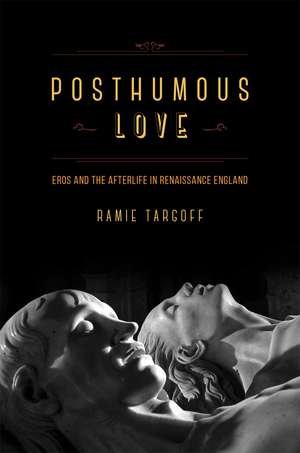
Posthumous Love: Eros and the Afterlife in Renaissance England
Autor Ramie Targoffen Limba Engleză Hardback – 2 mai 2014
Descoperim în Posthumous Love o examinare riguroasă a modului în care poezia engleză a Renașterii a abandonat convingerea medievală a unei iubiri care supraviețuiește morții. Studiul începe prin analiza modului în care reformatorii protestanți au trasat granițe rigide între viața biologică și cea spirituală, forțând poeții să caute compensații estetice pentru dispariția speranței unei reuniuni în ceruri. Ramie Targoff utilizează analize comparative pe textele lui Thomas Wyatt, care, deși traduce din Petrarca, elimină fluiditatea dintre lumi prezentă în original, și pe sonetele elisabetane ale lui Shakespeare sau Spenser.
Un punct de referință esențial al lucrării este analiza piesei Romeo și Julieta. Ramie Targoff demonstrează cum adaptarea lui Shakespeare elimină elementele din sursele italiene care sugerau o reîntâlnire a tinerilor amanți în viața de apoi, transformând tragedia într-o celebrare a finitudinii. Această abordare completează perspectiva oferită de The Metaphysics of Love de Albert James Smith, adăugând o dimensiune istorică și teologică specifică contextului englez, acolo unde Smith se concentra pe conflictul dintre senzual și spiritual.
Structura volumului ghidează cititorul de la banarea morții în scrierile lui Wyatt până la poeziile „carpe diem” ale secolului al XVII-lea, culminând cu studiul unor cazuri limită precum John Milton. Spre deosebire de Petrarchan Love and the English Renaissance de Gordon Braden, care oferă o istorie narativă a influenței italiene, lucrarea de față se concentrează pe o mutație conceptuală precisă: nașterea unei poetici a limitelor umane. În contextul operei autoarei, Posthumous Love continuă preocuparea pentru intersecția dintre devotamentul religios și expresia literară, temă explorată anterior în Common Prayer: The Language of Public Devotion in Early Modern England.
Preț: 312.84 lei
Carte disponibilă
Livrare economică 07-21 noiembrie
Livrare express 24-30 octombrie pentru 35.57 lei
Specificații
ISBN-10: 0226789594
Pagini: 224
Dimensiuni: 152 x 229 x 23 mm
Greutate: 0.48 kg
Editura: University of Chicago Press
Colecția University of Chicago Press
V-ar putea interesa
-
 -29%Preț: 80.72 lei113.63 lei
 -
 OCR the School for ScandalRichard SheridanPreț: 54.75 lei
 -
 The Lives of the Poets: A SelectionSamuel Johnson-17%Preț: 90.19 lei109.32 lei
 -
 -18%Preț: 59.02 lei72.22 lei
 -
 Selected PoetryJohn Donne-19%Preț: 52.19 lei64.47 lei
 -
 Five PlaysBen Jonson-15%Preț: 69.49 lei82.13 lei
 -
 The New Oxford Book of Eighteenth-Century Verse: ReissueRoger Lonsdale-16%Preț: 97.45 lei116.68 lei
 -
 Preț: 339.47 lei
 -
 Preț: 390.09 lei
 -
 Swift and ScienceG. LynallPreț: 403.27 lei
 -
 MacbethProf. Eric Rasmussen-18%Preț: 66.70 lei81.72 lei
 -
 Maurice Scève Poet of LoveDorothy Gabe ColemanPreț: 270.02 lei
 -
 The Cambridge Companion to VoltaireNicholas CronkPreț: 273.79 lei
 -
 The Cambridge Companion to Early Modern Women's WritingLaura Lunger KnoppersPreț: 280.43 lei
 -
 John Milton's 'Paradise Lost'Noam Reisner-13%Preț: 150.04 lei172.43 lei
 -
 Doctor Faustus: A critical guideProfessor Sara Munson Deats-14%Preț: 234.01 lei272.78 lei
De ce să citești această carte
Recomandăm această lucrare cercetătorilor și studenților la litere care doresc să înțeleagă tranziția de la viziunea medievală la cea modernă asupra iubirii. Cititorul va câștiga o perspectivă inedită asupra unor texte canonice, înțelegând cum teologia protestantă a modelat indirect intensitatea emoțională a literaturii elisabetane. Este un studiu esențial despre modul în care acceptarea mortalității a îmbogățit estetica poeziei engleze.
Despre autor
Ramie Targoff este profesor de literatură engleză la Brandeis University și o specialistă recunoscută în perioada modernă timpurie. Opera sa explorează frecvent legăturile dintre formele de rugăciune publică, moarte și identitatea literară, fiind autoarea unor volume precum Common Prayer și Shakespeare's Sisters. Prin lucrarea de față, publicată de University of Chicago Press, ea își consolidează reputația de critic capabil să identifice nuanțe teologice subtile care au redefinit genurile literare clasice, de la sonet la tragedia shakespeariană.
Descriere scurtă
Targoff shows that medieval notions of the somewhat flexible boundaries between love in this world and in the next were hardened by Protestant reformers, who envisioned a total break between the two. Tracing the narrative of this rupture, she focuses on central episodes in poetic history in which poets developed rich and compelling compensations for the lack of posthumous love—from Thomas Wyatt’s translations of Petrarch’s love sonnets and the Elizabethan sonnet series of Shakespeare and Spencer to the carpe diem poems of the seventeenth century. Targoff’s centerpiece is Romeo and Juliet, where she considers how Shakespeare’s reworking of the Italian story stripped away any expectation that the doomed teenagers would reunite in heaven. Casting new light on these familiar works of poetry and drama, this book ultimately demonstrates that the negation of posthumous love brought forth a new mode of poetics that derived its emotional and aesthetic power from its insistence upon love’s mortal limits.
Notă biografică
Cuprins
Introduction Burying Love
2 Banishing Death: Wyatt’s Petrarchan Poems
3 Dead Ends: The Elizabethan Sonnet
4 The Capulet Tomb
5 The Afterlife of Renaissance Sonnets
6 Carpe Diem
Conclusion Limit Cases: Henry King and John Milton
Epilogue “An Arundel Tomb”
Notes
Index