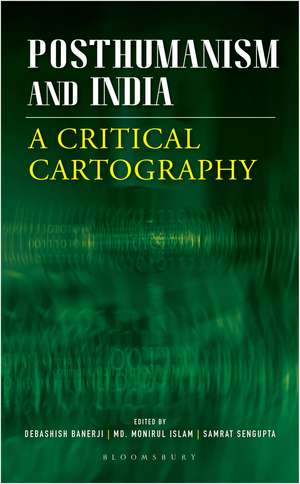
Posthumanism and India: A Critical Cartography
Editat de Debashish Banerji, Md. Monirul Islam, Samrat Senguptaen Limba Engleză Hardback – 26 iun 2025
Găsim în Posthumanism and India o incursiune academică de o rigoare excepțională, care propune o cartografiere critică a conceptului de postumanism dincolo de granițele teoriei occidentale. Volumul debutează prin stabilirea unei baze interdisciplinare solide, unde filosofia indiană se intersectează cu studiile culturale, etica tehnologică, biopolitica și ecologia. Reținem că această abordare nu este doar o adaptare a teoriilor europene, ci o contestare a istoriei universalizate a umanismului eurocentric, care a ignorat adesea specificul și marginalii spațiului sud-asiatic.
Structura volumului este organizată progresiv în cinci secțiuni tematice: „Internal Selves and Others”, „Technology, Normativity and Ethics”, „Human and Animal”, „Bodies and Their Discards” și „Becoming-Cosmos”. Această succesiune indică o trecere de la analiza subiectivității marginale — exemplificată prin eseul despre migrația Dalit sau analiza romanului lui Salman Rushdie — către problemele macroscopice ale crizei climatice și ale coliziunii dintre tehnocapitalism și naționalismul religios în contextul inteligenței artificiale. Credem că această ediție aduce un plus de valoare curriculumului de studii postcoloniale prin includerea unor perspective inedite, precum etnografia non-umană a macacilor în orașele indiene.
Comparabil cu The Bloomsbury Handbook of Posthumanism în rigurozitate, volumul de față este actualizat pentru dinamica socio-politică specifică Indiei contemporane, oferind o lentilă locală necesară acolo unde manualele generale rămân abstracte. În contextul operei editorului Debashish Banerji, lucrarea reprezintă o evoluție firească a temelor din Critical Posthumanism and Planetary Futures și Rabindranath Tagore in the 21st Century, rafinând dialogul dintre moștenirea culturală indiană și provocările tehnologice ale secolului XXI.
Preț: 550.86 lei
Preț vechi: 819.19 lei
-33%
Carte disponibilă
Livrare economică 07-21 noiembrie
Specificații
ISBN-10: 9356404186
Pagini: 288
Dimensiuni: 140 x 222 x 22 mm
Greutate: 0.48 kg
Editura: Bloomsbury Publishing
Colecția Bloomsbury Academic India
Locul publicării:New Delhi, India
De ce să citești această carte
Recomandăm această carte cercetătorilor și studenților din domeniile științelor umaniste și sociale care doresc să înțeleagă cum se reconfigurează identitatea umană în fața tehnologiei și a crizei ecologice. Cititorul câștigă o perspectivă critică asupra modului în care India poate oferi soluții unice la urgențele globale actuale, depășind narativele triumfaliste ale transumanismului occidental printr-o analiză etică și politică aplicată.
Despre autor
Debashish Banerji este profesor de filosofie și cultură indiană la California Institute of Integral Studies și coordonator educațional la University of Philosophical Research, Los Angeles. Cu un doctorat în istoria artei obținut la UCLA, Banerji este recunoscut pentru expertiza sa în estetică și studii postcoloniale, fiind strănepotul renumitului Abanindranath Tagore. În lucrările sale, acesta analizează frecvent intersecția dintre tradiția indiană și modernitate, poziționându-se ca o voce autoritară în discursul despre postumanismul critic și viitorul planetar.
Descriere
The world today has universalized a Eurocentric history of the human with its privileges, oppressions, exploitations and exclusions. On the one hand, this has led to the triumphalist narrative of technology, the blurring of biological embodiment through prostheses and the dream of transhumanist self-exceeding. On the other hand, we are witness to the contemporary eruption of dystopian anomalies due to the dis-balance or revolt of the "others" of humanism - climate crisis, chronic pandemic, religious, ethnocentric and geopolitical violence, ideological and authoritarian state control. Posthumanism is both an acknowledgement of these blurred boundaries of humanism and a critical response to it.
The editors of this volume opine that the discourse of posthumanism in India warrants urgent consideration, if we are to adequately address both national and global emergencies and look for solutions that India may be in a unique position to offer. Essays in the volume are by scholars in the area dealing with representative directions relating to posthumanism in India. The essays are divided into five areas of cultural relevance - (1) internal selves and others; (2) technology, normativity and ethics; (3) human and animal; (4) bodies and their discards; (5) becoming-cosmos. Together they form the beginnings of an approach to a critical cartography of posthumanism as it pertains specifically to India.
Cuprins
Debashish Banerji, Md.Monirul Islam, Samrat Sengupta
Section A: Internal Selves and Others
2. Some Observations on the Political Possibilities of Feminist Posthumanism
Ritu Sen Chaudhuri
3. Making and Unmaking of the Marginal Subject: How a Dalit Migrant Remembers the Nonhuman
Samrat Sengupta
4. The Posthuman Uncanny Materiality in Salman Rushdie's Novel Midnight's Children
Malgorzata Kowalcze
Section B: Human and Animal
5. Can Bulls be Cyborgs? Unmaking the Logics of Dispensability
Susan Haris
6. Being Macaque: Nonhuman Ethnographies of Urban India
Anindya Sinha, Maan Barua
Section C: Technology, Normativity and Ethics
7. Artificial Intelligence in India: Crisis of Collusion Between Technocapitalism and Religious Nationalism
Debashish Banerji, Md. Monirul Islam, Samrat Sengupta
8. The Spectre of Artificial Intelligence and Indian Cinema: Critical Perspectives on AI Ethics and Machine Agency
Md Monirul Islam
9. Indian Supercrip Cyborg: Deconstructing Normativity through Feminist Posthumanism
Jaya Sarkar
Section D: Bodies and Their Discards
10. Space, Race, Garbage and the Posthuman: An Intersectional Analysis of the Photographic Representations of the Wasteocene in Varanasi by European Tourists
Sayan Dey
11.'Dirt Accha, Hain': A Posthumanist Critique of Mahatma Gandhi's Doctrines of Sanitation and Sanitation Labourers
Soumili Das
12. The Posthuman in the Burial Grounds: Unravelling the Headless and the Crematorial Kali
Asijit Datta
Section E: Becoming Cosmos
13. Poems
I. A Journey into the Chakras: 7 Posthuman Visions
II. Five Fingers: In Touch with Reality
III. Posthuman Love
Francesca Ferrando
14. Posthumanism and Indian Spirituality
Debashish Banerji
15. Becoming Raga: From Posthuman Sono-Rituals to Transindividual Sound-Bodies
Jonathan Kay
16. Sri Aurobindo's Tales of Prison Life and the New Ethics of Selfhood
Subham Dutta
About the Editors and Contributors
Index
Recenzii
Posthumanism and India is a fundamental book for the international philosophical discourse that shows us how today, more than ever, we need to overcome the barriers between cultures and the hierarchical and disjunctive approach that has characterised Western humanism. It is a book that urges us to rediscover an inclusive relationship and coexistence with the Earth, abandoning that anthropocentric logic of domination and submission of every form of otherness that is at the basis of the global ecological crisis, through an ethics of empathy and a plural ontology. This book also considers our contemporary relationship with technology in a critical way, eschewing triumphalist tones and irrational fears, with the awareness that every technology has an impact on human beings as well as on the world. I highly recommend reading this work which, through the vision of the various authors, shows us an important perspective of posthumanism.
If humanism is the language of modernity, how do we think about posthumanism in relation to what comes after the modern? By raising questions like this, the aim of this volume is to create a much needed critical space for considering posthumanism in the Indian scene of postcolonial thought. Most significantly, it underscores the political nature of posthumanist knowledge practices in the Indian context, covering a wide range of topics from human-animal relations to technology and mobilising multiple disciplines like philosophy, literature, cinema studies and anthropology. The book's layered discussions on Brahminical normativity, gender, politics of AI, embodiment and waste, music, spirituality, religion and tantrism will make it an esoteric trailblazer for the dissemination of posthumanism in India.