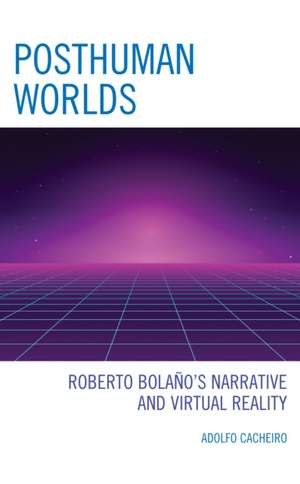
Posthuman Worlds: Roberto Bolaño's Narrative and Virtual Reality
Autor Adolfo Cacheiroen Limba Engleză Hardback – 3 mar 2022
Preț: 526.13 lei
Preț vechi: 816.49 lei
-36%
Puncte Express: 789
Carte tipărită la comandă
Livrare economică 16-30 noiembrie
Livrare prin curier în România Termenul estimat este afișat lângă disponibilitate.
Transport gratuit pentru acest produs Plată online sau ramburs, în funcție de opțiunile comenzii.
Retur gratuit în 14 zile Comandă securizată și suport în română.
Specificații
ISBN-13: 9781793649874
ISBN-10: 1793649871
Pagini: 256
Ilustrații: 10 b/w illustrations;
Dimensiuni: 163 x 237 x 22 mm
Greutate: 0.54 kg
Editura: Bloomsbury Publishing
Colecția Lexington Books
Locul publicării:New York, United States
ISBN-10: 1793649871
Pagini: 256
Ilustrații: 10 b/w illustrations;
Dimensiuni: 163 x 237 x 22 mm
Greutate: 0.54 kg
Editura: Bloomsbury Publishing
Colecția Lexington Books
Locul publicării:New York, United States
Cuprins
Preface
Acknowledgements
Introduction: Autobiographical Phenomenology
Chapter 1: The Force Field of the Real: Imaginary and Symbolic Identification in Distant Star
Chapter 2: Fidelity to the Event in "Labyrinth"
Chapter 3: The Savage Detectives and Fate
Chapter 4: Amulet as a Posthuman Text
Chapter 5: Transnational Allegory as a Prelude to Brexit
Chapter 6: The Part about Heidegger
Chapter 7: Bizarro World
Chapter 8: Virtual Reality and the Revolutionary Subject
Chapter 9: "Redemption to the Redeemer"
Conclusion: Ontological Considerations
Bibliography
Index
About the Author
Acknowledgements
Introduction: Autobiographical Phenomenology
Chapter 1: The Force Field of the Real: Imaginary and Symbolic Identification in Distant Star
Chapter 2: Fidelity to the Event in "Labyrinth"
Chapter 3: The Savage Detectives and Fate
Chapter 4: Amulet as a Posthuman Text
Chapter 5: Transnational Allegory as a Prelude to Brexit
Chapter 6: The Part about Heidegger
Chapter 7: Bizarro World
Chapter 8: Virtual Reality and the Revolutionary Subject
Chapter 9: "Redemption to the Redeemer"
Conclusion: Ontological Considerations
Bibliography
Index
About the Author
Recenzii
Whereas critics have argued that the leitmotiv connecting Bolaño's oeuvre is friendship, violence and evil, marginal, obsessive writers and writing itself, or failure of the revolutionary project of the 1960s and 70s in Latin American, Cacheiro proposes an alternative cornerstone for Bolaño's fragmented narrative: he contends that, echoing the author's personal displacement from Latin America to Europe, as his characters travel from Latin America to Europe and vice versa, the Latin America represented in his writing must be understood as contrasted, in a phenomenological divide, with Europe. Applying theories by Lacan, Zizek and Badiou, Posthuman Worlds offers an original and insightful reading of the political message in Bolaño's literature, which proposes, as a model for Latin America, the European renewal of the modernist project and of the progressive ideals of social justice that failed in the Americas. Along the way, claims Cacheiro, uncanny forces that cause anxiety to Bolaño's characters end up having socioeconomic effects. They feel manipulated by external forces, as if they were posthumans being played as part of the entertainment for the director of a virtual reality computer simulation.
Posthuman Worlds is a daring and refined philosophical theorizing of/on Roberto Bolaño´s bestsellers. Virtual reality is analyzed as a livable political real to deem "the impact of transnational European politics and ideology" (civilization). Cacheiro´s imaginative close readings creatively engage with Lacanian psychoanalysis vis-à-vis Borges´ s short stories. Through conversations with a diverse range of philosophers and literary critics, the author plots a labyrinthine journey of Bolaño´s geographical displacements (from Mexico to Chile and, finally, Spain) to provide answers to what kind of world can make a life worth living.
Cacheiro runs with the sci-fi spirit that haunts Roberto Bolaño's 2666, producing a genuinely surprising critical intervention. Equal parts fabulation and analysis, Posthuman Worlds convincingly reads novelistic episodes, both famous and under-examined, as philosophical vignettes. The end result is a tour de force from simulation to revolution.
Posthuman Worlds is a daring and refined philosophical theorizing of/on Roberto Bolaño´s bestsellers. Virtual reality is analyzed as a livable political real to deem "the impact of transnational European politics and ideology" (civilization). Cacheiro´s imaginative close readings creatively engage with Lacanian psychoanalysis vis-à-vis Borges´ s short stories. Through conversations with a diverse range of philosophers and literary critics, the author plots a labyrinthine journey of Bolaño´s geographical displacements (from Mexico to Chile and, finally, Spain) to provide answers to what kind of world can make a life worth living.
Cacheiro runs with the sci-fi spirit that haunts Roberto Bolaño's 2666, producing a genuinely surprising critical intervention. Equal parts fabulation and analysis, Posthuman Worlds convincingly reads novelistic episodes, both famous and under-examined, as philosophical vignettes. The end result is a tour de force from simulation to revolution.