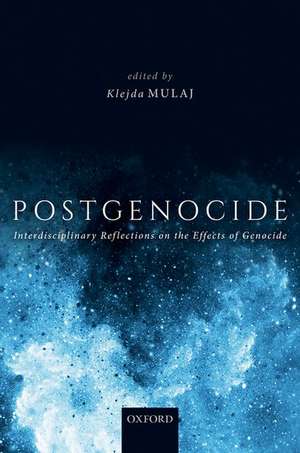
Postgenocide: Interdisciplinary Reflections on the Effects of Genocide
Editat de Klejda Mulajen Limba Engleză Hardback – 15 mar 2021
Preț: 778.22 lei
Preț vechi: 1146.10 lei
-32%
Puncte Express: 1167
Carte disponibilă
Livrare economică 12-18 noiembrie
Livrare prin curier în România Termenul estimat este afișat lângă disponibilitate.
Transport gratuit pentru acest produs Plată online sau ramburs, în funcție de opțiunile comenzii.
Retur gratuit în 14 zile Comandă securizată și suport în română.
Specificații
ISBN-13: 9780192895189
ISBN-10: 0192895184
Pagini: 336
Dimensiuni: 165 x 242 x 23 mm
Greutate: 0.66 kg
Ediția:1
Editura: OUP OXFORD
Colecția OUP Oxford
Locul publicării:Oxford, United Kingdom
ISBN-10: 0192895184
Pagini: 336
Dimensiuni: 165 x 242 x 23 mm
Greutate: 0.66 kg
Ediția:1
Editura: OUP OXFORD
Colecția OUP Oxford
Locul publicării:Oxford, United Kingdom
Recenzii
Postgenocide is an extremely interesting book ... A reading like this is recommended since it leaves the person who approaches it with many questions and the courage to inquire.
This is an excellent volume that makes an innovative and valuable contribution to the available literature on genocide studies.
Postgenocide makes a significant contribution to the literature on genocide. Klejda Mulaj and a multi-disciplinary group of distinguished contributors use the novel approach of postgenocide to consider the effects of genocide on society. They examine the role of law in criminalising state responsibility for genocide and enabling postgenocide recovery, how victims' communities react to genocide denial, and how survivors seek recognition and redress in the aftermath of genocide. An essential reading for anyone keen to understand the effects of genocide with the view of mitigating their devastating repercussions.
An important volume that combines an interdisciplinary approach to understanding life after genocide. The volume explores in a comparative setting various means that societies can use to overcome horrors of genocide. Highly recommended for those wishing to comprehend how individuals, groups and societies can move past the violence and hate of genocide.
Too often books on genocide and mass atrocity studies suffer the defect of being centred in one discipline and focused on the causes or events of the genocide. This book does not. It is very usefully interdisciplinary and suitably examines the impacts, effects, and legacies of massive human rights abuses in several contexts. It explores the efficacy of a range of responses, legal and others, to massive human rights abuses. There is tremendous value to this book for readers from a range of disciplines who are interested in going beyond what the literature usually offers.
This is an excellent volume that makes an innovative and valuable contribution to the available literature on genocide studies.
Postgenocide makes a significant contribution to the literature on genocide. Klejda Mulaj and a multi-disciplinary group of distinguished contributors use the novel approach of postgenocide to consider the effects of genocide on society. They examine the role of law in criminalising state responsibility for genocide and enabling postgenocide recovery, how victims' communities react to genocide denial, and how survivors seek recognition and redress in the aftermath of genocide. An essential reading for anyone keen to understand the effects of genocide with the view of mitigating their devastating repercussions.
An important volume that combines an interdisciplinary approach to understanding life after genocide. The volume explores in a comparative setting various means that societies can use to overcome horrors of genocide. Highly recommended for those wishing to comprehend how individuals, groups and societies can move past the violence and hate of genocide.
Too often books on genocide and mass atrocity studies suffer the defect of being centred in one discipline and focused on the causes or events of the genocide. This book does not. It is very usefully interdisciplinary and suitably examines the impacts, effects, and legacies of massive human rights abuses in several contexts. It explores the efficacy of a range of responses, legal and others, to massive human rights abuses. There is tremendous value to this book for readers from a range of disciplines who are interested in going beyond what the literature usually offers.
Notă biografică
Klejda Mulaj studies political violence with particular reference to war and mass atrocity. Her latest published work dwells on effects of mass violence at the intersection between war and peace; nationalism; state-formation; and postconflict rebuilding. She is author of Politics of Ethnic Cleansing (2008); editor and author of Violent Non-State Actors in World Politics (2010); and author of 25 peer reviewed papers and book chapters. She has taught at university level since 2001 and is a Senior Fellow of the Higher Education Academy. She obtained her PhD in International Relations from London School of Economics and Political Science in 2004.