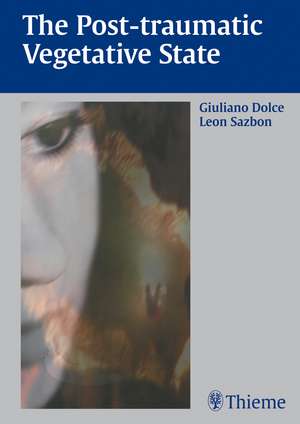
Post-Traumatic Vegetative State
Autor Giuliano Dolce, Leon Sazbonen Limba Engleză Hardback – 3 sep 2002
Written by authors with over 20 years of experience in the rehabilitation of patients in a persistent vegetative state, this practical text bridges a gap in the specialized literature by providing neurologists, emergency physicians, physiatrists, and internists, as well as therapists, with a new set of tools to make rapid progress in the treatment of these patients whose improvement is wholly dependent upon them. A second equally relevant aspect covered in this book is the relationship of the care-giving physician with the patient's family. Particular attention is given to the approach the physician must take towards family members of the patient lacking mental activity. A third section illustrates the structural and instrumental devices useful in planning and operating a unit specialized in the treatment of patients in the persistent vegetative state, with particular attention given to the rules governing the unit.
Preț: 284.40 lei
Preț vechi: 335.12 lei
-15%
Puncte Express: 427
Carte tipărită la comandă
Livrare economică 19-25 noiembrie
Livrare prin curier în România Termenul estimat este afișat lângă disponibilitate.
Transport gratuit de la 400.00 lei Plată online sau ramburs, în funcție de opțiunile comenzii.
Retur gratuit în 14 zile Comandă securizată și suport în română.
Specificații
ISBN-13: 9783131300713
ISBN-10: 313130071X
Pagini: 158
Ilustrații: 33
Dimensiuni: 170 x 240 mm
Greutate: 0.5 kg
Ediția:1st edition
Editura: Thieme
Colecția Thieme
ISBN-10: 313130071X
Pagini: 158
Ilustrații: 33
Dimensiuni: 170 x 240 mm
Greutate: 0.5 kg
Ediția:1st edition
Editura: Thieme
Colecția Thieme
Recenzii
'This text should be considered mandatory reading for those working with patients in VS and their families. [It] is an authoritative reference. . . . well-organized, comprehensive and detailed. . . [The authors] have made a significant contribution to the understanding and care of those faced with this condition.' -- Brain Injury
Textul de pe ultima copertă
Written by authors with over 20 years of experience in the rehabilitation of patients in a persistent vegetative state, this practical text bridges a gap in the specialized literature by providing neurologists, emergency physicians, physiatrists, and internists, as well as therapists, with a new set of tools to make rapid progress in the treatment of these patients whose improvement is wholly dependent upon them. A second equally relevant aspect covered in this book is the relationship of the care-giving physician with the patient's family. Particular attention is given to the approach the physician must take towards family members of the patient lacking mental activity. A third section illustrates the structural and instrumental devices useful in planning and operating a unit specialized in the treatment of patients in the persistent vegetative state, with particular attention given to the rules governing the unit.