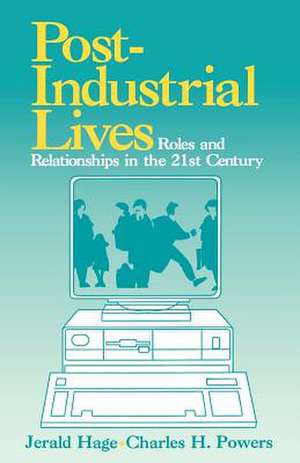
Post Industrial Lives
Autor Jerald Hage, Charles H. Powersen Limba Engleză Paperback – dec 1992
Preț: 648.89 lei
Preț vechi: 763.40 lei
-15%
Puncte Express: 973
Carte tipărită la comandă
Livrare economică 05-19 iunie
Specificații
ISBN-13: 9780803944954
ISBN-10: 0803944950
Pagini: 264
Ilustrații: 1
Dimensiuni: 140 x 216 x 16 mm
Greutate: 0.38 kg
Ediția:1
Editura: SAGE Publications
Locul publicării:Thousand Oaks, United States
ISBN-10: 0803944950
Pagini: 264
Ilustrații: 1
Dimensiuni: 140 x 216 x 16 mm
Greutate: 0.38 kg
Ediția:1
Editura: SAGE Publications
Locul publicării:Thousand Oaks, United States
V-ar putea interesa
-
 -23%Preț: 384.48 lei498.66 lei
 -
 The SAGE Dictionary of Cultural StudiesChris BarkerPreț: 250.64 lei
 -
 MegawordsRichard OsbornePreț: 429.36 lei
 -
 Questions of Cultural IdentityStuart Hall-11%Preț: 448.12 lei503.51 lei
 -
 Doing Cultural TheoryDavid WaltonPreț: 427.55 lei
 -
 Preț: 74.89 lei
 -
 Cultural Studies: The BasicsJeff Lewis-19%Preț: 496.43 lei612.88 lei
 -
 Handbook of Material CultureChristopher TilleyPreț: 322.49 lei
 -
 Skilled VisionsCristina GrasseniPreț: 247.63 lei
 -
 What's Become of Cultural Studies?Graeme TurnerPreț: 400.99 lei
 -
 Discombobulated: Dispatches From the Wrong SideSimon Morrison-30%Preț: 67.31 lei95.79 lei
 -
 A New Thoughtfulness in Contemporary ChinaJörg Huber-23%Preț: 220.71 lei287.33 lei
Cuprins
Introduction
The New Society
From Rational to Complex Work
Creative Minds and Complex Selves
Emotion
Role Redefinition
The Pivotal Micro Process
Analytical Tools for Understanding Role Structure
The Metamorphosis of Roles into Interpersonal Relationships
Epilogue
Sociology for the Post-Industrial Era
The New Society
From Rational to Complex Work
Creative Minds and Complex Selves
Emotion
Role Redefinition
The Pivotal Micro Process
Analytical Tools for Understanding Role Structure
The Metamorphosis of Roles into Interpersonal Relationships
Epilogue
Sociology for the Post-Industrial Era
Descriere
The move from an industrial to a post-industrial society has been documented by many, as has the impact of this new order on the macro-level institutions of society - government, the workplace and the economy. But what does post-industrial life mean to the individual and for relationships between people? Hage and Powers examine that question, linking global changes in the work patterns, information flow and knowledge to the practice of everyday life. Their answer is that the complexification of society requires a different kind of person. Creativity, flexibility and emotional astuteness will become the watchwords of the future, personality traits that will enable people to successfully adapt to the ever-changing swirl of wo