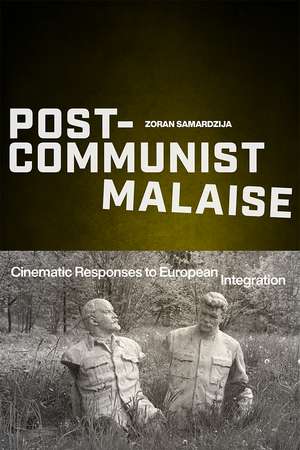
Post-Communist Malaise: Cinematic Responses to European Integration: Media Matters
Autor Zoran Samardzijaen Limba Engleză Paperback – 15 mai 2020 – vârsta ani

Preț: 336.76 lei
Puncte Express: 505
Carte indisponibilă temporar
Doresc să fiu notificat când acest titlu va fi disponibil:
Se trimite...
Specificații
ISBN-13: 9780813587141
ISBN-10: 081358714X
Pagini: 220
Ilustrații: 0 illustrations
Dimensiuni: 152 x 229 x 15 mm
Greutate: 0.32 kg
Ediția:None
Editura: Rutgers University Press
Colecția Rutgers University Press
Seria Media Matters
ISBN-10: 081358714X
Pagini: 220
Ilustrații: 0 illustrations
Dimensiuni: 152 x 229 x 15 mm
Greutate: 0.32 kg
Ediția:None
Editura: Rutgers University Press
Colecția Rutgers University Press
Seria Media Matters
Notă biografică
Zoran Samardzija is an associate professor in the Department of Cinema and Television Arts at Columbia College, Chicago. He is the author of essays on David Lynch, Andrei Tarkovsky, and Eastern European and Balkan cinemas.
Recenzii
"Forging upstream against critical currents, Samardzija’s book stubbornly holds out for the principle of aesthetic hope, extracted from the carapace of political modernism with a set of sharp theoretical tools. Within the unique neither-quite-West-nor-anymore-East terrain of Europe’s post-communist countries, he finds a set of films capable of giving shape to the 'post-communist malaise' by capturing and making visible the gap between the expired promises of universal utopia and the disenchantments and exclusions of neoliberal Euro markets. His ingenious close readings bring the revisionist contours of such latent hope to light."
Descriere
Post-Communist Malaise examines political modernism within the context of post-communist Eastern Europe and the Balkans. It focuses on how select cinemas from the regions critique European unification and how they represent related issues like the transition from communism to free-market capitalism, the Euro crisis and austerity, and the rise of nationalism and right-wing politics.