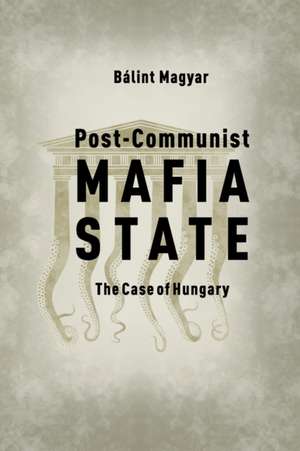
Post-Communist Mafia State: The Case of Hungary
Autor Bálint Magyaren Limba Engleză Paperback – 10 feb 2016
Bazându-ne pe analiza detaliată oferită de Central European University Press, observăm că Post-Communist Mafia State reprezintă o piatră de temelie în înțelegerea regimurilor hibride din Europa Centrală. Bálint Magyar propune un aparat conceptual riguros, înlocuind termenii descriptivi vagi cu categorii sociologice precise precum „familia politică adoptată” și „statul care utilizează metode mafiote”. Premisa centrală a lucrării este transformarea partidului Fidesz dintr-un actor democratic într-un „prădător politic” care, după 2010, a capturat instituțiile statului pentru a servi interesele unui clan restrâns.
Notăm cu interes modul în care autorul structurează argumentația, plecând de la dezintegrarea ordinii constituționale din Ungaria spre o definiție generalizabilă a statului mafiot post-comunist ca subtip al regimurilor autocratice. Cartea completează perspectiva oferită de Dynamics of an Authoritarian System de Mária Csanádi; în timp ce Csanádi explorează vulnerabilitatea setărilor democratice în fața populismului, Magyar se concentrează pe mecanismele interne de putere și pe modul în care legislația parlamentară și autoritățile fiscale sunt folosite ca instrumente de coerciție, similar metodelor mafiei clasice, dar sub acoperirea legalității.
În contextul operei sale, această lucrare este fundamentală pentru înțelegerea sistemului teoretic dezvoltat ulterior în The Anatomy of Post-Communist Regimes. Dacă în scrierile mai recente despre Ucraina sau Rusia, autorul aplică aceste concepte la nivel geopolitic, în volumul de față găsim geneza și fundamentarea empirică a modelului său. Este o lectură esențială pentru specialiștii în științe politice care caută să înțeleagă cum se pot consolida structurile informale de putere în interiorul unor instituții formale democratice.
Preț: 405.33 lei
Preț vechi: 440.57 lei
-8%
Carte disponibilă
Livrare economică 14-28 noiembrie
Livrare express 03-07 noiembrie pentru 142.84 lei
Specificații
ISBN-10: 6155513546
Pagini: 336
Dimensiuni: 152 x 229 x 19 mm
Greutate: 0.62 kg
Ediția:1
Editura: Amsterdam University Press
Colecția Central European University Press
Locul publicării:Oxford, United Kingdom
V-ar putea interesa
-
 The Benn DiariesTony Benn-17%Preț: 102.74 lei124.53 lei
 -
 -22%Preț: 150.64 lei193.00 lei
 -
 -32%Preț: 749.43 lei1095.97 lei
 -
 From Marx to the Market: Socialism in Search of an Economic SystemWlodzimierz Brus-19%Preț: 365.50 lei453.87 lei
 -
 Karl Marx's Theory of History: A DefenceG. A. Cohen-27%Preț: 558.03 lei766.73 lei
 -
 The New European LeftK. HudsonPreț: 389.10 lei
 -
 Ten Years of New LabourM. BeechPreț: 370.75 lei
 -
 Whither Socialism?Joseph E. StiglitzPreț: 397.32 lei
 -
 Glasnost, Perestroika, and the Socialist CommunityCharles Bukowski-30%Preț: 374.64 lei532.43 lei
 -
 China′s Communist Party – Atrophy and AdaptationDavid ShambaughPreț: 228.95 lei
 -
 Why Not Socialism?Gerald a CohenPreț: 79.96 lei
 -
 The Strange Death of Labour ScotlandGerry Hassan-16%Preț: 183.25 lei218.13 lei
 -
 Towards a Liberal Utopia?Philip Booth-30%Preț: 373.76 lei532.89 lei
 -
 Red Emma Speaks: An Emma Goldman ReaderEmma Goldman-24%Preț: 225.31 lei295.87 lei
 -
 Destructive GenerationPeter CollierPreț: 105.25 lei
 -
 On Practice and ContradictionMao Tse-TungPreț: 140.79 lei
Public țintă
AcademicDe ce să citești această carte
Această carte este indispensabilă pentru cercetătorii și studenții la științe politice care doresc să înțeleagă transformarea regimului politic din Ungaria. Cititorul câștigă un set de instrumente analitice noi pentru a identifica mecanismele prin care un stat poate fi capturat din interior. Este un ghid teoretic riguros despre cum concentrarea puterii și a bogăției în mâinile unui clan poate fi realizată prin mijloace aparent legale.
Despre autor
Bálint Magyar este un sociolog și fost politician maghiar, recunoscut la nivel internațional pentru cercetările sale asupra regimurilor post-comuniste. A servit ca ministru al educației în Ungaria, experiență care i-a oferit o perspectivă unică asupra funcționării instituțiilor statului. Opera sa vastă, publicată în mare parte la Central European University Press, include analize profunde ale sistemelor patronale și autocratice din Eurasia. Magyar este arhitectul conceptual al termenului „stat mafiot”, utilizat pentru a descrie evoluția politică a Ungariei sub conducerea lui Viktor Orbán, contribuind semnificativ la literatura de specialitate despre democrațiile iliberale.
Descriere scurtă
Notă biografică
He was a member of the Hungarian Parliament (1990-2010). As a Minister of Education (1996-1998; 2002-2006) he initiated and carried out reforms in public and higher education.