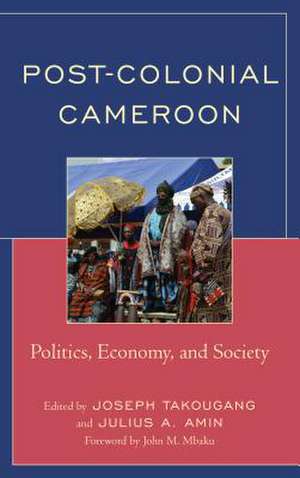
Post-Colonial Cameroon: Politics, Economy, and Society
Editat de Joseph Takougang, Julius A. Amin Contribuţii de Fonkem Achankeng, Peter Ngwafu, Walter Gam Nkwi, Roland N. Ndille, Honoré Mimche, Christian Bios Nelem, Achille Pinghane Yonta, Nobert Lengha Tohnain, Carlson Anyangwe, Moses K. Tesi, Lotsmart Fonjong, Kengo Emmanuel, Zacharia N. Nchinda, Jeannette Wogaing, Mireille Nnanga, Rose Angeline Abissi Cuvânt înainte de John M. Mbaku Contribuţii de Augustine E. Ayuk, Emmanuel E. Kengo, Rose Mireille Nnangaen Limba Engleză Hardback – 13 iun 2018
Preț: 797.79 lei
Preț vechi: 1246.56 lei
-36%
Puncte Express: 1197
Carte tipărită la comandă
Livrare economică 23 noiembrie-07 decembrie
Livrare prin curier în România Termenul estimat este afișat lângă disponibilitate.
Transport gratuit pentru acest produs Plată online sau ramburs, în funcție de opțiunile comenzii.
Retur gratuit în 14 zile Comandă securizată și suport în română.
Specificații
ISBN-13: 9781498564632
ISBN-10: 1498564631
Pagini: 472
Ilustrații: 10 b/w illustrations; 11 tables;
Dimensiuni: 158 x 239 x 32 mm
Greutate: 0.84 kg
Editura: Bloomsbury Publishing
Colecția Lexington Books
Locul publicării:New York, United States
ISBN-10: 1498564631
Pagini: 472
Ilustrații: 10 b/w illustrations; 11 tables;
Dimensiuni: 158 x 239 x 32 mm
Greutate: 0.84 kg
Editura: Bloomsbury Publishing
Colecția Lexington Books
Locul publicării:New York, United States
Cuprins
Section 1: Politics
Chapter 1: The State, Politics, and the Struggle for Democracy in Cameroon
Moses K. Tesi
Chapter 2: The Roots of Stability and Instability in Cameroon
Augustine E. Ayuk
Chapter 3: The Right to Self-determination in the African Charter: A Critique of the African Commission's Jurisprudence in Kevin Gumne et al v Cameroun
Carlson Anyangwe
Chapter 4: Resistance and the Nationalist Pathos: Southern Cameroon's Exiles Write Back
Fonkem Achankeng I
Section 2: Economy
Chapter 5: The Demise of the Coffee Industry in the North West Region of Cameroon
Emmanuel E. Kengo
Chapter 6: What Has Changed? A Historical Appraisal of Legal and Institutional Frameworks for Environmental Management in Cameroon
Lotsmart Fonjong
Section 3: Society and Culture
Chapter 7: Changes in Female Roles in Cameroon: Towards the end of "Social Juniors?"
Honore Mimche, Achille Pinghane Yonta, and Nobert Lengha Tohnain
Chapter 8: Representations of the Figure of Femininity among the Bamileke, Bassa, and Duala Cultures of Cameroon
Jeannette Wogaing, Rose Mireille Nnanga and Rose Angeline Abissi
Chapter 9: Dynamics of Religious Modernity in Cameroonian Cities
Honore Mimche and Christian Bios Nelem
Chapter 10: The "Cameroonization" of Education: A Decolonial Analysis of Content and Language Issues, 1960-2015
Roland N. Ndille
Section 4: International Relations
Chapter 11: Cameroon's Foreign Policy and Inter-African Relations in the Post-Ahidjo Era
Peter A. Ngwafu
Chapter 12: Cameroon and China: The Paradox of Beijing's "Win-Win-Gain" Pronouncements
Julius A. Amin
Chapter 13: Foreign Volunteer Organizations in Cameroon: The Case of the United States Peace Corps
Julius A. Amin
Section 5: Migration
Chapter 14: Cameroonians on the Move: Searching for Promised Lands
Joseph Takougang
Chapter 15: The Concept of Homeland: The Choice of Burial Place for Cameroonian
Immigrants in America
Zacharia N. Nchinda
Chapter 16: Return Youth Migrants in Cameroon: Understanding the Other Side of Bushfalling, 1990-2015
Walter Gam Nkwi
Conclusion: The Endless Protest
Julius A. Amin and Joseph Takougang
Chapter 1: The State, Politics, and the Struggle for Democracy in Cameroon
Moses K. Tesi
Chapter 2: The Roots of Stability and Instability in Cameroon
Augustine E. Ayuk
Chapter 3: The Right to Self-determination in the African Charter: A Critique of the African Commission's Jurisprudence in Kevin Gumne et al v Cameroun
Carlson Anyangwe
Chapter 4: Resistance and the Nationalist Pathos: Southern Cameroon's Exiles Write Back
Fonkem Achankeng I
Section 2: Economy
Chapter 5: The Demise of the Coffee Industry in the North West Region of Cameroon
Emmanuel E. Kengo
Chapter 6: What Has Changed? A Historical Appraisal of Legal and Institutional Frameworks for Environmental Management in Cameroon
Lotsmart Fonjong
Section 3: Society and Culture
Chapter 7: Changes in Female Roles in Cameroon: Towards the end of "Social Juniors?"
Honore Mimche, Achille Pinghane Yonta, and Nobert Lengha Tohnain
Chapter 8: Representations of the Figure of Femininity among the Bamileke, Bassa, and Duala Cultures of Cameroon
Jeannette Wogaing, Rose Mireille Nnanga and Rose Angeline Abissi
Chapter 9: Dynamics of Religious Modernity in Cameroonian Cities
Honore Mimche and Christian Bios Nelem
Chapter 10: The "Cameroonization" of Education: A Decolonial Analysis of Content and Language Issues, 1960-2015
Roland N. Ndille
Section 4: International Relations
Chapter 11: Cameroon's Foreign Policy and Inter-African Relations in the Post-Ahidjo Era
Peter A. Ngwafu
Chapter 12: Cameroon and China: The Paradox of Beijing's "Win-Win-Gain" Pronouncements
Julius A. Amin
Chapter 13: Foreign Volunteer Organizations in Cameroon: The Case of the United States Peace Corps
Julius A. Amin
Section 5: Migration
Chapter 14: Cameroonians on the Move: Searching for Promised Lands
Joseph Takougang
Chapter 15: The Concept of Homeland: The Choice of Burial Place for Cameroonian
Immigrants in America
Zacharia N. Nchinda
Chapter 16: Return Youth Migrants in Cameroon: Understanding the Other Side of Bushfalling, 1990-2015
Walter Gam Nkwi
Conclusion: The Endless Protest
Julius A. Amin and Joseph Takougang
Recenzii
This impressive collection of essays by Cameroonian scholars both abroad and at home presents a wide variety of insights into contemporary Cameroon with sections on politics, economy, society and culture, international relations, migration, and important concluding comments on the current political crisis.
This volume is an extraordinary treat for scholars of Cameroon and African historiography. Fusing a wide range of themes including previously overlooked issues such as return migration, representations of femininity and motherhood, religious modernity, environmental degradation and nature protection, this volume makes a particularly expedient case for robust interdisciplinary conversations on current Cameroonian society. Though much has been written about Cameroon's latter-day Machiavellian political culture, epitomized by Paul Biya's enduring three decades of unrepentant misrule, this monograph breaks new ground by moving the spotlight away from the autocrat himself and focusing instead on the resilience of everyday life in the postcolony. By synthesizing sharp analysis of politics, the economy, society and culture and international relations, this volume deepens our knowledge of today's Cameroon and its emergent diasporic spaces. This multidisciplinary effort, predictably has brought together seasoned and junior scholars, both Anglophone and Francophone, home-based and diasporic, women and men dedicated to the enterprise of knowledge production that lightens the murky and sometimes sleepy alleys of a postcolony yet to rise to its herculean potentials.
Amin and Takougang have put together an impressive roster of experts on Cameroon whose collective work is a first-rate, comprehensive, and critical assessment of Cameroon's timid attempt to forge a nation out of diverse and competing linguistic, ethnic, and political institutions. The contributors provide varied perspectives that capture a perpetually restless country, but one teeming with enviable human and natural resources which its leadership has failed to summon. Indeed, the editors underscore the brief optimism that welcomed President Paul Biya following the resignation of his predecessor. The work concludes that the brutal repression of peaceful demonstrators and the rise of secessionists movement are direct consequences of the Biya decades and could be the defining event in the history of the country.
This volume is an extraordinary treat for scholars of Cameroon and African historiography. Fusing a wide range of themes including previously overlooked issues such as return migration, representations of femininity and motherhood, religious modernity, environmental degradation and nature protection, this volume makes a particularly expedient case for robust interdisciplinary conversations on current Cameroonian society. Though much has been written about Cameroon's latter-day Machiavellian political culture, epitomized by Paul Biya's enduring three decades of unrepentant misrule, this monograph breaks new ground by moving the spotlight away from the autocrat himself and focusing instead on the resilience of everyday life in the postcolony. By synthesizing sharp analysis of politics, the economy, society and culture and international relations, this volume deepens our knowledge of today's Cameroon and its emergent diasporic spaces. This multidisciplinary effort, predictably has brought together seasoned and junior scholars, both Anglophone and Francophone, home-based and diasporic, women and men dedicated to the enterprise of knowledge production that lightens the murky and sometimes sleepy alleys of a postcolony yet to rise to its herculean potentials.
Amin and Takougang have put together an impressive roster of experts on Cameroon whose collective work is a first-rate, comprehensive, and critical assessment of Cameroon's timid attempt to forge a nation out of diverse and competing linguistic, ethnic, and political institutions. The contributors provide varied perspectives that capture a perpetually restless country, but one teeming with enviable human and natural resources which its leadership has failed to summon. Indeed, the editors underscore the brief optimism that welcomed President Paul Biya following the resignation of his predecessor. The work concludes that the brutal repression of peaceful demonstrators and the rise of secessionists movement are direct consequences of the Biya decades and could be the defining event in the history of the country.