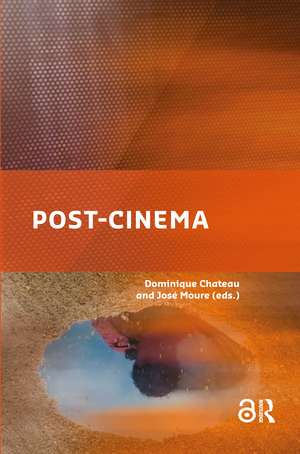
Post-cinema: Cinema in the Post-art Era: The Key Debates: Mutations and Appropriations in European Film Studies
Editat de José Moure, Dominique Chateauen Limba Engleză Hardback – 29 sep 2020



Preț: 918.03 lei
Preț vechi: 1119.55 lei
-18%
Puncte Express: 1377
Preț estimativ în valută:
162.53€ • 189.25$ • 141.19£
162.53€ • 189.25$ • 141.19£
Carte tipărită la comandă
Livrare economică 23 februarie-09 martie
Preluare comenzi: 021 569.72.76
Specificații
ISBN-13: 9789463727235
ISBN-10: 946372723X
Pagini: 366
Dimensiuni: 156 x 234 x 26 mm
Greutate: 0.72 kg
Ediția:1
Editura: Taylor & Francis
Colecția Routledge
Seria The Key Debates: Mutations and Appropriations in European Film Studies
Locul publicării:Oxford, United Kingdom
ISBN-10: 946372723X
Pagini: 366
Dimensiuni: 156 x 234 x 26 mm
Greutate: 0.72 kg
Ediția:1
Editura: Taylor & Francis
Colecția Routledge
Seria The Key Debates: Mutations and Appropriations in European Film Studies
Locul publicării:Oxford, United Kingdom
Public țintă
AcademicNotă biografică
José Moure is Professor of Cinema Studies in the Sorbonne School of the Arts at Panthéon-Sorbonne University, Paris I. He is director of the Research Institute ACTE. Dominique Chateau is Emeritus Professor of Aesthetics and Cinema at the Sorbonne School of the Arts at Panthéon-Sorbonne University, Paris I.
Cuprins
Editorial, Acknowledgments, 1. Introduction - Dominique Chateau & José Moure., Part I - A tribute to Agnès Varda, 2. The Incipit of BEACHES OF AGNÊS (LES PLAGES D'AGNÊS): An Installation in the Form of a Self-portrait - José Moure, II. The End of Cinema ?, 3. Announcing the End of the Film Era.. The Lumière Galaxy: Seven Key Words for the Cinema to Come (Columbia University Press, 2015) by Francesco Casetti - Dudley Andrew, 4. Cinema Hangs Tough - André Gaudreault & Philippe Marion, 5. Jean-Luc Godard's Histoire(s) du cinéma or Cinema Surpasses Itself - Céline Scemama, III. Technological Transformations, 6. Mutation, appropriation and style - Victor Burgin, 7. The 21st-Century Post-Cinematic Ecology of the Film Museum: Theorizing a Film Archival Practice Is Transition - a Dialogue - Giovanna Fossati & Annie van den Oever, 8. In-flight Entertainment or the Emptying Process of Art in the Air - Christophe Génin, IV. New dispositif, new conditions, 9. What Kind of Art is the Cinema of Interactions? - François Jost, 10. Thinking Inside and Outside of the (Black) Box. BIRD BOX and Netflix' algorithmic operations - Malte Hagener, 11. Post-Cinema Ecology - Francesco Cassetti & Andrea Pinotti, V. Transformations in film form, 12. Space-Image: for an Environmental Reading of Artists' Moving Image Experience - Miriam de Rosa, 13. EXTRAORDINARY STORIES, a Mariano Llinás' Postmodern Art Film - A. Gabriela Rivadaneira, 14. Art, Otherwise Than Art. Cinema and Contemporary Art : a Mutual Challenge - Dominique Chateau, 15. The Zidane Film - Richard Conte, V. Post-cinema, an artists' affair, 16. Marcel Broodthaers: Post-cinema Before Itself? - Christophe Viart, 17. Per aspera ad astra, or Through Post-cinema Towards Cinema, the Reverse Journey of Ilya Khrzhanovsky's DAU - Eugénie Zvonkine, 18. CINÉMATON: the Shortest Films for the Longest Film - A Dialogue - Gérard Courant, Dominique Chateau & José Moure, 19. Documentary as Contemporary Art - A Dialogue - Wang Bing, Dominique Chateau & José Moure, Index
Descriere
Post-cinema designates a new way of making films. It is time to ask whether this novelty is complete or relative and to evaluate to what extent it represents a unitary or diversified current. The book proposes to integrate the post-cinema question within the post-art question in order to study the new ways of making filmic images.