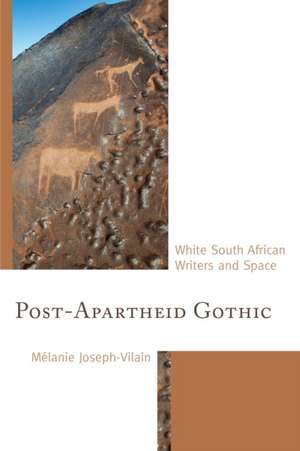
Post-Apartheid Gothic: White South African Writers and Space
Autor Mélanie Joseph-Vilainen Limba Engleză Hardback – 19 mar 2021
Preț: 584.03 lei
Preț vechi: 864.49 lei
-32%
Puncte Express: 876
Carte tipărită la comandă
Livrare economică 24 noiembrie-08 decembrie
Livrare prin curier în România Termenul estimat este afișat lângă disponibilitate.
Transport gratuit pentru acest produs Plată online sau ramburs, în funcție de opțiunile comenzii.
Retur gratuit în 14 zile Comandă securizată și suport în română.
Specificații
ISBN-13: 9781683932451
ISBN-10: 1683932455
Pagini: 318
Dimensiuni: 163 x 227 x 26 mm
Greutate: 0.56 kg
Editura: Bloomsbury Publishing
Colecția Fairleigh Dickinson University Press
Locul publicării:New York, United States
ISBN-10: 1683932455
Pagini: 318
Dimensiuni: 163 x 227 x 26 mm
Greutate: 0.56 kg
Editura: Bloomsbury Publishing
Colecția Fairleigh Dickinson University Press
Locul publicării:New York, United States
Cuprins
Chapter 1. The Sense of Place
Chapter 2. Unhomely homes
Chapter 3. Landscapes
Chapter 4. Cities: South African "Urban Gothic"
Chapter 5. Non-places
Chapter 2. Unhomely homes
Chapter 3. Landscapes
Chapter 4. Cities: South African "Urban Gothic"
Chapter 5. Non-places
Recenzii
The Gothic genre has become extremely popular in South Africa since apartheid. Joseph-Vilai maintains that the eerie and disturbing qualities of Gothic writing express the anxieties of a troubled society, and she makes a strong case... Especially interesting is the author's discussion of the Gothic transformation of a keystone of South African white writing, the "farm novel." The last and most original chapter, "Non-Places," looks at science fiction and dystopian writing. Joseph-Vilain concedes that she is not a South African, but points out that an outsider can have special insights. She interrogates the explosively problematic term "white" with insight, and she skillfully balances theory and close reading. Including an extensive bibliography, helpful notes, and a thorough index, this will be an useful resource for those interested in South African writing. Recommended for upper-division undergraduates through faculty.
This is a most timely and elucidating work, lucid in exposition and wide ranging in its target texts as well as its theoretical underpinning. The book reads informatively even to somebody not in the first instance engaged by the Gothic as a genre or temper, and, as I have attempted to highlight, its wider import is in the critical study and exposition of South African landscapes. It is up to date, introduces the reader to contemporary white and English (and, obliquely, Afrikaans) authors. It grows out of the pioneering White Writing (1988) of Coetzee, without falling into its shadow. And its author makes a persuasive and closely argued case for the impress of the
Gothic upon recent literary production in South Africa.
A welcome contribution to the scholarship devoted to South African literary studies, Post-Apartheid Gothic shows how a postcolonial dialogue with the Gothic in the new "Rainbow Nation" proves extremely suggestive. The emergence of this new literary form, which Joseph-Vilain labels "post-apartheid gothic," brings her study into dialogue with contemporary investigations on the Gothic as a "global" mode capable of traveling through time and space and of adapting to different cultures. At the same time, it reflects particular, local preoccupations in South Africa, responding to the need felt by white writers for coming to terms with an outrageous history of oppression and redefining a new, problematic subjectivity. [The] book succeeds in emphasizing how white anxieties are staged through a broadening of textual boundaries and a radical experimentation in generic practice, using Gothic motifs to creatively map both physical and psychological territories.
This is a most timely and elucidating work, lucid in exposition and wide ranging in its target texts as well as its theoretical underpinning. The book reads informatively even to somebody not in the first instance engaged by the Gothic as a genre or temper, and, as I have attempted to highlight, its wider import is in the critical study and exposition of South African landscapes. It is up to date, introduces the reader to contemporary white and English (and, obliquely, Afrikaans) authors. It grows out of the pioneering White Writing (1988) of Coetzee, without falling into its shadow. And its author makes a persuasive and closely argued case for the impress of the
Gothic upon recent literary production in South Africa.
A welcome contribution to the scholarship devoted to South African literary studies, Post-Apartheid Gothic shows how a postcolonial dialogue with the Gothic in the new "Rainbow Nation" proves extremely suggestive. The emergence of this new literary form, which Joseph-Vilain labels "post-apartheid gothic," brings her study into dialogue with contemporary investigations on the Gothic as a "global" mode capable of traveling through time and space and of adapting to different cultures. At the same time, it reflects particular, local preoccupations in South Africa, responding to the need felt by white writers for coming to terms with an outrageous history of oppression and redefining a new, problematic subjectivity. [The] book succeeds in emphasizing how white anxieties are staged through a broadening of textual boundaries and a radical experimentation in generic practice, using Gothic motifs to creatively map both physical and psychological territories.