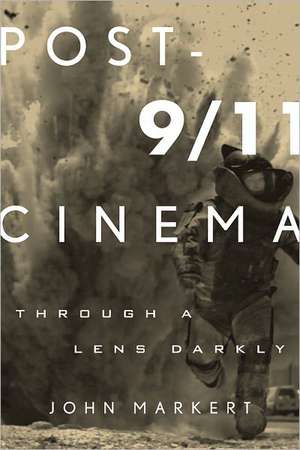
Post-9/11 Cinema: Through a Lens Darkly
Autor John Markerten Limba Engleză Hardback – 5 aug 2011
In Post-9/11 Cinema: Through a Lens Darkly, John Markert takes a close look at the films depicting these events. Covering cinematic portrayals of 9/11 and the attacks that followed, this book examines both dramas and documentaries that depict what some have termed "Bush's war," as well as rebuttal films, films about terrorist activities, and films seen from the vantage point of journalists and military personnel. Post-9/11 Cinema not only shows how motion pictures reflect societal values but also how such works can influence social attitudes and thus promote change. In addition, Markert appraises the film industry and critiques how images are manipulated to sway the viewer to appreciate the side being advocated.
Examining such dramas as The Messenger, Stop-Loss, The Lucky Ones, In the Valley of Elah, and The Hurt Locker, as well as documentaries including Fahrenheit 9/11, Soldiers of Conscience, and Taxi to the Dark Side, Post-9/11 Cinema is a valuable read for professors of media and mass communication, popular culture, and film studies, as well as cultural sociologists.
Preț: 485.43 lei
Preț vechi: 701.61 lei
-31%
Puncte Express: 728
Carte tipărită la comandă
Livrare economică 10-24 august
Livrare prin curier în România Termenul estimat este afișat lângă disponibilitate.
Transport gratuit pentru acest produs Plată online sau ramburs, în funcție de opțiunile comenzii.
Retur gratuit în 14 zile Comandă securizată și suport în română.
Specificații
ISBN-13: 9780810881341
ISBN-10: 0810881349
Pagini: 349
Ilustrații: black & white illustrations, black & white line drawings
Dimensiuni: 166 x 241 x 33 mm
Greutate: 0.73 kg
Editura: Bloomsbury Publishing
Colecția Scarecrow Press
Locul publicării:New York, United States
ISBN-10: 0810881349
Pagini: 349
Ilustrații: black & white illustrations, black & white line drawings
Dimensiuni: 166 x 241 x 33 mm
Greutate: 0.73 kg
Editura: Bloomsbury Publishing
Colecția Scarecrow Press
Locul publicării:New York, United States
Cuprins
Preface
Introduction
Chapter 1: Cinema Simplicity: Heroes and Villains
Chapter 2: The Cinematic Dialectic: Movies Begin to Debate the War(s)
Chapter 3: The Dialectic Rages On: Documentary Films 2006-2010
Chapter 4: Fictional Features Belatedly Appear
Chapter 5: Conclusion
Selected Bibliography
Index
About the Author
Introduction
Chapter 1: Cinema Simplicity: Heroes and Villains
Chapter 2: The Cinematic Dialectic: Movies Begin to Debate the War(s)
Chapter 3: The Dialectic Rages On: Documentary Films 2006-2010
Chapter 4: Fictional Features Belatedly Appear
Chapter 5: Conclusion
Selected Bibliography
Index
About the Author
Recenzii
Films can both reflect and shape social values. Markert (sociology, Cumberland Univ.) examines over 200 films depicting American concerns after the 9/11 attacks. In the first few years, films tended to focus on the attacks themselves and on America's enemies. By 2004, post 9/11 films-both dramatic and documentary-looked at the wars in Iraq and Afghanistan as well, and were more critical of American actions abroad and Bush administration policies. Working from his sociological approach, Markert also provides an overview of American films since World War II that have been related to issues of war and security. This volume does not focus specifically on the details of 9/11 itself, but will be of interest to readers interested in cultural, communication, or film studies.
Sociologist Markert (Cumberland Univ.) examines 210 feature-length films and documentaries depicting 9/11 and the subsequent military interventions in Afghanistan and Iraq. He divides these films into three categories: dealing with the enemy; depicting 9/11 events; and, the largest category, the war on the ground. Markert begins with a discussion of reflection/refraction theories exploring the extent to which film both mirrors and shapes societal values and attitudes. Next comes a dialectical film analysis focusing on three time periods: early post-9/11 films appearing between 2001 and 2004, which are primarily concerned with demonizing the enemy and commemorating the heroics of the victims and those rendering assistance; a transitional period between 2004 and 2005, when films began providing an alternative interpretation of the war; and finally, post-2006 films, of which the vast majority provide a darker, more critical, nuanced analysis of US involvement in Iraq and Afghanistan. While it is difficult to argue that films changed social attitudes, Markert demonstrates how films, especially documentaries, contributed to the public debate by maintaining interest and providing a dissenting perspective that eventually countered the war on terror and weapons of mass destruction rhetoric of the Bush administration. A welcome addition to mass media, film studies, and cultural sociology collections. Summing Up: Recommended. All levels/libraries.
Sociologist Markert (Cumberland Univ.) examines 210 feature-length films and documentaries depicting 9/11 and the subsequent military interventions in Afghanistan and Iraq. He divides these films into three categories: dealing with the enemy; depicting 9/11 events; and, the largest category, the war on the ground. Markert begins with a discussion of reflection/refraction theories exploring the extent to which film both mirrors and shapes societal values and attitudes. Next comes a dialectical film analysis focusing on three time periods: early post-9/11 films appearing between 2001 and 2004, which are primarily concerned with demonizing the enemy and commemorating the heroics of the victims and those rendering assistance; a transitional period between 2004 and 2005, when films began providing an alternative interpretation of the war; and finally, post-2006 films, of which the vast majority provide a darker, more critical, nuanced analysis of US involvement in Iraq and Afghanistan. While it is difficult to argue that films changed social attitudes, Markert demonstrates how films, especially documentaries, contributed to the public debate by maintaining interest and providing a dissenting perspective that eventually countered the war on terror and weapons of mass destruction rhetoric of the Bush administration. A welcome addition to mass media, film studies, and cultural sociology collections. Summing Up: Recommended. All levels/libraries.