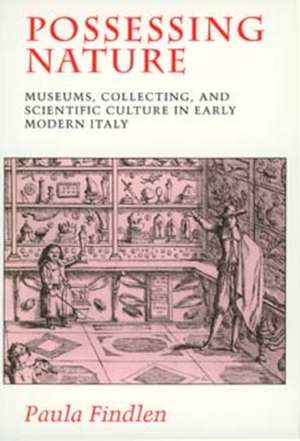
Possessing Nature: Studies on the History of Society and Culture
Autor Paula Findlenen Limba Engleză Paperback – 2 apr 1996
În cadrul programelor de studii dedicate muzeologiei și istoriei ideilor, Findlen, P: Possessing Nature ocupă un loc central, oferind o perspectivă nuanțată asupra modului în care s-au format primele instituții de cercetare a lumii naturale. Paula Findlen investighează momentul de cotitură din Italia anilor 1500-1700, când colecționarea de curiozități — de la fosile la specimene rare — a încetat să fie un simplu hobby nobiliar, devenind motorul unei noi culturi științifice. Remarcăm modul în care autoarea reconstruiește universul lui Ulisse Aldrovandi, a cărui colecție din Bologna a servit drept model pentru răspândirea acestui fenomen către ordinele religioase și societățile savante. Textul se distinge printr-o analiză riguroasă a relației dintre patronaj și producția de cunoaștere. Paula Findlen demonstrează că Revoluția Științifică nu a fost o rupere bruscă de trecut, ci un proces de mediere continuă între autoritatea textelor antice și rigoarea noilor observații empirice. Ediția revizuită de la University of California Press păstrează densitatea academică, fiind susținută de un aparat critic vast ce include jurnale de epocă și documente de arhivă. Acoperă aceeași arie tematică precum Cultures of Natural History de N. Jardine, dar cu o abordare mult mai focalizată pe spațiul italian și pe structurile sociale de putere care au facilitat apariția muzeelor. În timp ce alte lucrări, precum Museums de John E. Simmons, oferă o privire de ansamblu cronologică asupra instituției muzeale de la preistorie până în prezent, Possessing Nature preferă o scufundare profundă în mecanismele baroce ale cunoașterii, transformând studiul colecțiilor într-o istorie socială a inteligenței europene.
Preț: 250.32 lei
Carte disponibilă
Livrare economică 04-18 noiembrie
Livrare express 20-24 octombrie pentru 42.60 lei
Specificații
ISBN-10: 0520205081
Pagini: 449
Dimensiuni: 173 x 227 x 29 mm
Greutate: 0.65 kg
Ediția:Revised
Editura: University of California Press
Colecția Studies on the History of Society and Culture
Seria Studies on the History of Society and Culture
V-ar putea interesa
-
 -33%Preț: 782.65 lei1164.11 lei
 -
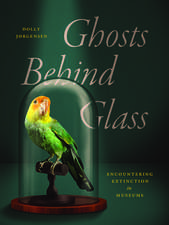 Ghosts Behind Glass: Encountering Extinction in MuseumsDolly JørgensenPreț: 124.04 lei
 -
 The New NaturalistsClaire BinghamPreț: 195.38 lei
 -
 Provenance and PossessionK. J. P. LowePreț: 326.35 lei
 -
 Collecting the WorldJames Delbourgo-27%Preț: 89.47 lei123.01 lei
 -
 Nature on Paper: Documenting Science in Prussia, 1770-1850Anne Greenwood Greenwood-19%Preț: 437.55 lei540.19 lei
 -
 A Cultural History of Objects in the RenaissanceJames Symonds-45%Preț: 138.25 lei250.50 lei
 -
 Forms of the VisiblePhilippe DescolaPreț: 290.51 lei
 -
 -31%Preț: 134.18 lei193.17 lei
 -
 -8%Preț: 440.70 lei479.02 lei
 -
 Preț: 175.25 lei
 -
 Treasured Possessions: From the Renaissance to the EnlightenmentDr Melissa CalaresuPreț: 310.24 lei
 -
 -18%Preț: 77.70 lei94.51 lei
 -
 Plunder?: How Museums Got Their TreasuresJustin M. JacobsPreț: 77.56 lei
 -
 -25%Preț: 175.98 lei233.12 lei
 -
 The Endurance of ThingsMartin GrayPreț: 143.80 lei
 -
 Massimo ListriAntonio Paolucci-18%Preț: 1097.24 lei1338.09 lei
 -
 Massimo Listri. Cabinet of Curiosities. 40th Ed.Antonio PaolucciPreț: 201.56 lei
 -
 From Fascination to Folly: A Troubled History of Collecting since the 1600sCharles MerewetherPreț: 283.78 lei
De ce să citești această carte
Această lucrare este esențială pentru studenții și specialiștii în muzeologie care doresc să înțeleagă rădăcinile politice și sociale ale instituțiilor de profil. Cititorul câștigă o viziune clară asupra modului în care „cabinetele de curiozități” au prefigurat laboratoarele moderne, demontând mitul unei științe izolate de societate. Este o resursă academică de referință despre modul în care posesia obiectelor naturale a devenit o formă de putere intelectuală.