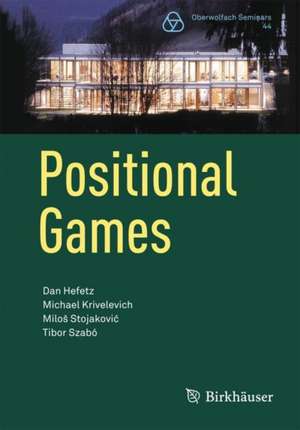
Positional Games: Oberwolfach Seminars, cartea 44
Autor Dan Hefetz, Michael Krivelevich, Miloš Stojaković, Tibor Szabóen Limba Engleză Paperback – 3 iul 2014
În cadrul programelor de studii masterale și doctorale dedicate matematicii discrete, studiul jocurilor poziționale a devenit o componentă esențială a combinatoricii moderne. Positional Games reprezintă o sinteză riguroasă a cursului susținut de autori la renumitul institut Oberwolfach, oferind un fundament teoretic solid pentru jocurile de informație completă. Ne-a atras atenția modul în care autorii reușesc să transforme mecanisme simple, precum cele din X și Zero sau Hex, în probleme matematice complexe jucate pe hipergrafuri.
Subliniem structura progresivă a lucrării, care pornește de la jocurile de tip Maker-Breaker și Biased Games, avansând spre concepte avansate precum jocurile Avoider-Enforcer și ipoteza vecinătății (Neighborhood Conjecture). Relevanța pentru curriculum este susținută de capitolele dedicate jocurilor de conectivitate și hamiltonicitate, care fac puntea între teoria jocurilor și teoria grafurilor extremale. Sub aspectul metodologiei, textul integrează metodele probabilistice, o temă pe care Michael Krivelevich a explorat-o și în lucrarea sa Random Graphs, Geometry and Asymptotic Structure, însă aici accentul cade pe structurile de joc pe table aleatorii.
Comparativ cu Combinatorial Games de József Beck, care utilizează „metoda probabilistică falsă” pentru a gestiona haosul combinatorial, volumul de față adoptă o abordare mai didactică și mai aplicată pe structuri specifice de grafuri. De asemenea, în timp ce Lessons in Play de Michael Albert se concentrează pe o introducere generală în jocurile combinatoriale, Positional Games este mai tehnic, fiind calibrat special pentru cercetătorii care doresc să stăpânească ultimele dezvoltări din domeniu. Prezența exercițiilor la finalul fiecărui capitol transformă aceste note de curs într-un instrument de lucru activ pentru seminar.
Din seria Oberwolfach Seminars
-
 Preț: 353.89 lei
 -
 Preț: 264.39 lei
 -
 Preț: 435.65 lei
 -
 Preț: 364.92 lei
 -
 Preț: 466.90 lei
 -
 Preț: 467.94 lei
 -
 Preț: 371.00 lei
 -
 Preț: 365.65 lei
 -
 Preț: 303.32 lei
 - 15%
 Preț: 557.03 lei
 -
 Preț: 341.60 lei
 -
 Preț: 365.45 lei
 -
 Preț: 343.11 lei
 -
 Preț: 367.12 lei
 -
 Preț: 381.72 lei
 -
 Preț: 362.23 lei
 -
 Preț: 461.56 lei
 -
 Preț: 311.81 lei
 -
 Preț: 335.40 lei
 -
 Preț: 496.53 lei
 -
 Preț: 419.17 lei
 -
 Preț: 418.11 lei
 -
 Preț: 355.33 lei
 - 19%
 Preț: 530.94 lei
 - 19%
 Preț: 445.45 lei
 -
 Preț: 364.71 lei
 -
 Preț: 229.70 lei
 -
 Preț: 281.52 lei
Preț: 247.44 lei
Carte disponibilă
Livrare economică 09-23 noiembrie
Specificații
ISBN-10: 3034808240
Pagini: 146
Ilustrații: X, 146 p. 13 illus., 8 illus. in color.
Dimensiuni: 168 x 240 x 12 mm
Greutate: 0.32 kg
Ediția:2014
Editura: Springer
Colecția Birkhäuser
Seria Oberwolfach Seminars
Locul publicării:Basel, Switzerland
V-ar putea interesa
-
 Around the World in 80 GamesMarcus Du SautoyPreț: 80.65 lei
 -
 Preț: 91.19 lei
 -
 Problem Solving Through Recreational MathematicsBonnie Averbach-35%Preț: 99.48 lei152.18 lei
 -
 A First Course in Graph TheoryGary Chartrand-24%Preț: 147.14 lei192.83 lei
 -
 Introductory Discrete MathematicsV. K. Balakrishnan-18%Preț: 100.50 lei122.92 lei
 -
 The ScoreC. Thi NguyenPreț: 194.17 lei
 -
 The Mathematics of Various Entertaining SubjectsJennifer BeinekePreț: 463.16 lei
 -
 Primer In Game Theory, ARobert Gibbons-9%Preț: 614.32 lei675.08 lei
 -
 -17%Preț: 89.02 lei107.71 lei
 -
 Preț: 227.87 leiRecomandat
 -
 Preț: 450.76 lei
 -
 The Discrete Mathematical Charms of Paul ErdosVasek ChvátalPreț: 237.66 lei
 -
 Games, Strategies, and Decision MakingJoseph Harrington-40%Preț: 535.43 lei890.43 lei
 -
 Winning Ways for Your Mathematical Plays: Volume 1Elwyn R. Berlekamp-11%Preț: 616.27 lei692.44 lei
 -
 Winning Ways for Your Mathematical Plays, Volume 2Elwyn R. Berlekamp-8%Preț: 552.87 lei600.94 lei
 -
 Hadfield, J: Intermediate Communication Games 2.0Jill HadfieldPreț: 353.05 lei
 -
 Graph TheoryRalucca GeraPreț: 536.31 lei
 -
 Geometry, Structure and Randomness in CombinatoricsJi& MatousekPreț: 280.82 lei
 -
 -14%Preț: 695.28 lei808.47 lei
Public țintă
GraduateDe ce să citești această carte
Recomandăm această carte studenților gradați care doresc să aprofundeze intersecția dintre combinatorică și teoria jocurilor. Cititorul câștigă o înțelegere sistematică a strategiilor de câștig în jocuri de informație completă, beneficiind de expertiza unor lideri în domeniu. Este un titlu esențial pentru cei care urmăresc să aplice metodele probabilistice și teoria grafurilor în contexte computaționale și strategice.
Despre autor
Echipa de autori reunește experți de calibru internațional în matematică discretă. Michael Krivelevich este o figură centrală în teoria grafurilor aleatorii, activitatea sa fiind strâns legată de dezvoltarea metodelor probabilistice în combinatorică. Dan Hefetz, Miloš Stojaković și Tibor Szabó sunt cercetători activi cu contribuții semnificative în jocurile poziționale și structurile extremale. Colaborarea lor pentru acest volum din seria Oberwolfach Seminars reflectă o abordare unitară și actualizată a domeniului, extrasă direct din mediul de cercetare de elită al institutului german.