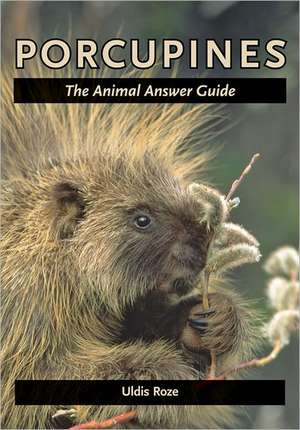
Porcupines
Autor Uldis Rozeen Limba Engleză Hardback – dec 2012
- Porcupines survive on a diet of leaves, bark, and fruit
- Quills are actually modified hairs
- There are 26 species of porcupines (and counting)
- Old World and New World porcupines have a common ancestor but evolved independently
- New World males will gather to fight ferociously over a single female
Porcupines: The Animal Answer Guide presents solid, current science in the field of porcupine biology. Uldis Roze compares and contrasts porcupines in terms of body plan, behavior, ecology, reproduction, and evolutionary relationships. He examines the diversity of porcupines from around the world--from North and South America to Africa and Asia.
This guide explores the interactions between humans and porcupines, including hunting, use of quills by aboriginal societies, efforts to poison porcupines, and human and pet injuries (and deaths) caused by porcupines. Roze also highlights the conservation issues that surround some porcupine species, such as the thin-spine porcupine of Brazil, which is so rare that it was thought to be extinct until its rediscovery in the 1980s.
Preț: 280.77 lei
Preț vechi: 338.05 lei
-17%
Puncte Express: 421
Carte indisponibilă temporar
Doresc să fiu notificat când acest titlu va fi disponibil:
Se trimite...
Specificații
ISBN-13: 9781421407357
ISBN-10: 1421407353
Pagini: 240
Dimensiuni: 185 x 254 x 23 mm
Greutate: 0.7 kg
Ediția:New.
Editura: Johns Hopkins University Press
ISBN-10: 1421407353
Pagini: 240
Dimensiuni: 185 x 254 x 23 mm
Greutate: 0.7 kg
Ediția:New.
Editura: Johns Hopkins University Press
Descriere
Roze highlights the conservation issues that surround some porcupine species, such as the thin-spine porcupine of Brazil, which is so rare that it was thought to be extinct until its rediscovery in the 1980s.