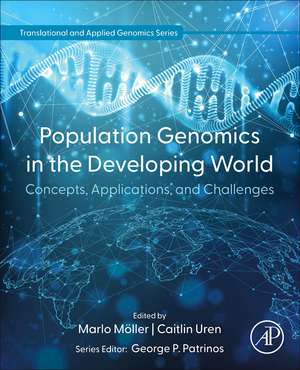
Population Genomics in the Developing World: Concepts, Applications, and Challenges: Translational and Applied Genomics
Editat de Marlo Möller, Caitlin Uren George P. Patrinosen Limba Engleză Paperback – 15 noi 2024
- Addresses the unique opportunities to positively impact global health by practicing population genomics in developing countries
- Features applied case studies from genomic research in various developing nations, with clear instruction in research rationale, methods, tools, materials used, analysis, and outcomes
- Features international chapter authors and population genomics experts practicing in South Africa, Gabon, India, South America, Central America, and Honduras, among other locations

Preț: 689.05 lei
Preț vechi: 927.63 lei
-26%
Puncte Express: 1034
Carte tipărită la comandă
Livrare economică 19 noiembrie-03 decembrie
Livrare prin curier în România Termenul estimat este afișat lângă disponibilitate.
Transport gratuit pentru acest produs Plată online sau ramburs, în funcție de opțiunile comenzii.
Retur gratuit în 14 zile Comandă securizată și suport în română.
Specificații
ISBN-13: 9780443185465
ISBN-10: 0443185468
Pagini: 224
Dimensiuni: 191 x 235 mm
Greutate: 0.39 kg
Editura: ELSEVIER SCIENCE
Seria Translational and Applied Genomics
ISBN-10: 0443185468
Pagini: 224
Dimensiuni: 191 x 235 mm
Greutate: 0.39 kg
Editura: ELSEVIER SCIENCE
Seria Translational and Applied Genomics
Cuprins
1. Population genomics - The fundamentals
2. Why focus on population genomics in developing countries?
3. Contribution of large consortia studies to population genomics in the developing world: Examples from Africa and South Asia
4. Implementing genomics research in developing countries: Common challenges, and emerging solutions
5. Next-generation sequencing technologies: Implementation in developing countries
6. Computational disease-risk prediction: Tools and statistical approaches
7. Genotype versus phenotype versus environment
8. Implementing population pharmacogenomics: Tailoring drug therapy for diverse populations
9. Direct-to-consumer (DTC) genetic testing and the population genomics industry
10. Clinical translation of genomics research in Africa - Mainstreaming medical ethics, equity, genetics education, and public engagement
11. The future of population genomics in developing countries
2. Why focus on population genomics in developing countries?
3. Contribution of large consortia studies to population genomics in the developing world: Examples from Africa and South Asia
4. Implementing genomics research in developing countries: Common challenges, and emerging solutions
5. Next-generation sequencing technologies: Implementation in developing countries
6. Computational disease-risk prediction: Tools and statistical approaches
7. Genotype versus phenotype versus environment
8. Implementing population pharmacogenomics: Tailoring drug therapy for diverse populations
9. Direct-to-consumer (DTC) genetic testing and the population genomics industry
10. Clinical translation of genomics research in Africa - Mainstreaming medical ethics, equity, genetics education, and public engagement
11. The future of population genomics in developing countries
Recenzii
"...addresses that topic head-on, delving into strategies, methods and results of population genomic studies in the developing world. [Its] purpose is to introduce researchers and clinicians to population genomics in the developing world. Through discussions of the current state of the field and outlining the skills and approaches necessary for these studies, the book aims to illustrate the challenges and opportunities of population studies in developing countries. In addition, it seeks to address the need for a broader perspective in population genomics.... [It] is extraordinarily successful in providing the information and practical knowledge needed for work by the intended audience in the developing world,... benefits from clear writing and from the practical experience of the authors in the matters they discuss.... an excellent place for those interested in this aspect of the field to get their start, recommend[ed] to those interested in a more complete understanding of the origins, evolution, and composition of the human genome." ©Doody's Review Service, 2025, Mark Sanders, PhD (UC Davis College of Biological Sciences)