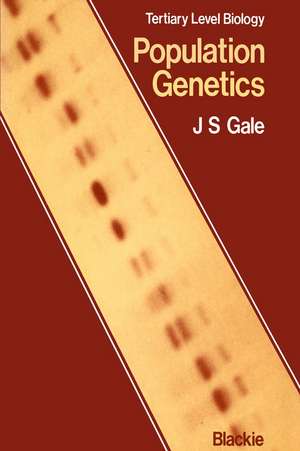
Population Genetics: Developments Series
Autor J. S. Galeen Limba Engleză Paperback – 16 apr 2013
Preț: 370.22 lei
Puncte Express: 555
Carte tipărită la comandă
Livrare economică 28 noiembrie-12 decembrie
Livrare prin curier în România Termenul estimat este afișat lângă disponibilitate.
Transport gratuit de la 400.00 lei Plată online sau ramburs, în funcție de opțiunile comenzii.
Retur gratuit în 14 zile Comandă securizată și suport în română.
Specificații
ISBN-13: 9781461339267
ISBN-10: 146133926X
Pagini: 204
Ilustrații: X, 189 p.
Dimensiuni: 152 x 229 x 12 mm
Greutate: 0.3 kg
Ediția:Softcover reprint of the original 1st ed. 1980
Editura: Springer
Colecția Developments Series
Seria Developments Series
Locul publicării:New York, NY, United States
ISBN-10: 146133926X
Pagini: 204
Ilustrații: X, 189 p.
Dimensiuni: 152 x 229 x 12 mm
Greutate: 0.3 kg
Ediția:Softcover reprint of the original 1st ed. 1980
Editura: Springer
Colecția Developments Series
Seria Developments Series
Locul publicării:New York, NY, United States
V-ar putea interesa
-
 MutantsArmand Marie LeroiPreț: 108.48 lei
 -
 Schaum's Easy Outline of GeneticsWilliam Stansfield-13%Preț: 88.89 lei102.32 lei
 -
 -39%Preț: 502.06 lei818.40 lei
 -
 Y: The Descent Of MenProfessor Steve Jones-27%Preț: 67.74 lei92.76 lei
 -
 Endless Forms Most Beautiful: The New Science of Evo DevoSean B. CarrollPreț: 104.76 lei
 -
 Analysis of Genes and GenomesRichard J Reece-8%Preț: 439.13 lei477.31 lei
 -
 Essential BioinformaticsJin Xiong-19%Preț: 627.94 lei775.24 lei
 -
 Genomes, Browsers and DatabasesPeter SchattnerPreț: 402.08 lei
 -
 The Phylogenetic HandbookPhilippe Lemey-11%Preț: 518.87 lei583.01 lei
 -
 Introduction to Quantitative GeneticsDouglas S. Falconer-13%Preț: 562.74 lei646.82 lei
 -
 BLASTIan KorfPreț: 289.01 lei
 -
 Robustness and Evolvability in Living SystemsAndreas Wagner-19%Preț: 485.72 lei599.67 lei
Public țintă
ResearchCuprins
1. Introduction.- Natural selection.- Problems studied by population geneticists.- Approaches to our problems.- The Mendelian population.- Factors affecting the genetic composition of populations.- Summary.- 2. Selfing.- Inbreeding.- Inbreeding depression.- Difficulties in allowing for natural selection during inbreeding.- Species inbreeding to some extent in nature.- Effect of selling on genotype frequencies at a single locus.- Information needed to discuss the effect of inbreeding on the entire genotype.- The start (generation 0).- A later stage (generation n).- Proportion of lines completely homozygous at a late stage.- To determine the average number of tracts in a given generation.- To determine the average number of heterozygous ends.- To determine the average number of external junctions.- Proportion of lines homozygous at all loci.- An illustrative example.- Total length heterozygous.- Summary.- 3. Random Genetic Drift.- On the word “probability”.- Intuitive notions on the effects of drift.- Probability distribution of allele frequency.- Mean allele frequency: mean frequency of heterozygotes.- Extreme versus intermediate allele frequencies.- Circumstances under which drift may be ignored.- Long-term effects of drift.- Variable fertilities Variable population size.- Summary.- 4. Survival and Fixation of Advantageous Mutants.- Factors affecting the chance of fixation.- Genic selection. Mean and variance of the change in allele frequency.- The probability of fixation: Kimura’s formula.- Accuracy of Kimura’s formula.- The probability of fixation: some conclusions.- Initial frequency larger than 1/(2N).- Variable population size (initial frequency 1/(2N)).- Dominance in fitness.- Summary.- 5. What is the role of Drift in Evolution? I. MorphologicalCharacters.- The problem.- Harmful mutants.- Obviously adaptive characters.- “Minor” morphological variants.- Chromosomal inversions in Drosophila pseudoobscura.- Colour and banding in Cepaea nemoralis.- Sternopleural chaetae in Drosophila melanogaster.- Wing colour in Panaxia dominula.- Conclusions on morphological characters.- 6. What is the role of Drift in Evolution? II. Protein Variation.- Protein polymorphism.- Rate of nucleotide substitution: theory Rate of nucleotide substitution in practice.- A different approach Allele frequencies in geographically distant areas.- Effect of migration.- Frequency of heterozygotes.- Testing the neutral theory from frequency data: summary.- Experimental approach.- Experiments involving several loci.- Predicting selective response from biochemical studies.- Tentative conclusions.- Summary.- 7. Hitch-Hiking Effect of a Favourable Gene.- The hitch-hiking effect defined.- Effect of recombination.- The setup most favourable for hitch-hiking.- Some other situations leading to hitch-hiking.- Summary.- 8 Changes of Allele Frequency Under Natural Selection in Large Random Mating Populations.- Conditions under which the problem can be simplified.- Genic selection.- Wright’s formula.- Change in allele frequency per generation (mild selection).- Time required for a given change Allowance for drift.- Industrial melanism.- Summary.- 9. Evolution of Dominance.- Modifiers of dominance.- Disadvantageous mutants.- Advantageous mutants.- Balanced polymorphism.- Metrical characters.- Summary.- 10. Polymorphism.- Frequency of polymorphism.- Some possible explanations for polymorphism.- Heterozygous advantage: theory.- Sickle-cell anaemia.- Is heterozygous advantage common?.- Variable selective advantage: formal theory.- Measuring selectiveadvantage: formal approach.- The ecological genetic approach.- Inversions in Drosophila pseudoobscura.- Batesian mimicry in butterflies.- Final comments.- Summary.- 11. Evolution of Altruism.- Altruistic behaviour.- Kin selection.- Social insects.- Group selection.- Summary.- 12. Summary. Some Tentative Conclusions.- Appendix 1. A Misapplication of the Hardy-Weinberg Law.- If genotype frequencies do not obey the Hardy-Weinberg law what can we conclude?.- Problem.- Solution.- General comment.- Appendix 2. Some Points in Statistics.- Probability.- Mean and variance.- Probability distributions.- Binomial distribution.- Poisson distribution.- Poisson approximation to binomial distribution.- Continuous distributions.- Normal distribution.- Normal approximation to binomial distribution.- A note on chapter 3.- Some mathematical points.- Suggestions for Further Reading.