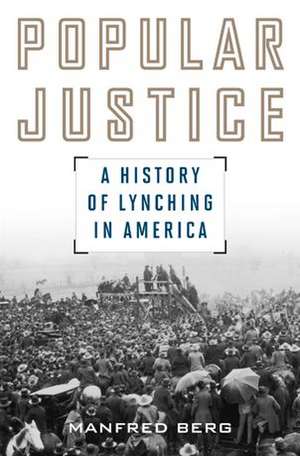
Popular Justice: A History of Lynching in America
Autor Manfred Bergen Limba Engleză Paperback – 4 mar 2015
In Popular Justice, Manfred Berg explores the history of lynching from the colonial era to the present. American lynch law, he argues, has rested on three pillars: the frontier experience, racism, and the anti-authoritarian spirit of grassroots democracy. Berg looks beyond the familiar story of mob violence against African American victims, who comprised the majority of lynch targets, to include violence targeting other victim groups, such as Mexicans and the Chinese, as well as many of those cases in which race did not play a role. As he nears the modern era, he focuses on the societal changes that ended lynching as a public spectacle.
Berg's narrative concludes with an examination of lynching's legacy in American culture. From the colonial era and the American Revolution up to the twenty-first century, lynching has been a part of our nation's history. Manfred Berg provides us with the first comprehensive overview of "popular justice."
Preț: 170.78 lei
Preț vechi: 231.60 lei
-26%
Puncte Express: 256
Carte tipărită la comandă
Livrare economică 08-22 iunie
Specificații
ISBN-13: 9781442245983
ISBN-10: 1442245980
Pagini: 232
Ilustrații: illustrations
Dimensiuni: 145 x 223 x 17 mm
Greutate: 0.34 kg
Editura: Bloomsbury Publishing
Colecția Rowman & Littlefield
Locul publicării:New York, United States
ISBN-10: 1442245980
Pagini: 232
Ilustrații: illustrations
Dimensiuni: 145 x 223 x 17 mm
Greutate: 0.34 kg
Editura: Bloomsbury Publishing
Colecția Rowman & Littlefield
Locul publicării:New York, United States
Cuprins
Chapter 1: The Roots of Lynching in Colonial and Revolutionary North America
Chapter 2: The Rising Tide of Lynch-Law in Antebellum America
Chapter 3: Frontier Justice
Chapter 4: Lynching, Riots, and Political Terror in the Civil War Era
Chapter 5: "Indescribable Barbarism": The Lynching of African Americans in the Age of Jim Crow
Chapter 6: Popular Justice Beyond Black and White
Chapter 7: The Struggle Against Lynching
Chapter 8: From Lynching to Hate Crime
Conclusion: Lynching in American Memory and Culture
Chapter 2: The Rising Tide of Lynch-Law in Antebellum America
Chapter 3: Frontier Justice
Chapter 4: Lynching, Riots, and Political Terror in the Civil War Era
Chapter 5: "Indescribable Barbarism": The Lynching of African Americans in the Age of Jim Crow
Chapter 6: Popular Justice Beyond Black and White
Chapter 7: The Struggle Against Lynching
Chapter 8: From Lynching to Hate Crime
Conclusion: Lynching in American Memory and Culture
Recenzii
Berg traces lynching's U.S. history, starting with the Colonial era and coming to the present, addressing the characteristics of this brutal punishment undertaken by 'ordinary' people.
Even the ancient Greeks saw the danger that democracy and other forms of popular government could degenerate into mob rule. In this thought-provoking and disturbing history of lynching from colonial times to the present, Berg, a history professor at the University of Heidelberg, draws a clear connection between lynching and a perversion of democratic impulses. Berg views racism as a fundamental component of many lynchings, particularly after the Civil War, when many white southerners rejected the authority of various Reconstructionist state and local governments. African Americans were the most frequent victims, but other racial and ethnic minorities were often targets. Obviously, simple mob blood-lust plays a role, but at a deeper level, Berg asserts that the perpetrators of lynchings often see themselves as antiauthoritarian avengers, representing the popular will and standing in opposition to an 'illegitimate' state power that cannot be trusted to act swiftly or justly. This is a well-written examination of the history and psychology of this particular form of mob violence.
Popular Justice explores lynching from the colonial period to the present, closing with emphasis on the societal changes that contributed to the demise of extralegal violence....Recommended.
Popular Justice is a long overdue overview of the history of mob violence in American history. [Manfred Berg's] impressive study chronicles not only the deservedly well known history of extralegal violence against black victims but also the less familiar collective violence that targeting whites, Mexicans, Native Americans, and the Chinese. Berg's survey simultaneously engages in a thought-provoking discussion of critical issues in lynching scholarship while also providing an accessible summary of the history of mob violence in the United States.
Manfred Berg's Popular Justice is a landmark contribution to the literature on American violence. This deeply researched, cogently argued book is the first modern single volume scholarly study of the practice of lynching in American history. Encompassing within its analysis all key dimensions of the historical development of mob violence in the United States, Popular Justice will be of great aid to all interested in the history of American lynching.
To the terrible tragedy of mob violence Manfred Berg brings vivid detail and narrative, capturing the sweep of violence across all regions and every ethnic group, a comprehensive account.
Manfred Berg has written the most comprehensive overview to date on the history of mob violence in the United States. Popular Justice provides an intelligent synthesis of the extensive scholarship on lynching that is perfect for classroom use.
Comprehensive yet concise, this is a superb history of lynching from its colonial origins to contemporary hate crimes. While giving due emphasis to white violence against African Americans, Berg conclusively demonstrates that mob violence afflicted other racial and ethnic minorities, not only in the South but across the entire nation.
Even the ancient Greeks saw the danger that democracy and other forms of popular government could degenerate into mob rule. In this thought-provoking and disturbing history of lynching from colonial times to the present, Berg, a history professor at the University of Heidelberg, draws a clear connection between lynching and a perversion of democratic impulses. Berg views racism as a fundamental component of many lynchings, particularly after the Civil War, when many white southerners rejected the authority of various Reconstructionist state and local governments. African Americans were the most frequent victims, but other racial and ethnic minorities were often targets. Obviously, simple mob blood-lust plays a role, but at a deeper level, Berg asserts that the perpetrators of lynchings often see themselves as antiauthoritarian avengers, representing the popular will and standing in opposition to an 'illegitimate' state power that cannot be trusted to act swiftly or justly. This is a well-written examination of the history and psychology of this particular form of mob violence.
Popular Justice explores lynching from the colonial period to the present, closing with emphasis on the societal changes that contributed to the demise of extralegal violence....Recommended.
Popular Justice is a long overdue overview of the history of mob violence in American history. [Manfred Berg's] impressive study chronicles not only the deservedly well known history of extralegal violence against black victims but also the less familiar collective violence that targeting whites, Mexicans, Native Americans, and the Chinese. Berg's survey simultaneously engages in a thought-provoking discussion of critical issues in lynching scholarship while also providing an accessible summary of the history of mob violence in the United States.
Manfred Berg's Popular Justice is a landmark contribution to the literature on American violence. This deeply researched, cogently argued book is the first modern single volume scholarly study of the practice of lynching in American history. Encompassing within its analysis all key dimensions of the historical development of mob violence in the United States, Popular Justice will be of great aid to all interested in the history of American lynching.
To the terrible tragedy of mob violence Manfred Berg brings vivid detail and narrative, capturing the sweep of violence across all regions and every ethnic group, a comprehensive account.
Manfred Berg has written the most comprehensive overview to date on the history of mob violence in the United States. Popular Justice provides an intelligent synthesis of the extensive scholarship on lynching that is perfect for classroom use.
Comprehensive yet concise, this is a superb history of lynching from its colonial origins to contemporary hate crimes. While giving due emphasis to white violence against African Americans, Berg conclusively demonstrates that mob violence afflicted other racial and ethnic minorities, not only in the South but across the entire nation.