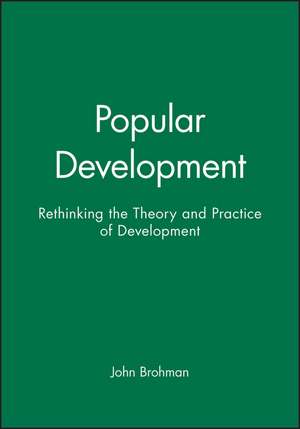
Popular Development
Autor Brohmanen Limba Engleză Paperback – 13 sep 1996
John Brohman then looks at alternative development theories and practices. He considers both their positive and negative aspects, and focuses on three critical areas: democratic participation and empowerment, women and gender, and environment and sustainability. He concludes by examining whether popular development - a strategy which rejects formal models - can succeed in providing an approach that will meet the needs and interests of people in diverse political, cultural and social conditions.
This book is important and timely. It integrates theoretical analysis with practical experience in a wide range of development contexts. Its argument is trenchant, its analysis clear, and its recommendations urgent. It is fully referenced, contains a guide to further reading, and has a comprehensive index.
Preț: 567.02 lei
Puncte Express: 851
Carte tipărită la comandă
Livrare economică 30 noiembrie-14 decembrie
Livrare prin curier în România Termenul estimat este afișat lângă disponibilitate.
Transport gratuit pentru acest produs Plată online sau ramburs, în funcție de opțiunile comenzii.
Retur gratuit în 14 zile Comandă securizată și suport în română.
Specificații
ISBN-13: 9781557863164
ISBN-10: 1557863164
Pagini: 412
Dimensiuni: 152 x 229 x 22 mm
Greutate: 0.59 kg
Editura: Blackwell Publishers
Locul publicării:Chichester, United Kingdom
ISBN-10: 1557863164
Pagini: 412
Dimensiuni: 152 x 229 x 22 mm
Greutate: 0.59 kg
Editura: Blackwell Publishers
Locul publicării:Chichester, United Kingdom
V-ar putea interesa
-
 Global Latin AmericaMatthew C. GutmannPreț: 282.08 lei
 -
 Preț: 267.80 lei
 -
 -19%Preț: 495.25 lei611.42 lei
 -
 Preț: 268.59 lei
 -
 Film Studies For DummiesJames CateridgePreț: 132.48 lei
 -
 Preț: 307.03 lei
 -
 Global Issues: An IntroductionKristen A. HitePreț: 421.07 lei
 -
 Readings in Planning Theory 4eJames DefilippisPreț: 298.66 lei
 -
 The Rules of DisorderPeter Marsh-18%Preț: 1112.48 lei1356.68 lei
 -
 Community LifeGraham Crow-18%Preț: 1364.38 lei1663.88 lei
 -
 Crime and Society: Readings in History and TheoryMike Fitzgerald-18%Preț: 1358.20 lei1656.34 lei
 -
 Preț: 445.02 lei
 -
 Showing Remorse: Law and the Social Control of EmotionRichard Weisman-15%Preț: 441.77 lei519.72 lei
 -
 Critical Journeys: The Making of AnthropologistsGeert De Neve-15%Preț: 447.37 lei526.33 lei
 -
 Nomadic and Indigenous Spaces: Productions and CognitionsJudith Miggelbrink-15%Preț: 434.24 lei510.88 lei
 -
 Bourdieusian ProspectsLisa Adkins-18%Preț: 1247.42 lei1521.24 lei
 -
 Boredom Studies Reader: Frameworks and PerspectivesMichael Gardiner-18%Preț: 1250.55 lei1525.06 lei
 -
 Consumer Culture and SocietyWendy Wiedenhoft Murphy-23%Preț: 655.32 lei851.07 lei
 -
 -20%Preț: 206.29 lei259.23 lei
Public țintă
students of development theory and planning in departments of sociology, economics, politics, geography and planningNotă biografică
John Brohman is Associate Professor of Geography and Latin American Studies at Simon Fraser University, British Columbia, Canada. His current research focuses on theories and strategies of Third World development. He has worked and traveled widely in all of the South's major regions, most recently in Latin America. During the 1980s he worked on the agrarian reform in Nicaragua and is presently involved in a rural development project there.
Cuprins
Acknowledgements. Abbreviations.
Introduction.
Part I: Mainstream Theories and Practices: .
1. The Postwar Tradition in Theory.
2. Strategies of Growth and Industrialization.
3. The Asian Newly Industrialized Countries.
4. The South (1): Neoliberal Policy and Strategy.
5. The South (2): The Neglect of Politics and People.
Part II: Alternative Theories and Practices:.
6. Refocusing on Needs.
7. New Concepts of Planning.
8. Participation and Power.
9. Women and Gender.
10. Environment and Sustainability.
11. Popular Development.
Further Reading.
References.
Index.
Introduction.
Part I: Mainstream Theories and Practices: .
1. The Postwar Tradition in Theory.
2. Strategies of Growth and Industrialization.
3. The Asian Newly Industrialized Countries.
4. The South (1): Neoliberal Policy and Strategy.
5. The South (2): The Neglect of Politics and People.
Part II: Alternative Theories and Practices:.
6. Refocusing on Needs.
7. New Concepts of Planning.
8. Participation and Power.
9. Women and Gender.
10. Environment and Sustainability.
11. Popular Development.
Further Reading.
References.
Index.
Descriere
This critical evaluation of development strategies examines development frameworks, and looks at their theoretical underpinnings and the results of their implementation in practice. It covers all the major regions, including Africa, Latin America and Asia.