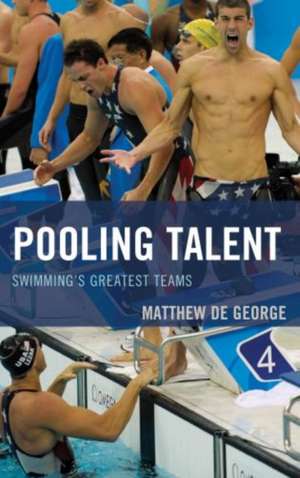
Pooling Talent: Swimming's Greatest Teams: Rowman & Littlefield Swimming Series
Autor Matthew De Georgeen Limba Engleză Hardback – 2 iul 2014
Subliniem cu interes o perspectivă inedită asupra unui sport adesea definit de efortul solitar: înotul de performanță. În Pooling Talent, Matthew De George demonstrează că succesul individual, chiar și în cazul unor nume legendare, este indisolubil legat de dinamica grupului. Organizarea volumului este riguroasă și progresivă: începe cu analiza tehnică a ștafetelor istorice, trece prin complexitatea loturilor naționale și culminează cu studiul programelor de elită care au modelat generații de campioni.
Notăm modul în care autorul disecă momente de tensiune maximă, cum a fost cursa de 400 de metri liber de la Beijing 2008, unde recordul absolut al lui Michael Phelps a depins critic de efortul colectiv al echipei. Fanii volumului The 100 Greatest Swimmers in History vor recunoaște aceeași atenție la detaliul biografic și statistic, însă aplicată aici nu doar individului, ci unității tactice a echipei. Dacă în lucrarea sa anterioară, Duels in the Pool, De George explora tensiunea rivalităților directe, aici el face trecerea către colaborare, investigând cum foști adversari își unesc forțele pentru gloria națională.
Structura tripartită — Ștafete, Loturi și Programe — oferă o acoperire istorică vastă, de la Jocurile Olimpice din 1924 până la succesele moderne. Este o analiză despre cum cultura de grup, exemplificată prin centre precum North Baltimore Aquatic Club, transformă talentul brut în excelență constantă. Ritmul narativ este susținut de cercetări extinse, transformând fiecare capitol într-o lecție despre psihologia succesului colectiv în bazinele lumii.


Preț: 487.06 lei
Preț vechi: 722.61 lei
-33%
Carte tipărită la comandă
Livrare economică 21 noiembrie-05 decembrie
Specificații
ISBN-10: 1442237015
Pagini: 297
Dimensiuni: 162 x 234 x 26 mm
Greutate: 0.58 kg
Editura: Bloomsbury Publishing
Colecția Rowman & Littlefield
Seria Rowman & Littlefield Swimming Series
Locul publicării:New York, United States
V-ar putea interesa
-
 Synchronized Swimming: An American HistoryDawn Pawson BeanPreț: 382.56 lei
 -
 Contested WatersJeff WiltsePreț: 245.78 lei
 -
 -37%Preț: 660.07 lei1054.06 lei
 -
 Duels in the Pool: Swimming’s Greatest RivalriesMatthew De George-33%Preț: 576.05 lei863.48 lei
 -
 Adults Guide to Better SwimmingKatie SmithPreț: 57.94 lei
 -
 Learning to Swim When You're ScaredKatie SmithPreț: 57.94 lei
 -
 How To FloatMark YoungPreț: 36.85 lei
 -
 Dad Learns to Swim: The Adventures of AlexMichael CaronPreț: 136.84 lei
 -
 More Than Swim LessonsChuck SlaghtPreț: 225.29 lei
 -
 Learn to SwimDon SchifferPreț: 103.67 lei
 -
 The Ultimate Guide to Swimming and Diving NutritionCorrea (Certified Sports Nutritionist)Preț: 122.61 lei
 -
 La Guida Completa All'alimentazione Nel Nuoto E Nell' Immersione SportivaCorrea (Nutrizionista Dello Sport CertifPreț: 139.86 lei
 -
 Swimming EssentialsEldin OnsgardPreț: 69.18 lei
 -
 The Swimming Parent's Guide to Improved Nutrition by Enhancing Your RmrCorrea (Certified Sports Nutritionist)Preț: 154.00 lei
 -
 Vegan Protein Swimming Smoothie RecipesMariana CorreaPreț: 117.67 lei
 -
 Essential SwimmerSteve TarpinianPreț: 87.33 lei
 -
 America's First Woman LawyerJane M. FriedmanPreț: 135.11 lei
 -
 -19%Preț: 314.19 lei388.82 lei
 -
 Challenge Workouts for Advanced SwimmersBlythe LuceroPreț: 94.18 lei
 -
 WobblesNadine NeumannPreț: 169.16 lei
De ce să citești această carte
Pentru antrenori, sportivi și pasionați de istorie olimpică, această carte oferă o înțelegere profundă a mecanismelor din spatele podiumului. Cititorul câștigă o perspectivă nouă asupra modului în care se construiește o cultură a victoriei, învățând că și în cele mai individualiste discipline, echipa rămâne motorul performanței record. Este un studiu esențial despre leadership și colaborare sub presiune.
Descriere
In Pooling Talent: Swimming's Greatest Teams, Matthew De George highlights the top relay teams, squads, and programs in the history of competitive swimming. Each chapter describes in detail the history surrounding the team, the crucial races, and the key swimmers. Part I examines relay teams-such as the 1976 U.S. Women's 400 Freestyle, the 2000 Australian Men's Freestyle, and the 2004 U.S. Men's Medley-showcasing how four opponents in the individual events can mesh seamlessly into a team. Part II explores the national squads, spanning from the 1924 U.S. Olympians to the 2001 World's Australians, revealing the interplay between team and individual success. In Part III, the top developmental programs around the world are featured, including the 1930 Japanese Men's program and the North Baltimore Aquatic Club. Together, the relay teams, squads, and programs provide constant motivation, pushing individuals to achieve much more than they ever could in isolation.
Extensively researched and rich in detail, Pooling Talent takes a novel look at swimming accomplishments old and new, casting the accolades of individuals in a fresh light. Fans, coaches, athletes, and researchers alike will find this a unique and refreshing history of swimming's greatest teams.
Cuprins
Introduction
I. Relays
1. 1976 U.S. Women's 400 Freestyle
2. 984 U.S. Men's 800 Freestyle
3. 2000 Australian Men's Freestyle
4. 2000 U.S. Women's Medley
5. 2004 U.S. Men's Medley
6. 2004 South Africa Men's 400 Freestyle
7. 2008 U.S. Men's 400 Freestyle
8. 2012 France Men's 400 Freestyle
II. Squads
9. 1924 U.S. Olympians
10. 1950s Hungarian Women's Olympians
11. 1968 U.S. Olympians
12. 1973 East German Women's World Championship
13. 1976 U.S. Men's Olympians
14. 1980 U.S. Olympians
15. 1992 Unified Olympians
16. 2001 Worlds Australians
III. Programs
17. 1930s Japanese Men
18. 1950s Australians
19. Indiana University Men
20. Mission Viejo Nadadores
21. Stanford University Women
22. University of Texas Men
23. North Baltimore Aquatic Club
24. U.S. Men's Backstroke
Index
About the Author
Recenzii
Pooling Talent: Swimming's Greatest Teams, by sports writer and author Matthew De George, examines relay teams, national squads, and top developmental programs and how these three levels of swimming impact the athletes involved. This highly readable book, part of Rowman & Littlefield's Swimming Series, can be used as a reference or read from cover to cover. Part one, Relays, has individual chapters on several winning teams, including the 1976 U.S. women's freestyle team, the 2000 Australian freestyle team, the 2004 U.S. men's medley team, the 2004 South African men's 400 freestyle team, and the 2012 French men's 400 freestyle team. The team stories are told within the context of Olympic history, national and international relationships, Cold War tensions, performance-enhancing drug use, and more. Part two focuses on different national squads and serves as a history of swimming development over the course of the twentieth century, starting with the 1925 U.S. Olympic swimmers, and discussing such teams and events as the 1950's Hungarian women's Olympians, the 1968 U.S. Olympians, the 1973 East German Women's World Championships, the 1976 men's Olympians, the 1980 U.S. Olympians (thwarted by the U.S. boycott of the games that year), the 1992 Unified Olympians, and the 2001 Australian World Championships. Part three focuses on the successful developmental programs that have produced some of the sport's leading talent, including the Stanford University women under the guidance of Coach Richard Quick, the 1930's Japanese men's team, and the Mission Viejo Nadadores.