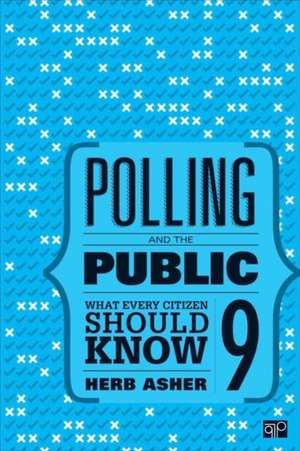
Polling and the Public
Autor Herbert Asheren Limba Engleză Paperback – 4 oct 2016
Cea de-a noua ediție a lucrării Polling and the Public reprezintă o actualizare necesară pentru a înțelege peisajul electoral contemporan, integrând date specifice din alegerile de la jumătatea mandatului din 2014. Subliniem că această revizuire pune un accent deosebit pe noile tehnologii de colectare a datelor, oferind analize extinse asupra sondajelor realizate pe platforme web și prin intermediul dispozitivelor smartphone, elemente care au redefinit viteza și accesibilitatea cercetării de piață politică. Reținem structura riguroasă a volumului, care ghidează cititorul de la importanța democratică a sondajelor până la aspectele tehnice ale eșantionării și erorii de măsurare. Primele capitole abordează problema critică a „non-atitudinilor” și modul în care formularea întrebărilor poate influența rezultatele, oferind instrumente practice pentru evaluarea validității unui sondaj. Comparabil cu The Voter's Guide to Election Polls de Michael W. Traugott în ceea ce privește rigoarea metodologică, textul lui Herbert Asher se distinge prin actualizarea constantă la noile realități digitale ale deceniului curent. În contextul operei autorului, lucrarea de față continuă preocuparea pentru precizia analitică regăsită și în Causal Modeling, însă Polling and the Public adoptă un ton mult mai accesibil, destinat formării „cetățeanului consumator de sondaje”. Progresia capitolelor este logică: după stabilirea fundamentelor teoretice, autorul trece la execuția practică — eșantionare, ponderare și tehnici de intervievare — încheind fiecare secțiune cu exerciții aplicate care transformă teoria în abilități critice de analiză politică.
Preț: 508.11 lei
Preț vechi: 627.31 lei
-19%
Carte disponibilă
Livrare economică 11-25 noiembrie
Livrare express 27-31 octombrie pentru 34.31 lei
Specificații
ISBN-10: 1506352421
Pagini: 360
Dimensiuni: 229 x 206 x 18 mm
Greutate: 0.49 kg
Ediția:9 Revised edition
Editura: Sage Publications, Inc
Locul publicării:Washington DC, United States
De ce să citești această carte
Această ediție este esențială pentru studenții la științe politice și sociologie care doresc să înțeleagă mecanismele din spatele cifrelor electorale. Cititorul câștigă capacitatea de a distinge între un sondaj riguros și unul eronat, învățând să identifice capcanele formulării întrebărilor și ale eșantionării deficitare. Este o resursă clară, fără jargon, care demistifică utilizarea sondajelor în campaniile moderne, inclusiv cele pe mobil.
Despre autor
Herbert Asher este profesor emerit de științe politice la The Ohio State University și consilier al președintelui universității. Cu o pregătire academică solidă, deținând un doctorat în științe politice de la University of Michigan, Asher a fost director fondator al John Glenn Institute for Public Service and Public Policy. Expertiza sa este frecvent solicitată de instituțiile media naționale și locale pentru analize politice de profunzime. În lucrările sale, acesta reușește să combine rigoarea matematică cu analiza comportamentului politic, fiind un mentor recunoscut pentru numeroase organizații studențești.
Descriere scurtă
Recenzii
“I’ve used Polling and the Public for several years in my courses. The book is pitched perfectly for the undergraduate reader: the concepts are clearly explained, the examples are memorable, and the comics engage students’ interest. As a political science professor, I also appreciate the way in which Asher addresses how polling fits into bigger questions about democracy.”
“Polling the Public is enjoyable to read and quite accessible. Students don’t need to have a course in statistics to understand the material, which makes it particularly useful for those with varied academic backgrounds. Polling the Public is perfect for students who are interested in learning about all aspects of polling, from sampling to the interpretation of results. They will also benefit from the book's excellent discussions of the critical benefits and drawbacks of polling as a way of measuring public opinion. The book is well written and uses current and attention-grabbing examples.”
"Polling and the Public is essential reading for any course on public opinion or survey research methods. My students have found Asher's lively writing style to be an engaging introduction to complex ideas, from survey sampling to the nature and measurement of attitudes. And just as important for the study of politics, Asher introduces students to broader theories about the place of polling within democratic governing institutions. Asher covers the art and science of polling, while providing students with a foundation of knowledge to understand current controversies in public opinion research."
“Polling the Public brings a wonderful sense of humor that would incite my students to talk about it during their next class period. It is very straightforward in manner, not reliant on jargon, and accessible to undergraduates and grad students who haven’t had many classes in public opinion. This book’s straightforward approach is useful to instructors by providing a thorough introduction to the complexities and nuances of the field.”
Cuprins
Chapter 1: Polling and the Public
The Importance of Polls
The Pervasiveness of Polls
Commissioned Polls
FRUGging, SUGging, and Pseudopolls
The Citizen as a Consumer of Polls
Citizens' Views of Polls
Polling and Democracy
Exercises
Chapter 2: The Problem of Nonattitudes
An Example of Nonattitudes
The Use of Screening Questions
Nonattitudes and the Middle Position in Survey Questions
Response Instability and Nonattitudes
Implications for Democracy and Public Policy
Conclusion
Exercises
Chapter 3: Wording and Context of Questions
Question Wording
Question Order and Context
Order, Context, and Visual Effects in Self-Administered Surveys
An Extended Example
Conclusion
Exercises
Chapter 4: Sampling Techniques
Nonprobability Sampling
Sampling Designs
Sample Size and Sampling Error
Total Versus Actual Sample Size
Response Rates
Weighting the Sample
Two Extended Examples
Conclusion
Exercises
Chapter 5: Interviewing and Data Collection Procedures
Methods of Collecting Polling Information
Interviewer Effects in Public Opinion Polling
Internet Polling
Conclusion
Exercises
Chapter 6: The Media and the Polls
Standards for Reporting Results
Substantive Interpretation of Polls
Media, Polls, and the News Reporting Emphasis
Conclusion
Exercises
Chapter 7: Polls and Elections
Sponsors of Election Polls
Types of Election Polls
Uses of Polls by Candidates
Polls in the Presidential Selection Process
When and Why Election Predictions Are Wrong
How Preelection Polls Affect Voters
Conclusion
Exercises
Chapter 8: Analyzing and Interpreting Polls
Choosing Items to Analyze
Examining Trends with Polling Data
Examining Subsets of Respondents
Interpreting Poll Results
When Polls Conflict and When Polls Surprise: Some Final Thoughts
Exercises
Chapter 9: Polling and Democracy
How to Evaluate Polls: A Summary
Polls and Their Effect on the Political System
Conclusion
Exercise
Websites
References
Index
Notă biografică
Dr. Asher earned his degrees at Bucknell University (B.S. Mathematics) and the University of Michigan (M.A. & PH.D. in political science).
Dr. Asher serves as faculty adviser to several student organizations, including the Undergraduate Student Government, the College Democrats, and two fraternities. He also serves on the Executive Committee and Board of Trustees of Hillel and formerly served as faculty adviser to the College Republicans.
Dr. Asher is a former member and chair of the Ohio Ethics Commission and a member of the Mid-Ohio Regional Planning Commission. He is a member of the Board of Trustees of Community Research Partners, a former member of the Board of Trustees of the Columbus Metropolitan Club, and former president of the Ohio State University Faculty Club.