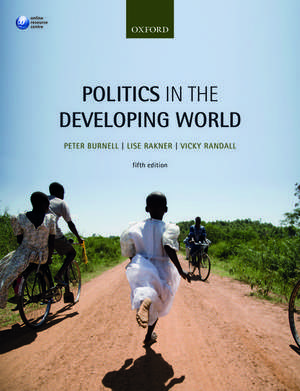
Politics in the Developing World
Editat de Peter Burnell, Vicky Randall, Lise Rakneren Limba Engleză Paperback – 30 mar 2017
Preț: 387.62 lei
Preț vechi: 485.14 lei
-20%
Puncte Express: 581
Carte tipărită la comandă
Livrare economică 04-15 decembrie
Livrare express 31 octombrie-06 noiembrie pentru 102.05 lei
Livrare prin curier în România Termenul estimat este afișat lângă disponibilitate.
Transport gratuit de la 400.00 lei Plată online sau ramburs, în funcție de opțiunile comenzii.
Retur gratuit în 14 zile Comandă securizată și suport în română.
Specificații
ISBN-13: 9780198737438
ISBN-10: 0198737432
Pagini: 496
Dimensiuni: 200 x 244 x 30 mm
Greutate: 0.7 kg
Ediția:5
Editura: OUP OXFORD
Colecția OUP Oxford
Locul publicării:Oxford, United Kingdom
ISBN-10: 0198737432
Pagini: 496
Dimensiuni: 200 x 244 x 30 mm
Greutate: 0.7 kg
Ediția:5
Editura: OUP OXFORD
Colecția OUP Oxford
Locul publicării:Oxford, United Kingdom
V-ar putea interesa
-
 Deliver Us from Evil: The Radical Underground in Britain, 1660-1663Richard L. Greaves-30%Preț: 801.14 lei1144.15 lei
 -
 -20%Preț: 384.17 lei481.17 lei
 -
 Liberal City, Conservative State: Moscow and Russia's Urban Crisis 1906-1914Robert William Thurston-30%Preț: 882.29 lei1261.71 lei
 -
 The Justice Broker: Lawyers and Ordinary LitigationHerbert M. Kritzer-27%Preț: 435.28 lei596.45 lei
 -
 -24%Preț: 573.93 lei759.07 lei
 -
 -23%Preț: 731.19 lei952.89 lei
 -
 Morocco: The Islamist Awakening and Other ChallengesMarvine Howe-18%Preț: 275.54 lei334.88 lei
 -
 Safire's Political DictionaryWilliam Safire-13%Preț: 152.40 lei175.18 lei
 -
 -32%Preț: 1010.71 lei1481.58 lei
 -
 The Politics of Child Daycare in BritainVicky Randall-30%Preț: 445.88 lei636.23 lei
 -
 Containing NationalismMichael Hechter-29%Preț: 529.68 lei744.54 lei
 -
 Racialization: Studies in Theory and PracticeKarim Murji-31%Preț: 657.11 lei957.57 lei
 -
 Foreign Aid in a Changing WorldPeter BurnellPreț: 423.40 lei
 -
 -18%Preț: 786.40 lei959.03 lei
 -
 The Augustinian PersonPeter BurnellPreț: 189.87 lei
 -
 Enron AscendingRobert L Bradley-8%Preț: 637.79 lei693.25 lei
 -
 Citizen, Customer, Partner: Engaging the Public in Public ManagementJohn Clayton Thomas-18%Preț: 1150.52 lei1403.06 lei
 -
 A Concise Introduction to Latin American Politics and DevelopmentHoward J. Wiarda-18%Preț: 1120.05 lei1365.91 lei
 -
 Critical Issues in Homeland Security: A CasebookJames D. Ramsay-18%Preț: 1165.57 lei1421.42 lei
 -
 Fire in the Minds of Men: Origins of the Revolutionary FaithJames Billington-18%Preț: 1319.39 lei1609.01 lei
 -
 -18%Preț: 1116.43 lei1361.49 lei
 -
 Prose Works of Gha'ib Tu'ma FarmanHilla Peled-Shapira-30%Preț: 538.14 lei769.26 lei
 -
 Regime Resilience in Malaysia and SingaporeGreg Lopez-35%Preț: 680.95 lei1055.24 lei
 -
 History, Empire, and IslamVicky Randall-23%Preț: 610.10 lei792.34 lei
 -
 Preț: 348.42 lei
Recenzii
'Burnell, Rakner, and Randall offer us a comprehensive overview of politics in the developing world and a perfect blend of real world empirics and social science theory. If you are looking for an idea textbook, this is it.'
'Clearly written and systematically presented, this textbook contains a wealth of information around the core themes in development studies. The combination of theoretical and conceptual debats with specific case studies provides students with a solid introduction to the subject.'
'Clearly written and systematically presented, this textbook contains a wealth of information around the core themes in development studies. The combination of theoretical and conceptual debats with specific case studies provides students with a solid introduction to the subject.'
Notă biografică
Peter Burnell is Professor of Politics and International Studies in the Department of Politics and International Studies at the University of Warwick. Vicky Randall is Emeritus Professor in the Department of Government at the University of Essex. Lise Rakner is Head of Department in the Department of Comparative Politics at the University of Bergen.
Cuprins
- Introduction
- Part I Approaches and global context
- 1: Vicky Randall: Changing analytical approaches to the study of politics in the developing world
- 2: James Chiriyankandrath: Colonialism and post-colonial development
- 3: Lise Rakner and Vicky Randall: Institutional perspectives
- 4: Robert Ahearne: The developing world in the global economy
- 5: Stephen Hobden: The developing world in international politics
- Part II Society and state
- 6: Jenny Pearce: Inequality
- 7: James R. Scarritt and Johanna Birnir: Ethnopolitics and nationalism
- 8: Jeff Haynes: Religion
- 9: Vicky Randall: Women and gender
- 10: Marina Ottaway: Civil society
- 11: Siri Gloppen: Social movements and alternative politics
- Part III State and society
- 12: Anna Persson: The Modern State: Characteristics, Capabilities, and Consequences
- 13: Astri Suhrke, Torunn Wimpelmann Chaudhary, and Ingrid Samset: Violent conflict and intervention
- 14: Lise Rakner: Democracy and regime change
- 15: Lise Rakner: Governance
- Part IV Policy issues
- 16: Tony Addison: Development
- 17: Peter Newell: Environment
- 18: Michael Freeman: Human rights
- Part V Regime change
- 19: David Taylor: Pakistan: regime change or continuing military dominance?
- 20: Gyda Maraas Sindre: Indonesia: redistributive power
- 21: Reinoud Leenders: Syria
- Part VI Fragile vs strong states
- 22: Nicola Pratt and Nadje Al-Ali: Iraq: from hard state to failed state - or fierce state?
- 23: Andreas Schedler: Mexico: transition to civil war democracy
- 24: Peter Ferdinand: South Korea: strong state, successful development
- Part VII Development and human rights
- 25: Stephen Wright: Nigeria: development, human rights, and democracy
- 26: Rachel Sieder: Guatemala: enduring underdevelopment
- 27: Liv Tønnessen: Sudan: Human Rights, Development, and Democracy
- Part VIII South-south relations
- 28: Leslie Elliott Armijo: Brazil as a global player?
- 29: Deborah Brautigam: China and the developing world
- 30: Emma Mawdsley: India as a post-colonial development partner