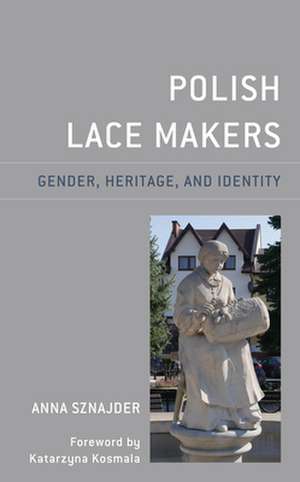
Polish Lace Makers: Gender, Heritage, and Identity
Autor Anna Sznajder Cuvânt înainte de Katarzyna Kosmalaen Limba Engleză Hardback – 15 oct 2019
Preț: 671.77 lei
Preț vechi: 1021.97 lei
-34%
Puncte Express: 1008
Carte tipărită la comandă
Livrare economică 08-22 iunie
Specificații
ISBN-13: 9781498584319
ISBN-10: 1498584314
Pagini: 334
Ilustrații: 1 b/w illustration; 15 b/w photos; 13 tables
Dimensiuni: 161 x 227 x 26 mm
Greutate: 0.61 kg
Editura: Bloomsbury Publishing
Colecția Lexington Books
Locul publicării:New York, United States
ISBN-10: 1498584314
Pagini: 334
Ilustrații: 1 b/w illustration; 15 b/w photos; 13 tables
Dimensiuni: 161 x 227 x 26 mm
Greutate: 0.61 kg
Editura: Bloomsbury Publishing
Colecția Lexington Books
Locul publicării:New York, United States
Cuprins
Chapter 1. Laces, lacemakers and lacemaking as a research project
Chapter 2. The history of lacemaking in Poland
Chapter 3. Bobowa - the lacemakers' community
Chapter 4. The lacemakers community up to 1945
Chapter 5. Lacemakers and the Koronka Cooperative - the organisation's role in women's lives and its contribution to craft development
Chapter 6. Lacemakers, laces and lacemaking, as presented in projects by the Local Handicraft Society and the Centre for Culture and Promotion
Chapter 7. Formation of contemporary entrepreneurial identities in relation to craft and place
Chapter 2. The history of lacemaking in Poland
Chapter 3. Bobowa - the lacemakers' community
Chapter 4. The lacemakers community up to 1945
Chapter 5. Lacemakers and the Koronka Cooperative - the organisation's role in women's lives and its contribution to craft development
Chapter 6. Lacemakers, laces and lacemaking, as presented in projects by the Local Handicraft Society and the Centre for Culture and Promotion
Chapter 7. Formation of contemporary entrepreneurial identities in relation to craft and place
Recenzii
As lace makers, we often look at a piece of lace or a pattern and consider its design and construction. This book challenges us to go much deeper than that and recognize the cultural, social, and economic history and context within which the lace has been made. Anna Sznajder eloquently captures the significant contribution of Bobowa lace makers to the region's cultural and economic history.