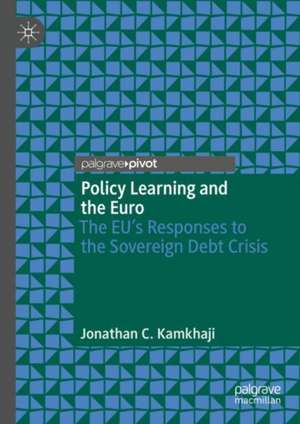
Policy Learning and the Euro
Autor Jonathan C. Kamkhajien Limba Engleză Hardback – 6 sep 2022
This book analyzes the EU’s responses to the sovereign debt crisis that hit the Economic and Monetary Union (EMU) in 2010. After reviewing the events that led to the crisis, it examines two case studies. The first assesses the short-term policy changes by drawing on a new mechanism, contingent learning. The second case study revolves around the long-term EMU reforms passed during the period 2010-2013. More specifically, it assesses these responses in relation to the institutional scientific publications of the European Central Bank and the DG ECFIN of the Commission. By analyzing both the short and long-term responses to the sovereign debt crisis, the book elucidates how policy learning can be an effective engine for deeper European integration. It will be of interest to scholars and students of EU integration, the EMU, policy learning, and supranational bureaucracies.
Preț: 365.01 lei
Puncte Express: 548
Carte tipărită la comandă
Livrare economică 07-21 decembrie
Livrare prin curier în România Termenul estimat este afișat lângă disponibilitate.
Transport gratuit de la 400.00 lei Plată online sau ramburs, în funcție de opțiunile comenzii.
Retur gratuit în 14 zile Comandă securizată și suport în română.
Specificații
ISBN-13: 9783031042638
ISBN-10: 3031042638
Pagini: 204
Ilustrații: XIX, 184 p. 3 illus.
Dimensiuni: 153 x 216 x 16 mm
Greutate: 0.34 kg
Ediția:1st edition 2022
Editura: Springer
Locul publicării:Cham, Switzerland
ISBN-10: 3031042638
Pagini: 204
Ilustrații: XIX, 184 p. 3 illus.
Dimensiuni: 153 x 216 x 16 mm
Greutate: 0.34 kg
Ediția:1st edition 2022
Editura: Springer
Locul publicării:Cham, Switzerland
Cuprins
Chapter 1. Introduction: EMU, fiscal policy coordination, crisis, and the case for learning.- Chapter 2. Research design.- Chapter 3. Introducing the beast: a primer on the euro crisis.- Chapter 4. How contingent learning saved EMU in 2010.- Chapter 5. The influence of internal epistemic actors on the construction of EMU expansionary consolidation paradigm.- Chapter 6. Conclusions. Integration through crisis and learning.
Textul de pe ultima copertă
“Finally, a book that asks the core forward-looking question overlooked in most analyses of the crises the EU has faced over the past decade: who learned what lesson, and to what effect? Using the case of the Eurozone crisis, the answers Kamkhaji provides are a crucial read for everyone interested in the process of European integration, crisis management and policy-making in general.” —Femke van Esch, Professor of European Governance and Leadership of the EU, Utrecht University, the Netherlands.
This book analyzes the EU’s responses to the sovereign debt crisis that hit the Economic and Monetary Union (EMU) in 2010. After reviewing the events that led to the crisis, it examines two case studies. The first assesses the short-term policy changes by drawing on a new mechanism, contingent learning. The second case study revolves around the long-term EMU reforms passed during the period 2010-2013. More specifically, it assesses these responses in relation to the institutional scientific publications of the European Central Bank and the DG ECFIN of the Commission. By analyzing both the short and long-term responses to the sovereign debt crisis, the book elucidates how policy learning can be an effective engine for deeper European integration. It will be of interest to scholars and students of EU integration, the EMU, policy learning, and supranational bureaucracies.
Jonathan C. Kamkhaji is a Post-Doctoral Researcher at the Department of Management, Economics and Industrial Engineering, Politecnico Milano, Italy. His research interests include European integration, public policy, and regulatory governance. He previously worked as a consultant for the World Bank, and has published research in the Journal of European Public Policy, Regulation & Governance, and Policy Studies Journal.
Caracteristici
Provides a unique account of how and what EU decision makers learned during the sovereign debt crisis Explains how a novel causal mechanism, contingent learning, led EU decision makers to save the euro in 2010 Offers a new account of the rise of the austerity paradigm by analyzing the scientific production of EU epistemic agents