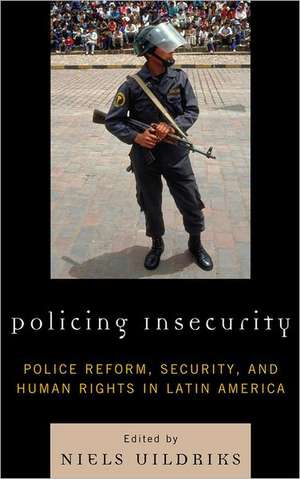
Policing Insecurity: Police Reform, Security, and Human Rights in Latin America
Autor Niels Uildriks Contribuţii de Lucia Dammert, Hugo Frühling, Marie-Louise Glebbeek, Anthony Harriott, Saima Husain, Mark Ungaren Limba Engleză Hardback – 16 apr 2009
By explicitly linking issues of state-social trust, democratic transition, human rights, and security, these case studies provide a basis for the wider discussion in the book about prerequisites for the success or failure of police reforms, thus adding to our empirical and theoretical knowledge in these areas and introducing an important dimension to the literature on police reform, security, and human rights.
Preț: 659.03 lei
Preț vechi: 1053.42 lei
-37%
Puncte Express: 989
Carte tipărită la comandă
Livrare economică 01-15 decembrie
Livrare prin curier în România Termenul estimat este afișat lângă disponibilitate.
Transport gratuit pentru acest produs Plată online sau ramburs, în funcție de opțiunile comenzii.
Retur gratuit în 14 zile Comandă securizată și suport în română.
Specificații
ISBN-13: 9780739132289
ISBN-10: 0739132288
Pagini: 262
Dimensiuni: 162 x 240 x 23 mm
Greutate: 0.52 kg
Editura: Bloomsbury Publishing
Colecția Lexington Books
Locul publicării:New York, United States
ISBN-10: 0739132288
Pagini: 262
Dimensiuni: 162 x 240 x 23 mm
Greutate: 0.52 kg
Editura: Bloomsbury Publishing
Colecția Lexington Books
Locul publicării:New York, United States
Cuprins
Chapter 1 Preface
Chapter 2 Police Reform, Security, and Human Rights in Latin America: An Introduction
Chapter 3 Recent Police Reforms in Latin America
Chapter 4 On the Long Road to Demilitarization and Professionalization of the Police in Brazil
Chapter 5 Post-War Violence and Police Reform in Guatemala
Chapter 6 International Police Assistance in Jamaica under Escalated Violence and Institutionalized Non-Integrity
Chapter 7 Police Transformation and International Cooperation: The Jamacian Experience
Chapter 8 Police and Judicial Reform in Chile
Chapter 9 Police Reform in Argentina: Public Security versus Human Rights
Chapter 10 Policing Insecurity and Police Reform in Mexico City and Beyond
Chapter 2 Police Reform, Security, and Human Rights in Latin America: An Introduction
Chapter 3 Recent Police Reforms in Latin America
Chapter 4 On the Long Road to Demilitarization and Professionalization of the Police in Brazil
Chapter 5 Post-War Violence and Police Reform in Guatemala
Chapter 6 International Police Assistance in Jamaica under Escalated Violence and Institutionalized Non-Integrity
Chapter 7 Police Transformation and International Cooperation: The Jamacian Experience
Chapter 8 Police and Judicial Reform in Chile
Chapter 9 Police Reform in Argentina: Public Security versus Human Rights
Chapter 10 Policing Insecurity and Police Reform in Mexico City and Beyond
Recenzii
Niels Uildriks has produced an outstanding book on human rights and police reform. In fascinating contrast with his recent book on human rights in post-communist societies, this reader assembles a star-studded group of Caribbean and Latin American scholars to address the issue of policing and human rights in selected nations. With globalization spreading, the magnitude of both internal and external terrorism/criminality accelerating, and transnational crime and the accompanying corruption of governments and criminal justice agencies increasing dramatically, the salience of human rights has diminished in many nations. However, this collection of scholars maintains that police-based solutions to these problems will not be realized without consideration of human rights. The book explores in depth a variety of criminal justice reforms and their implications for human rights issues in different cultural, political, and social environments. The contributors and editor not only describe the various environments but also analyze how they affect reform either positively or negatively. It is a must-read for any scholar who is interested in development, human rights, and criminal justice reform. It should be required reading for any policy maker or governmental official contemplating change in these arenas.
Latin America's police reforms face a double demand to improve both police integrity and public security. Uildriks and the other authors in this volume find that progress on both fronts has been partial at best, as their analyses draw out both the challenges of reform processes but also important lessons for scholars and practitioners alike. This is a valuable contribution to the growing body of literature examining human rights and security issues in post-authoritarian environments.
Latin America's police reforms face a double demand to improve both police integrity and public security. Uildriks and the other authors in this volume find that progress on both fronts has been partial at best, as their analyses draw out both the challenges of reform processes but also important lessons for scholars and practitioners alike. This is a valuable contribution to the growing body of literature examining human rights and security issues in post-authoritarian environments.