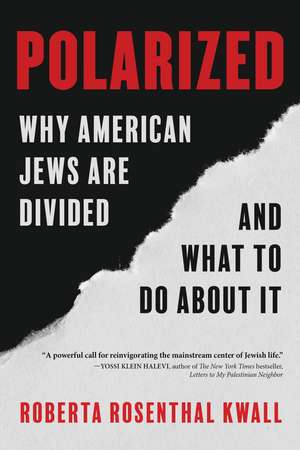
Polarized: Why American Jews are Divided and What to Do About it
Autor Roberta Rosenthal Kwallen Limba Engleză Hardback – oct 2026
Not only has polarization long been recognized as one of the most pressing problems facing the American Jewish community but, in fact, American Jews are among the most divided communities in the United States, a fracture that has deepened dramatically in the wake of the October 7th terrorist attacks against Israel and the ensuing Israel-Hamas war. Drawing on insights from law, sociology, psychology, history, and Jewish tradition, Professor Roberta Kwall examines how these divisions developed, how they both reflect and differ from polarization in our broader society and, most importantly, how and why they pose an existential threat to American Jewish communal life. In tracing the evolution of internal Jewish divides over religious practice, Israel, and antisemitism, she makes clear that different groups of Jews, like all people, are shaped by distinct moral priorities, fears, and understandings of political issues, and she shows how generation gaps and campus culture have intensified these conflicts.
Fortunately, beyond diagnosing the divisions that plague the American Jewish community, Kwall offers a path forward for rebuilding a strong American Jewish center capable of sustaining disagreement without fragmentation. Guided by Jewish teachings on speech, disagreement, and moral responsibility, she proposes a consensus platform that can promote communal dialogue, institutional planning, and educational initiatives by prioritizing respectful discourse over ideological victory.
Preț: 186.06 lei
Preț vechi: 205.11 lei
-9% Nou
Puncte Express: 279
Carte disponibilă
Livrare economică 07-21 noiembrie
Livrare express 24-30 octombrie pentru 51.71 lei
Livrare prin curier în România Termenul estimat este afișat lângă disponibilitate.
Transport gratuit de la 400.00 lei Plată online sau ramburs, în funcție de opțiunile comenzii.
Retur gratuit în 14 zile Comandă securizată și suport în română.
Specificații
ISBN-13: 9798881842505
Pagini: 224
Dimensiuni: 158 x 232 x 18 mm
Greutate: 0.45 kg
Editura: Bloomsbury Publishing
Colecția Bloomsbury Academic
Locul publicării:New York, United States
Pagini: 224
Dimensiuni: 158 x 232 x 18 mm
Greutate: 0.45 kg
Editura: Bloomsbury Publishing
Colecția Bloomsbury Academic
Locul publicării:New York, United States
Cuprins
Acknowledgements
Introduction
Part One: American Polarization and the Jews
1. America's Political and Religious Polarization Is not "Good for the Jews"
2. Liberal America and the Jews
3. Conservative America and the Jews
Part Two: Jewish Polarization: Growing Divides and Fears
4. Changes In Religious Divides
5. Growing Divides Surrounding Israel
6. Antisemitism Makes Jews a Polarizing People
Part Three: Future Directions For Strengthening The American Jewish Community And Beyond
7. Can American Social Institutions Reclaim Liberalism?
8. A Self-Help Blueprint for American Jews
Epilogue
Notes
Introduction
Part One: American Polarization and the Jews
1. America's Political and Religious Polarization Is not "Good for the Jews"
2. Liberal America and the Jews
3. Conservative America and the Jews
Part Two: Jewish Polarization: Growing Divides and Fears
4. Changes In Religious Divides
5. Growing Divides Surrounding Israel
6. Antisemitism Makes Jews a Polarizing People
Part Three: Future Directions For Strengthening The American Jewish Community And Beyond
7. Can American Social Institutions Reclaim Liberalism?
8. A Self-Help Blueprint for American Jews
Epilogue
Notes
Recenzii
With penetrating insights, profound understanding, sensitivity, and courage, Roberta Kwall has tackled what has arguably become the most divisive issue facing American Jews today--Zionism and support for the Jewish State. In Polarized, Kwall not only explores the origins and growth of this schism but proposes creative and unique ways of bridging it. Her book is essential reading for all who grapple with the challenges of Jewish identity today and care passionately about our people's bonds with Israel.
Roberta Kwall has written a powerful call for reinvigorating the mainstream center of Jewish life. At a time of growing dissension among Jews, even as antisemitism is spreading across the political spectrum, American Jewry desperately needs wise voices to help it navigate through this terrifying moment. This book is an essential contribution to that conversation.
Kwall offers an incisive and wide-ranging diagnosis of the many challenges facing the American Jewish community, along with thoughtful and practical proposals to move forward. Her work will reward both communal leaders and lay readers.
As American Jews navigate internal divisions and external pressures, Roberta Kwall is the kind of guide we need: humane, knowledgeable, and deeply committed to Jewish community. Anyone who wants to understand the present and feel more hopeful for the future should read Polarized.
Amid the clamor of polarization in American Jewish life, Professor Roberta Rosenthal Kwall offers a timely intervention. She shows how it is possible to discern multiple sides of controversial issues, talk with those with whom one disagrees, contextualize and document claims, preserve productive discourse amid principled disagreement, and press for a middle way. Valuable both as a record of our times and as a sound prescription for how to move forward.
If you care about the Jewish world and the Jewish future, it's important to read what Kwall has to say about the challenges facing our community. Whether or not you agree with her solutions, Polarized is an important contribution to a centuries-old debate about-Jewish debate.
Kwall effectively maps the polarization of the American Jewish community and provides a blueprint for a more productive way forward. Her vision is an important contribution to the effort to tackle the aftermath of October 7 and ensure a strong, resilient American Judaism that takes its identity seriously while maintaining its deep connection to Israel.
In this incisive book, Roberta Kwall offers both diagnosis and direction, tracing how antisemitism has resurfaced across the media and academia. More than critique, this is a roadmap for resilience and renewal, speaking to Jews of every background, belief, and level of observance. Whether Jewish identity is lived religiously, culturally, or ethnically, readers will come away with a deeper understanding of this moment-and a clearer sense of how to meet it.
Professor Kwall has written a magnificent book that is stunning in its originality and its insights. At a time when the United States is more politically polarized than at any time since Reconstruction, Professor Kwall focuses on the reality of polarization among Jewish people. With meticulous research and beautiful prose, Professor Kwall both explains why this is a serious problem and offers a wise path forward.
Polarized is meant to be widely read, and it will find a grateful audience of readers who have been waiting for precisely what this book so winningly offers.
Kwall puts the finger on one of the key issues facing the Jewish Community: not disagreement itself, but the loss of the capacity to disagree while remaining a people. It is possible - and necessary - to have strong convictions about issues affecting the Jewish World, while preserving the fabric of communal. It is also necessary to discuss the parameters of belonging and how internal dissent needs to be managed. This is an intriguing book that explores the changing realities of the Jewish community and opens an important conversation: how to give voice to the silent (and exhausted) majority.
Kwall makes a timely, persuasive case for how to strengthen an American Jewish community fractured by extremism, polarization, and antisemitism in the wake of the October 7 attack on Israel. . . It's a cogent, well-reasoned plea for intelligent discourse as a precondition for the health of Judaism in the U.S.
Persuasive. . . . An all-too-rare combination of a multi-disciplinary academic approach leavened with insights gleaned from a lifetime of active Jewish communal experience.
It is no secret that the Jewish community is divided. Whether over the future of Israel, the definition of antisemitism, or the ideal path of American politics, it feels that often the chasm is unbridgeable. In Polarized, Roberta Rosenthal Kwall masterfully diagnoses and analyzes this problem, offering concrete solutions and avenues where those who disagree can come together.
Roberta Kwall has written a powerful call for reinvigorating the mainstream center of Jewish life. At a time of growing dissension among Jews, even as antisemitism is spreading across the political spectrum, American Jewry desperately needs wise voices to help it navigate through this terrifying moment. This book is an essential contribution to that conversation.
Kwall offers an incisive and wide-ranging diagnosis of the many challenges facing the American Jewish community, along with thoughtful and practical proposals to move forward. Her work will reward both communal leaders and lay readers.
As American Jews navigate internal divisions and external pressures, Roberta Kwall is the kind of guide we need: humane, knowledgeable, and deeply committed to Jewish community. Anyone who wants to understand the present and feel more hopeful for the future should read Polarized.
Amid the clamor of polarization in American Jewish life, Professor Roberta Rosenthal Kwall offers a timely intervention. She shows how it is possible to discern multiple sides of controversial issues, talk with those with whom one disagrees, contextualize and document claims, preserve productive discourse amid principled disagreement, and press for a middle way. Valuable both as a record of our times and as a sound prescription for how to move forward.
If you care about the Jewish world and the Jewish future, it's important to read what Kwall has to say about the challenges facing our community. Whether or not you agree with her solutions, Polarized is an important contribution to a centuries-old debate about-Jewish debate.
Kwall effectively maps the polarization of the American Jewish community and provides a blueprint for a more productive way forward. Her vision is an important contribution to the effort to tackle the aftermath of October 7 and ensure a strong, resilient American Judaism that takes its identity seriously while maintaining its deep connection to Israel.
In this incisive book, Roberta Kwall offers both diagnosis and direction, tracing how antisemitism has resurfaced across the media and academia. More than critique, this is a roadmap for resilience and renewal, speaking to Jews of every background, belief, and level of observance. Whether Jewish identity is lived religiously, culturally, or ethnically, readers will come away with a deeper understanding of this moment-and a clearer sense of how to meet it.
Professor Kwall has written a magnificent book that is stunning in its originality and its insights. At a time when the United States is more politically polarized than at any time since Reconstruction, Professor Kwall focuses on the reality of polarization among Jewish people. With meticulous research and beautiful prose, Professor Kwall both explains why this is a serious problem and offers a wise path forward.
Polarized is meant to be widely read, and it will find a grateful audience of readers who have been waiting for precisely what this book so winningly offers.
Kwall puts the finger on one of the key issues facing the Jewish Community: not disagreement itself, but the loss of the capacity to disagree while remaining a people. It is possible - and necessary - to have strong convictions about issues affecting the Jewish World, while preserving the fabric of communal. It is also necessary to discuss the parameters of belonging and how internal dissent needs to be managed. This is an intriguing book that explores the changing realities of the Jewish community and opens an important conversation: how to give voice to the silent (and exhausted) majority.
Kwall makes a timely, persuasive case for how to strengthen an American Jewish community fractured by extremism, polarization, and antisemitism in the wake of the October 7 attack on Israel. . . It's a cogent, well-reasoned plea for intelligent discourse as a precondition for the health of Judaism in the U.S.
Persuasive. . . . An all-too-rare combination of a multi-disciplinary academic approach leavened with insights gleaned from a lifetime of active Jewish communal experience.
It is no secret that the Jewish community is divided. Whether over the future of Israel, the definition of antisemitism, or the ideal path of American politics, it feels that often the chasm is unbridgeable. In Polarized, Roberta Rosenthal Kwall masterfully diagnoses and analyzes this problem, offering concrete solutions and avenues where those who disagree can come together.