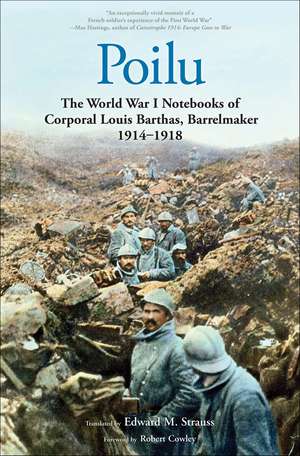
Poilu: The World War I Notebooks of Corporal Louis Barthas, Barrelmaker, 1914-1918
Autor Louis Barthas Traducere de Edward M. Strauss Introducere de Rémy Cazals Cuvânt înainte de Robert Cowleyen Limba Engleză Paperback – 31 mar 2015
Cum se explică faptul că un simplu dogar de treizeci și cinci de ani, animat de convingeri pacifiste și socialiste, a putut supraviețui timp de patru ani în inima celui mai distrugător conflict al modernității? Poilu nu este doar un jurnal de front, ci un exercițiu de rezistență umană prin scris. Reținem din paginile lui Louis Barthas o perspectivă rară: cea a soldatului de rând care nu doar că îndură noroiul din Artois sau măcelul de la Verdun, dar are curajul să analizeze critic incompetența propriei ierarhii militare. Considerăm că forța acestui volum rezidă în onestitatea sa brutală. Barthas nu scrie pentru glorie, ci pentru a salva de la uitare chipurile camarazilor săi și momentele de umanitate absurdă, cum ar fi episoadele de fraternizare cu inamicul german, petrecute la doar câțiva metri distanță de liniile de foc. Stilul său este direct, marcat de o observație ageră asupra suferinței și a epuizării fizice. În aceeași familie cu French Poilu 1914–18 de Ian Sumner, volumul Poilu adaugă o voce subiectivă și profund personală, transformând datele istorice reci într-o mărturie vie despre demnitate în condiții inumane. Spre deosebire de relatările ofițerilor, aici vocea aparține celui care a săpat tranșeele, oferind o perspectivă „de jos în sus” asupra Marelui Război, tradusă acum cu o fidelitate remarcabilă față de spiritul original al celor 19 caiete manuscrise.
Preț: 135.85 lei
Carte disponibilă
Livrare economică 02-16 noiembrie
Livrare express 16-22 octombrie pentru 37.70 lei
Specificații
ISBN-10: 0300212488
Pagini: 480
Ilustrații: 18 b-w illus.
Dimensiuni: 156 x 235 x 27 mm
Greutate: 0.64 kg
Editura: Yale University Press
Colecția Yale University Press
V-ar putea interesa
-
 The Mad and the BraveColin FreemanPreț: 142.36 lei
 -
 IndignityLea Ypi-28%Preț: 101.86 lei142.26 lei
 -
 The Forgotten SoldierGuy Sajer-25%Preț: 81.53 lei109.04 lei
 -
 Good-Bye to All ThatRobert GravesPreț: 113.82 lei
 -
 Somme MudE P F Lynch-29%Preț: 66.88 lei94.51 lei
 -
 Mud, Blood and BulletsEdward Rowbottom-30%Preț: 75.35 lei106.99 lei
 -
 Fritz and Tommy: Across the Barbed WirePeter DoylePreț: 146.59 lei
 -
 -26%Preț: 89.30 lei120.86 lei
 -
 The Verdun RegimentJohnathan BrackenPreț: 193.93 lei
 -
 LegionnaireSimon Murray-34%Preț: 60.38 lei91.97 lei
 -
 -26%Preț: 90.48 lei121.56 lei
 -
 -26%Preț: 91.51 lei123.28 lei
 -
 Memoirs from Beyond the Grave: 1815-1830Francois-Rene ChateaubriandPreț: 175.11 lei
 -
 Clouds Over ParisFelix HartlaubPreț: 77.30 lei
 -
 Preț: 94.33 lei
 -
 Preț: 49.73 lei
 -
 -19%Preț: 76.26 lei93.84 lei
 -
 War: First Ever English Translation of an Unpublished Work by Louis-Ferdinand CélineLouis-Ferdinand CélinePreț: 93.54 lei
 -
 A Cool Head in HellHarry SilmanPreț: 101.32 lei
 -
 Under FireThe Story of a Squad (Edition2024)Henri BarbussePreț: 122.83 lei
De ce să citești această carte
Recomandăm această carte oricărui pasionat de istorie care dorește să înțeleagă Primul Război Mondial dincolo de cifre și strategii. Cititorul câștigă acces la psihologia autentică a soldatului francez, descoperind cum un om obișnuit a reușit să-și păstreze simțul moral și spiritul critic în mijlocul haosului de la Somme sau Verdun. Este o lecție despre supraviețuire și integritate.
Despre autor
Louis Barthas (1879–1952) a fost un dogar francez din regiunea viticolă Languedoc, mobilizat ca caporal în infanterie pe parcursul întregului Primul Război Mondial. Membru activ al mișcării socialiste, Barthas a privit conflictul prin prisma solidarității de clasă, fiind un observator atent al nedreptăților sociale din cadrul armatei. După întoarcerea de pe front în 1919, și-a petrecut timpul liber transcriind minuțios însemnările de război în 19 caiete școlare, lăsând posterității una dintre cele mai importante și oneste mărturii ale experienței trăite de un „poilu” (soldat francez de infanterie).
Descriere scurtă
Along with millions of other Frenchmen, Louis Barthas, a thirty-five-year-old barrelmaker from a small wine-growing town, was conscripted to fight the Germans in the opening days of World War I. Corporal Barthas spent the next four years in near-ceaseless combat, wherever the French army fought its fiercest battles: Artois, Flanders, Champagne, Verdun, the Somme, the Argonne. Barthas’ riveting wartime narrative, first published in France in 1978, presents the vivid, immediate experiences of a frontline soldier.
This excellent new translation brings Barthas’ wartime writings to English-language readers for the first time. His notebooks and letters represent the quintessential memoir of a “poilu,” or “hairy one,” as the untidy, unshaven French infantryman of the fighting trenches was familiarly known. Upon Barthas’ return home in 1919, he painstakingly transcribed his day-to-day writings into nineteen notebooks, preserving not only his own story but also the larger story of the unnumbered soldiers who never returned. Recounting bloody battles and endless exhaustion, the deaths of comrades, the infuriating incompetence and tyranny of his own officers, Barthas also describes spontaneous acts of camaraderie between French poilus and their German foes in trenches just a few paces apart. An eloquent witness and keen observer, Barthas takes his readers directly into the heart of the Great War.
Recenzii
"Barthas was an ordinary working man, a barrel maker of socialist inclinations, and there was nothing about him to suggest he harbored literary gifts or genius. But his notebooks, assembled under the title Poilu, are among the great works of the war, deserving a place of mention with memoirs like Guy Chapman’s A Passionate Prodigality and Ernst Jünger’s Storm of Steel."—Geoffrey Norman, Wall Street Journal
"Nothing ever written provides a more accurate, raw and close-in account of the beastly life of the common soldier. . ."—Marc Wortman, Daily Beast
"One wonders why it took so long for an English translation—this is clearly one of the most readable and indispensable accounts of the death of the glory of war."—Nicholas Mancuso, Daily Beast
"The material here is raw and unvarnished—not just primary, but primal. This is not the grand stuff of geopolitics and strategy, nor of literary arcs and historical perspective, nor even of battlefield tactics and logistics. It is the day-to-day life of a foot soldier in the trenches."—Andrew Imbrie Dayton, The Washington Independent Review of Books
"Among World War I books being published in this centennial year of that conflict's start, none likely can connect readers more directly or vividly to the experience of those who fought it."—Alan Wallace, Pittsburgh Tribune-Review
"Barthas provides one of the best pictures of life in the trenches."—J.W. Thacker, Park City Daily News
"Barthas provides one of the best pictures of life in the trenches."—J.W. Thacker, Park City Daily News
"Barthas’ testimony, which exemplifies the title of this review and demonstrates the shared experiences of all the belligerents, is a superb addition to the many moving reminders of man’s bravery in the face of the futility of war."—Patricia M.E. Lorcin, Los Angeles Review of Books
"This translation of the diaries and letters of a French corporal on the Western front in World War I brings the gritty reality of trench warfare to an English-speaking audience in a manner unparalleled even in the best soldier writings from that war. The reader feels and smells and hears the mud, the blood, the fear, the deafening noise of exploding shells, the clatter of machine guns, the cries of the wounded and dying. Here is the war as the men in the trenches experienced it."—James McPherson, author of Battle Cry of Freedom
"An exceptionally vivid memoir of a French soldier's experience of the First World War."—Max Hastings, author of Catastrophe 1914: Europe Goes to War
"Louis Barthas, cooper, citizen, cynic and reluctant reservist, is one of the truly authentic voices of the Great War. A classic in France from its first publication, his account of the fighting (and he saw more of it than most) speaks not only for the 'poilu' but for all solders of the conflict."—Hew Strachan, author of The First World War
"A revelatory book that brings the French experience of the Great War to life as you read. However much we may think the British and Americans suffered, their agony was shorter and less intense than the tragedy that overwhelmed the French nation in 1914-1918."—Peter Hart, author of The Great War: A Combat History of the First World War
"Ah, the notebooks of Louis Barthas! This book has profound historic value. It is also a genuine work of literature."—François Mitterrand, former president of France