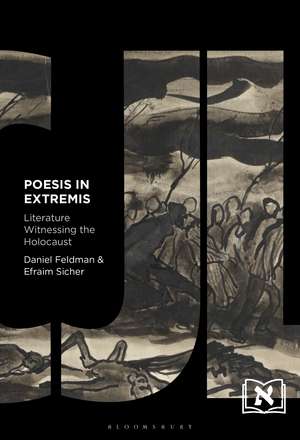
Poesis in Extremis: Literature Witnessing the Holocaust: Comparative Jewish Literatures
Autor Prof. or Dr. Daniel Feldman, Prof. or Dr. Efraim Sicheren Limba Engleză Paperback – 21 aug 2025
How can genocide be witnessed through imaginative literature? How can the Holocaust affect readers who were not there?
Reading the work of major figures such as Elie Wiesel, Paul Celan, Avrom Sutzkever, Ida Fink, Wladyslaw Szlengel, Itzhak Katzenelson, and Czeslaw Milosz, Poesis in Extremis poses fundamental questions about how prose and poetry are written under extreme conditions, either in real time or immediately after the Holocaust.
Framed by discussion of literary testimony, with Wiesel's literary memoir Night as an entry point, this innovative study explores the blurred boundary of fact and fiction in Holocaust literature. It asks whether there is a poetics of the Holocaust and what might be the criteria for literary witnessing. Wartime writing in particular tests the limits of "poesis in extremis" when poets faced their own annihilation and wrote in the hope that their words, like a message in a bottle, would somehow reach readers. Through Poesis in Extremis, Daniel Feldman and Efraim Sicher probe the boundaries of Holocaust literature, as well as the limits of representation.
| Toate formatele și edițiile | Preț | Express |
|---|---|---|
| Paperback (1) | 197.47 lei 6-8 săpt. | |
| Bloomsbury Publishing – 21 aug 2025 | 197.47 lei 6-8 săpt. | |
| Hardback (1) | 554.46 lei 6-8 săpt. | |
| Bloomsbury Publishing – 8 feb 2024 | 554.46 lei 6-8 săpt. |
Preț: 197.47 lei
Preț vechi: 270.38 lei
-27%
Puncte Express: 296
Preț estimativ în valută:
34.95€ • 40.84$ • 30.34£
34.95€ • 40.84$ • 30.34£
Carte tipărită la comandă
Livrare economică 20 februarie-06 martie
Preluare comenzi: 021 569.72.76
Specificații
ISBN-13: 9798765100226
Pagini: 272
Dimensiuni: 148 x 226 x 18 mm
Greutate: 0.4 kg
Editura: Bloomsbury Publishing
Colecția Bloomsbury Academic
Seria Comparative Jewish Literatures
Locul publicării:New York, United States
Pagini: 272
Dimensiuni: 148 x 226 x 18 mm
Greutate: 0.4 kg
Editura: Bloomsbury Publishing
Colecția Bloomsbury Academic
Seria Comparative Jewish Literatures
Locul publicării:New York, United States
Cuprins
Acknowledgments
Introduction (Daniel Feldman and Efraim Sicher)
Part I
1. Elie Wiesel's Night: Literature as Testimony (Efraim Sicher)
Part II
2. A Poetics of the Holocaust?: Celan, Sutzkever, Milosz (Efraim Sicher)
3. Writing Nothing: Negation and Subjectivity in the Holocaust Poetry of Paul Celan and Dan Pagis (Daniel Feldman)
4. Miklós Radnóti: Postcards from a Death March (Efraim Sicher)
5. Wladymir Szlengel's Ghetto Poems: Writing to the Dead (Daniel Feldman)
6. "Poem in a Bottle": Itzhak Katzenelson's Song of the Murdered Jewish People (Daniel Feldman)
Part III
7. Translating Oral Memory in Ida Fink's "Traces" (Daniel Feldman)
Postscript (Daniel Feldman and Efraim Sicher)
Notes
Bibliography
Index
Introduction (Daniel Feldman and Efraim Sicher)
Part I
1. Elie Wiesel's Night: Literature as Testimony (Efraim Sicher)
Part II
2. A Poetics of the Holocaust?: Celan, Sutzkever, Milosz (Efraim Sicher)
3. Writing Nothing: Negation and Subjectivity in the Holocaust Poetry of Paul Celan and Dan Pagis (Daniel Feldman)
4. Miklós Radnóti: Postcards from a Death March (Efraim Sicher)
5. Wladymir Szlengel's Ghetto Poems: Writing to the Dead (Daniel Feldman)
6. "Poem in a Bottle": Itzhak Katzenelson's Song of the Murdered Jewish People (Daniel Feldman)
Part III
7. Translating Oral Memory in Ida Fink's "Traces" (Daniel Feldman)
Postscript (Daniel Feldman and Efraim Sicher)
Notes
Bibliography
Index
Recenzii
A long overdue analysis and cogent discussion of Holocaust literature as literary testimony ... This is essential reading for anyone interested in 20th-century literature and history.
It is not only by focusing on poetry, but also by insisting on its evidentiary value, that Feldman and Sicher's volume becomes a timely and original contribution to a relatively neglected area of Holocaust research, the study of verse. Poesis in Extremis is thoroughly researched, erudite, and engaging, with each chapter providing helpful historical and biographical contextualization, and deftly interweaving these paratextual details with close literary analysis.
Well researched and insightful, this book closes a major gap in Holocaust studies by discussing the role of literature, and particularly that of poetry, as testimony in the spiritual lives of victims during as well as after the Holocaust.
This inspiring study gives a new slant on the vexed question of literary art of the Holocaust era. Through detailed readings of works by such writers as Elie Wiesel and Wladyslaw Szlengel, Ida Fink and Miklós Radnóti, Feldman and Sicher compellingly argue that poetic rather than documentary testimony was the most 'radical outlet' for witnesses' grief and horror. This important book reaffirms the crucial role of poetry after Auschwitz.
It is not only by focusing on poetry, but also by insisting on its evidentiary value, that Feldman and Sicher's volume becomes a timely and original contribution to a relatively neglected area of Holocaust research, the study of verse. Poesis in Extremis is thoroughly researched, erudite, and engaging, with each chapter providing helpful historical and biographical contextualization, and deftly interweaving these paratextual details with close literary analysis.
Well researched and insightful, this book closes a major gap in Holocaust studies by discussing the role of literature, and particularly that of poetry, as testimony in the spiritual lives of victims during as well as after the Holocaust.
This inspiring study gives a new slant on the vexed question of literary art of the Holocaust era. Through detailed readings of works by such writers as Elie Wiesel and Wladyslaw Szlengel, Ida Fink and Miklós Radnóti, Feldman and Sicher compellingly argue that poetic rather than documentary testimony was the most 'radical outlet' for witnesses' grief and horror. This important book reaffirms the crucial role of poetry after Auschwitz.