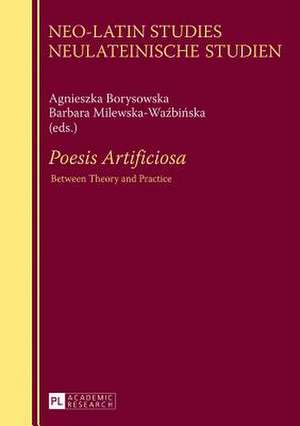
'Poesis Artificiosa': Neo-Latin Studies / Neulateinische Studien, cartea 2
Editat de Barbara Milewska-Wazbinska, Agnieszka Borysowskaen Limba Engleză Hardback – 20 noi 2013
Preț: 423.34 lei
Preț vechi: 549.79 lei
-23%
Puncte Express: 635
Carte disponibilă
Livrare economică 28 octombrie-11 noiembrie
Livrare prin curier în România Termenul estimat este afișat lângă disponibilitate.
Transport gratuit pentru acest produs Plată online sau ramburs, în funcție de opțiunile comenzii.
Retur gratuit în 14 zile Comandă securizată și suport în română.
Specificații
ISBN-13: 9783631643693
ISBN-10: 3631643691
Pagini: 244
Dimensiuni: 148 x 210 x 14 mm
Greutate: 0.32 kg
Ediția:1. Auflage
Editura: PETER LANG
Colecția Neo-Latin Studies / Neulateinische Studien
Seria Neo-Latin Studies / Neulateinische Studien
ISBN-10: 3631643691
Pagini: 244
Dimensiuni: 148 x 210 x 14 mm
Greutate: 0.32 kg
Ediția:1. Auflage
Editura: PETER LANG
Colecția Neo-Latin Studies / Neulateinische Studien
Seria Neo-Latin Studies / Neulateinische Studien
V-ar putea interesa
-
 Horace: Odes and EpodesMichele Lowrie-24%Preț: 546.52 lei719.51 lei
 -
 Selected DialoguesLucian-19%Preț: 57.28 lei70.98 lei
 -
 The Dance of the Islands: Insularity, Networks, the Athenian Empire, and the Aegean WorldChristy Constantakopoulou-22%Preț: 387.57 lei499.72 lei
 -
 Classics in Post-Colonial WorldsLorna Hardwick-22%Preț: 389.94 lei501.13 lei
 -
 Work in Progress: Literary Revision as Social Performance in Ancient RomeSean Alexander Gurd-31%Preț: 706.89 lei1028.67 lei
 -
![The [European] Other in Medieval Arabic Literature and Culture](https://i0.books-express.ro/bt/9780230109407/the-european-other-in-medieval-arabic-literature-and-culture.jpg) -15%Preț: 719.25 lei846.18 lei
-15%Preț: 719.25 lei846.18 lei -
 Preț: 181.26 lei
 -
 The Making of the Poema de Mio CidColin Journalist SmithPreț: 298.96 lei
 -
 Dante's Style in His Lyric PoetryPatrick BoydePreț: 369.76 lei
 -
 Preț: 270.22 lei
 -
 The Mind of DanteU. LimentaniPreț: 300.63 lei
 -
 Preț: 330.10 lei
 -
 Preț: 281.73 lei
 -
 An Introduction to Wolframs 'Parzival'Sacker HughPreț: 302.30 lei
 -
 AstronomiconManilii MPreț: 295.07 lei
 -
 Preț: 249.98 lei
 -
 Aeschylean TragedyAlan H. SommersteinPreț: 335.66 lei
 -
 Writing Ancient PersiaDr Thomas Harrison-15%Preț: 165.92 lei195.45 lei
 -
 -21%Preț: 169.99 lei214.26 lei
Notă biografică
Agnieszka Borysowska is Librarian in the Department of Manuscripts and Rare Books of Ksiaznica Pomorska and Senior Lecturer at the University of Szczecin (Poland). Barbara Milewska-Wazbinska is Professor at the Institute of Classical Studies at the University of Warsaw (Poland). Her main fields of interest are Neo-Latin literature and the classical tradition in literature and art. She has published four books on Neo-Latin poetry and old Polish culture and numerous articles in Polish, English, Italian, and German.
Cuprins
Contents: Rafal Wójcik: Early Fifteenth Century Acrostics in the Cistercian Codex from Rudy - Angelika Modlinska-Piekarz: Some Example of Metrical Virtuosity: Poetic Psalm Paraphrase of Caspar Cunradus - Jaroslaw Nowaszczuk: The Judas the Traitor Epigrammatic Cycle: Introduction into Jacob Masen's Theory of the Argutia Sources - Anna Kapuscinska/Piotr Urbanski: Poesis Artificiosa ad Gloriam Dei: Paul Zacharias and His Disticha Sacra - Magdalena Górska: Emblematics towards Visual Poetry: The Example of the Via triumphalis Polonorum et Svecorum Regem ... Vladislaum IV ... celebrata ... ducens ... (1634) - Agnieszka Borysowska: Pomeranian Poets about their Dead Rulers: Elaborate Forms in Seventeenth Century Funeral Poetry - Elwira Buszewicz: The Dead Persons, Lapidary Letters, Immortal Memory: Atoms of the Poesis Artificiosa in the Church of St. Casimir the Prince, Kraków - Bartlomiej Czarski/Barbara Milewska-Wazbinska: Pattern Heraldic Forms in Old Polish Literature: Inspirations, Realizations, Functions - Magdalena Piskala: Chronograms in the Poetry of Maurycy Kielkowski and Other Poets of the Saxon Period in Poland - Jakub Niedzwiedz: The Theory of Poesis Artificiosa in the Grand Duchy of Lithuania (1660-1760) - Maciej Pieczynski: Ars Combinatoria as a Poetics On the Presence of Combinatorial Structures in the Late-Baroque Artificial Poetry - Piotr Rypson: Around the Proteus Poem.