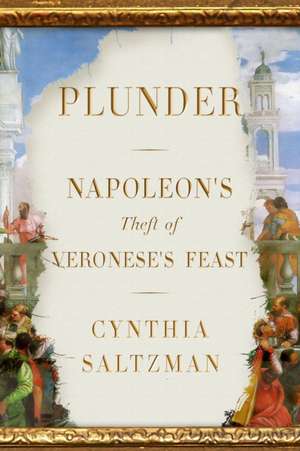
Plunder
Autor Cynthia Saltzmanen Limba Engleză Hardback – 11 mai 2021
În centrul volumului Plunder de Cynthia Saltzman se află destinul unei pânze monumentale: „Nunta din Cana” de Paolo Veronese. Observăm cum această lucrare de peste 60 de metri pătrați devine un simbol al ambițiilor imperiale franceze atunci când, în 1797, este smulsă de pe peretele mănăstirii San Giorgio Maggiore din Veneția și transportată pe Mediterană, rulată pe un cilindru, pentru a deveni piesa centrală a noului muzeu Luvru. Autoarea nu se limitează la o cronică de război, ci construiește o analiză a modului în care arta a fost instrumentalizată pentru a legitima regimul lui Napoleon Bonaparte. Textul reușește să pună în lumină dualitatea lui Napoleon — un personaj care dorea să concentreze cele mai fine realizări ale civilizației în inima Franței, dar care nu ezita să folosească forța brută pentru a obține acest lucru. Plunder completează perspectiva oferită de Art as Plunder de Margaret M. Miles, care examinează rădăcinile antice ale dezbaterii despre proprietatea culturală. În timp ce Miles se concentrează pe argumentele juridice și morale ale lui Cicero, Saltzman aduce discuția în modernitate, arătând cum campaniile napoleoniene au forțat Europa să redefinească conceptul de patrimoniu național și muzeu universal. Continuând preocuparea pentru migrația artei și ambiția colecționarilor explorată în lucrarea sa anterioară, Old Masters, New World, Cynthia Saltzman utilizează aici o structură narativă riguroasă, susținută de expertiza sa în istoria artei și rigoarea jurnalistică. Rezultatul este o istorie culturală care explică de ce, după înfrângerea de la Waterloo, deși Aliații au cerut returnarea multor opere, capodopera lui Veronese a rămas în Paris, unde poate fi văzută și astăzi.
Preț: 229.83 lei
Carte disponibilă
Livrare economică 07-21 decembrie
Livrare express 21-27 noiembrie pentru 37.96 lei
Specificații
ISBN-10: 0374219036
Pagini: 317
Dimensiuni: 162 x 236 x 35 mm
Greutate: 0.56 kg
Editura: FARRAR STRAUS&GIROUX
V-ar putea interesa
-
 The Daughters of YaltaCatherine Grace KatzPreț: 108.24 lei
-
 Old Masters, New WorldCynthia SaltzmanPreț: 158.91 lei
-
 King of the WorldPhilip Mansel-25%Preț: 103.79 lei137.96 lei
-
 InnerscapeRobert L. SchwenckPreț: 92.90 lei
-
 Sanando VidasCatalina Hernandez GarciaPreț: 85.70 lei
-
 Mandala WorldMaya NecalliPreț: 49.13 lei
-
 Mandala World 2Maya NecalliPreț: 57.89 lei
-
 Mandala Mythical 2Maya NecalliPreț: 49.13 lei
-
 Albania Coloring the WorldAnthony HutzlerPreț: 45.13 lei
-
 Das Bildnis des Dr. GachetCynthia SaltzmanPreț: 145.29 lei
De ce să citești această carte
Pentru cititorii interesați de istoria artei și de epoca napoleoniană, Plunder oferă o perspectivă fascinantă asupra modului în care a luat naștere Luvrul prin apropriere și jaf. Veți înțelege complexitatea din spatele unora dintre cele mai faimoase exponate ale lumii și mecanismele politice care decid unde trebuie să rămână o operă de artă. Este o lectură esențială pentru a înțelege dezbaterile actuale despre repatrierea patrimoniului cultural.
Despre autor
Cynthia Saltzman deține diplome în istoria artei de la universitățile Harvard și Berkeley, precum și un MBA de la Stanford. Experiența sa profesională îmbină expertiza academică cu rigoarea jurnalistică, fiind fost reporter pentru publicații prestigioase precum Forbes și The Wall Street Journal. În lucrările sale, Saltzman explorează frecvent intersecția dintre artă, putere și bani. Pe lângă Plunder, este autoarea volumelor The Portrait of Dr. Gachet și Old Masters, New World, acesta din urmă analizând achizițiile masive de artă europeană făcute de colecționarii americani în perioada Gilded Age.
Descriere scurtă
A captivatingstudy of Napoleon's plundering of Europe's art for the Louvre, told through the story of a Renaissance masterpiece seized from Venice
Cynthia Saltzman's Plunder recounts the fate of Paolo Veronese's Wedding Feast at Cana, a vast, sublime canvas that the French, under the command of the young Napoleon Bonaparte, tore from a wall of the monastery of San Giorgio Maggiore, on an island in Venice, in 1797. Painted in 1563 during the Renaissance, the picture was immediately hailed as a masterpiece. Veronese had filled the scene with some 130 figures, lavishing color on the canvas to build the illusion that the viewers' space opened onto a biblical banquet taking place on a terrace in sixteenth-century Venice. Once pulled from the wall, the Venetian canvas crossed the Mediterranean rolled on a cylinder; soon after, artworks commandeered from Venice and Rome were triumphantly brought into Paris. In 1801, the Veronese went on exhibition at the Louvre, the new public art museum founded during the Revolution in the former palace of the French kings.
As Saltzman tells the larger story of Napoleon's looting of Italian art and its role in the creation of the Louvre, she reveals the contradictions of his character: his thirst for greatness--to carry forward the finest aspects of civilization--and his ruthlessness in getting whatever he sought. After Napoleon's 1815 defeat at Waterloo, the Duke of Wellington and the Allies forced the French to return many of the Louvre's plundered paintings and sculptures. Nevertheless, The Wedding Feast at Cana remains in Paris to this day, hanging directly across from the Mona Lisa. Expertly researched and deftly told, Plunder chronicles one of the most spectacular art appropriation campaigns in history, one that sheds light on a seminal historical figure and the complex origins of one of the great museums of the world.
Notă biografică
Cuprins
1. "Send me a list of the pictures, statues, cabinets and curiosities"
2. Venice need not "fear that the French Armies would not fully respect its neutrality"
3. "Master Paolo will . . . not spare any expense for the finest ultramarine"
4. "He is rich in plans"
5. "This museum must demonstrate the nation's great riches"
6. "Draw as much as you can from Venetian territory"
7. "The Pope will deliver . . . one hundred paintings, busts, vases or statues"
8. "I'm on a path a thousand times more glorious"
9. "The Republic of Venice will surrender . . . twenty paintings"
10. "In the Church of St. George . . . The Wedding Feast at Cana"
11. "We . . . have received from Citizen Pietro Edwards"
12. "The most secure way would be to send them on a frigate, with 32 cannons"
13. "The seam . . . will be unstitched"
14. "The Revolution . . . is finished"
15. "You enter a gallery-such a gallery. But such a gallery!!!"
16. "The transparency of air . . . place[s] Gros beside Tintoretto and Paul Veronese"
17. "This beautiful work reminds us of the picture by Paul Veronese"
18. "I succeeded . . . in packing most of the pieces of small size and great value"
19. "The only thing to do is to burn them!"
20. "This foreboding painting . . . seems to summon the eye . . . from all directions"
21. "The masterpieces of the arts now belong to us"
22. "We are at last beginning to drag forth from this great cavern of stolen goods the precious objects of Art"
Epilogue
Notes
Selected Bibliography
Acknowledgments
Index