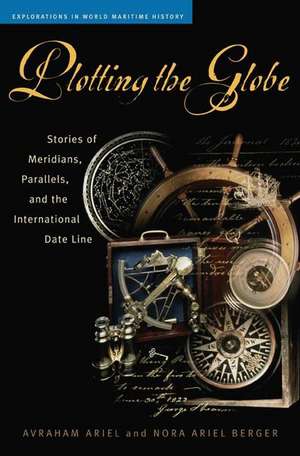
Plotting the Globe: Stories of Meridians, Parallels, and the International Date Line
Autor Avraham Ariel, Nora Ariel Bergeren Limba Engleză Hardback – 30 dec 2005
This book is a collection of stories and myths about geography, navigation, and geodesy- the science that deals with the Earth's figure and the interrelationship of selected points on its surface-that reaches far beyond dry scientific texts to concentrate on the people behind the discoveries. The knowledge and understanding of abstract notions such as the Prime Meridian, the Equator, and the International Date Line is conveyed through emphasis on the human spirit that motivated the pioneer scientists and sailors. It is a tale littered with heroes and villains, battles, tragedies and international intrigue. Readers will learn of a time when nothing was certain-even the shape and size of the earth were the subjects of fierce competition, conflict, and politics.
Preț: 390.11 lei
Preț vechi: 436.84 lei
-11%
Puncte Express: 585
Carte disponibilă
Livrare economică 04-18 noiembrie
Livrare prin curier în România Termenul estimat este afișat lângă disponibilitate.
Transport gratuit de la 400.00 lei Plată online sau ramburs, în funcție de opțiunile comenzii.
Retur gratuit în 14 zile Comandă securizată și suport în română.
Specificații
ISBN-13: 9780275988951
ISBN-10: 0275988953
Pagini: 235
Dimensiuni: 156 x 236 x 22 mm
Greutate: 0.77 kg
Editura: Bloomsbury Publishing
Colecția Praeger
Locul publicării:New York, United States
ISBN-10: 0275988953
Pagini: 235
Dimensiuni: 156 x 236 x 22 mm
Greutate: 0.77 kg
Editura: Bloomsbury Publishing
Colecția Praeger
Locul publicării:New York, United States
V-ar putea interesa
-
 The Last Grain RaceEric NewbyPreț: 92.77 lei
 -
 Stockwin's Maritime MiscellanyJulian StockwinPreț: 113.87 lei
 -
 Last Man OffMatt LewisPreț: 91.39 lei
 -
 Dunkirk Little ShipsNigel SharpPreț: 112.90 lei
 -
 The Sea and CivilizationLincoln Paine-16%Preț: 197.69 lei235.10 lei
Cuprins
Acknowledgements
Introduction
The Meridians
The Lemon or Orange Debate
Measuring a Meridian Mark I: What is the Shape of the Earth?
Measuring a Meridian Mark II: How Long is One Meter?
The Prime Meridian
From Hipparchus to Pulkovo
Greenwich - The Ultimate Prime Meridian
Greenwich Goes International
1984 Beats 1884 - The GPS
Time and Tide Wait for No Man, Especially at Greenwich
The International Date Line
The Paradox: Lost by Magellan, Found by Fogg
The International Date Line: Truth or Myth?
The International Date Line and the Millennium
The Equator
Crossing the Line
Who Did it First?
End of Story
References
Internet Sites
Credits and Illustrations
Index
Introduction
The Meridians
The Lemon or Orange Debate
Measuring a Meridian Mark I: What is the Shape of the Earth?
Measuring a Meridian Mark II: How Long is One Meter?
The Prime Meridian
From Hipparchus to Pulkovo
Greenwich - The Ultimate Prime Meridian
Greenwich Goes International
1984 Beats 1884 - The GPS
Time and Tide Wait for No Man, Especially at Greenwich
The International Date Line
The Paradox: Lost by Magellan, Found by Fogg
The International Date Line: Truth or Myth?
The International Date Line and the Millennium
The Equator
Crossing the Line
Who Did it First?
End of Story
References
Internet Sites
Credits and Illustrations
Index
Recenzii
The individuals and their intriguing stories are woven together into a narrative that on the one hand traces the history of how these circles came into existence, and the other hand, describes how simple ideas, such as a Prime Meridian, could cause considerable international and personal turmoil..The primary strength of this text is its readability. The authors successfully take on, and add a sense of intrigue to, topics that most people would find dry..The authors are also keen to link these many historically significant events to contemporary life..For those interested be the personal dynamics of exploration, nationalistic pride, scientific pursuits, political angst, and convention in the context of geography, then this text will not disappoint.
[A] lively and idiosyncratic style blissfully uncoupled from any contemporary regimes of social history or criticism. Ariel spent decades as a mariner and sea captain and he knows his subjects expertly, but when he considers Foucault he thinks only of his pendulum. There is no larger encompassing theme here, though the reader will find a fabulous cast of very lively and peculiar characters who sacrificed much of their lives to get to some desolate peak in Greenland for the briefest transit of the sun by tiny Venus. The authors have repackaged secondary sources, but they have read the most recent and best materials and assimilated them well. If you have ever wondered why the International Date Line meanders down the vast Pacific as it does, then this book, unlike many an academic geography tome, will tell you..As long as the earth remains curved but the screens lie flat, there will be a market, and an essential one, for books like this.
[A]n entertaining and easy read. Written by a former ship's master, who 'escaped' the seagoing life for an academic one, and with the research assistance of his daughter, it treats the development of the dimensional knowledge of the earth and the characters involved in its advancement in a light hearted, at times whimsical, manner..The narrative moves along with ease and factually reflects considerable research. This is borne out by a comprehensive bibliography, fully attributed illustrations, a list of Web site sources and 17 pages of footnotes collected together at the end of the book under chapter headings..The book includes many facts and topics of interest which may have passed by the more academic student of geodesy, in particular the stories surrounding the personal lives, travels and scientific endeavor of the explorers who undertook the assorted privations of the new world, both east and west, in their search for knowledge, territory and riches, -- often in reverse order.
Ariel and Berger have collected a variety of stories and myths of navigation, geography and geodesy to describe how the Prime Meridian, the Equator, and the International Date Line work and thereby how we measure time itself. They begin by describing how the points and lines on the globe work, then move to who determined the shape of the earth and the length of one meter, what the folks of the classic age had to say about time and space, why Greenwich is the center of all time, what happened when the Global Positioning System was born, how the Date Line became the Date Line and who found the equator so very interesting.
.this book is a unique exploration of the abstract great circles that run around the earth and how humans have created and given meaning to them.
[A] lively and idiosyncratic style blissfully uncoupled from any contemporary regimes of social history or criticism. Ariel spent decades as a mariner and sea captain and he knows his subjects expertly, but when he considers Foucault he thinks only of his pendulum. There is no larger encompassing theme here, though the reader will find a fabulous cast of very lively and peculiar characters who sacrificed much of their lives to get to some desolate peak in Greenland for the briefest transit of the sun by tiny Venus. The authors have repackaged secondary sources, but they have read the most recent and best materials and assimilated them well. If you have ever wondered why the International Date Line meanders down the vast Pacific as it does, then this book, unlike many an academic geography tome, will tell you..As long as the earth remains curved but the screens lie flat, there will be a market, and an essential one, for books like this.
[A]n entertaining and easy read. Written by a former ship's master, who 'escaped' the seagoing life for an academic one, and with the research assistance of his daughter, it treats the development of the dimensional knowledge of the earth and the characters involved in its advancement in a light hearted, at times whimsical, manner..The narrative moves along with ease and factually reflects considerable research. This is borne out by a comprehensive bibliography, fully attributed illustrations, a list of Web site sources and 17 pages of footnotes collected together at the end of the book under chapter headings..The book includes many facts and topics of interest which may have passed by the more academic student of geodesy, in particular the stories surrounding the personal lives, travels and scientific endeavor of the explorers who undertook the assorted privations of the new world, both east and west, in their search for knowledge, territory and riches, -- often in reverse order.
Ariel and Berger have collected a variety of stories and myths of navigation, geography and geodesy to describe how the Prime Meridian, the Equator, and the International Date Line work and thereby how we measure time itself. They begin by describing how the points and lines on the globe work, then move to who determined the shape of the earth and the length of one meter, what the folks of the classic age had to say about time and space, why Greenwich is the center of all time, what happened when the Global Positioning System was born, how the Date Line became the Date Line and who found the equator so very interesting.
.this book is a unique exploration of the abstract great circles that run around the earth and how humans have created and given meaning to them.