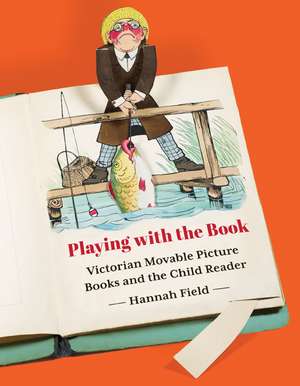
Playing with the Book : Victorian Movable Picture Books and the Child Reader
Autor Hannah Fielden Limba Engleză Paperback – 2 iul 2019
Notăm cu interes modul în care Playing with the Book propune o reevaluare a materialității lecturii, transformând o discuție teoretică despre istoria cărții într-o analiză aplicată a interacțiunii dintre copil și obiectul tipărit. Hannah Field se concentrează pe perioada 1835–1914, o eră în care inovațiile tehnice au permis apariția unor volume cu clapete, panorame și mecanisme complexe, forțând micii cititori să devină utilizatori activi. Reținem că această lucrare extinde cadrul propus de Interactive Books de Jacqueline Reid-Walsh cu date noi din perioada victoriană târzie, perioadă în care producția de masă a rafinat tehnicile „viziunilor dizolvabile” și ale cărților mecanice.
Descoperim aici o structură riguroasă, organizată tematic și cronologic. Primele capitole explorează actul distructiv-creativ al copiilor — ruperea și reconstrucția paginilor — în timp ce secțiunile centrale se apleacă asupra unor studii de caz specifice, precum lucrările lui Ernest Nister sau mecanismele sofisticate ale lui Lothar Meggendorfer. Autoarea demonstrează cum aceste obiecte hibride între jucărie și text au prefigurat concepte moderne de interactivitate, provocând limitele literaturii pentru copii. Față de The Victorian Mind's Eye, unde accentul cade pe relația vizuală dintre cuvânt și imagine, Field adaugă dimensiunea tactilă, argumentând că lectura victoriană era o experiență senzorială completă. În contextul operei sale, Playing with the Book continuă preocupările din Space and Place in Children’s Literature, 1789 to the Present, mutând însă atenția de la spațiul narativ metaforic la spațiul fizic, tridimensional al paginii pliabile.
Preț: 201.44 lei
Carte disponibilă
Livrare economică 30 octombrie-13 noiembrie
Livrare express 16-22 octombrie pentru 34.86 lei
Specificații
ISBN-10: 1517901774
Pagini: 248
Ilustrații: 78
Dimensiuni: 178 x 229 x 28 mm
Greutate: 0.54 kg
Editura: University of Minnesota Press
Colecția Univ Of Minnesota Press
De ce să citești această carte
Această lucrare este esențială pentru cercetătorii din domeniul istoriei cărții și al pedagogiei, oferind o perspectivă rară asupra modului în care designul influențează procesul cognitiv. Cititorul câștigă o înțelegere profundă a evoluției formatelor interactive, descoperind că „postmodernismul” grafic își are rădăcinile în ingeniozitatea victoriană. Este un instrument valoros pentru curatori și colecționari care doresc să descifreze contextul cultural al cărților mobile clasice.
Despre autor
Hannah Field este o cercetătoare specializată în literatura pentru copii și istoria culturii materiale, fiind recunoscută pentru modul în care analizează relația dintre obiectul fizic și experiența umană. În Playing with the Book, ea își folosește expertiza pentru a arhiva și interpreta interacțiunile uitate dintre copiii epocii victoriene și cărțile lor. Opera sa explorează frecvent intersecția dintre spațiu, loc și text, așa cum se observă și în volumul colectiv Space and Place in Children’s Literature, 1789 to the Present. Această abordare interdisciplinară îi permite să trateze cartea nu doar ca suport de informație, ci ca pe un artefact tehnologic complex.
Descriere scurtă
The Victorian era saw an explosion of novelty picture books with flaps to lift and tabs to pull, pages that could fold out, pop-up scenes, and even mechanical toys mounted on pages. Analyzing books for young children published between 1835 and 1914, Playing with the Book studies how these elaborately designed works raise questions not just about what books should look like but also about what reading is, particularly in relation to children’s literature and child readers.
Novelty books promised (or threatened) to make reading a physical as well as intellectual activity, requiring the child to pull a tab or lift a flap to continue the story. These books changed the relationship between pictures, words, and format in both productive and troubling ways. Hannah Field considers these aspects of children’s reading through case studies of different formats of novelty and movable books and intensive examination of editions that have survived from the nineteenth century. She discovers that children ripped, tore, and colored in their novelty books—despite these books’ explicit instructions against such behaviors.
Richly illustrated with images of these ingenious constructions, Playing with the Book argues that novelty books construct a process of reading that involves touch as well as sight, thus reconfiguring our understanding of the phenomenology of reading.
Notă biografică
Cuprins
Introduction: Novelty Value
1. The Three Rs: Reading, Ripping, Reconstructing
2. Against the Wall: Stories, Spaces, and the Children’s Panorama
3. The Movable Book in 3-D
4. Ernest Nister Christopher Columbus: The Tale of a Dissolving-View Book
5. Going through the Motions: Lothar Meggendorfer and the Mechanical Book
Conclusion: Novelty Book History
Acknowledgments
Notes
Index
Recenzii
"We may be underestimating the movable text’s place in the Victorian imagination. In this persuasive and lively study, Hannah Field reveals how nineteenth-century audiences played with and perceived toy theatres, panoramas, and mechanical books and describes modernity’s ferment in these powerfully nostalgic, ephemeral technologies. Movable novelties provided unique and engaging sensory experiences in the domestic space and in exhibition halls, and Field opens a critical window onto these interactive texts."—Nathalie op de Beeck, author of Suspended Animation: Children’s Picture Books and the Fairy Tale of Modernity
"Such books were made to be handled and used as much as read, and as such, they offer insight into the vexing question of children's agency as readers, especially when one looks at, as Field does, physical traces—ripping, scribbling, coloring—left behind by child readers."—CHOICE
"Field makes a significant contribution to what seems a niche topic, not least in her argument that it shouldn't be niche at all. At a moment when the focus of book history has shifted towards embodied reading and "doing things with books", such books—often bearing the traces of clumsy little hands—have a new kind of resonance."—Times Literary Supplement
"A well-written, thought-provoking, and timely book."—Barnboken
"Close attention to embodied engagement and agency is a strength of Field’s Playing with the Book."—Victorian Studies
"A valuable addition to graduate and undergraduate-level courses in children’s literature, book history, and Victorian studies... Playing with the Book teaches readers that we might pave the future of children’s literature by looking back into the past innovations and complications of movable books."—ImageText
"Field provides insightful readings and thoughtful considerations of novelty and movable books."—Children’s Literature Association Quarterly