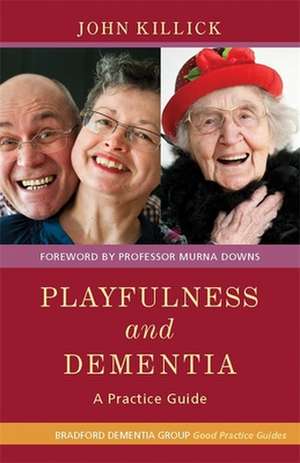
Playfulness and Dementia: A Practice Guide: University of Bradford Dementia Good Practice Guides
Contribuţii de Robin Lang Autor Mr John Killick Contribuţii de Sarah Zoutewelle-Morris Autor Kate Allan Contribuţii de Nicola Hodge, Ian Cameronen Limba Engleză Paperback – 15 oct 2012
John Killick explores the nature of playfulness and the many ways in which it can enrich the lives of people with dementia, including as a means of maintaining relationships and communication, supporting communication and generally lifting the spirits. Specific approaches already in existence are described, including improvised drama, clowning and laughter yoga, and a chapter on the playful approach to art and craft activities is also included. Personal accounts of playfulness by individuals with dementia, relatives and an actor with a decade's experience of using playful approaches with people with dementia offer rich first-hand insights into its transformative potential. Throughout the book, the importance of spontaneity and of being with the person with dementia in the present moment is emphasised, and the reader is encouraged to develop a playful mindset. A selection of colour photographs amply demonstrate playful approaches in action.
Offering a fresh and perhaps unexpected perspective, this book is essential reading for dementia care practitioners and managers, activity coordinators, therapists, people with dementia and their relatives, and anyone else concerned with the wellbeing of those with the condition.
Din seria University of Bradford Dementia Good Practice Guides
- 24%
 Preț: 259.68 lei
 - 26%
 Preț: 177.22 lei
 - 26%
 Preț: 176.55 lei
 - 30%
 Preț: 169.05 lei
 - 21%
 Preț: 141.59 lei
 - 28%
 Preț: 235.00 lei
 - 21%
 Preț: 142.22 lei
 - 21%
 Preț: 121.62 lei
 - 28%
 Preț: 213.62 lei
 - 21%
 Preț: 161.90 lei
 - 5%
 Preț: 221.61 lei
 -
 Preț: 211.74 lei
 -
 Preț: 219.11 lei
 - 5%
 Preț: 254.41 lei
 - 30%
 Preț: 187.86 lei
 - 26%
 Preț: 201.31 lei
 - 26%
 Preț: 175.84 lei
 - 5%
 Preț: 330.62 lei
 -
 Preț: 152.64 lei
Preț: 161.74 lei
Preț vechi: 206.32 lei
-22%
Puncte Express: 243
Carte disponibilă
Livrare economică 21 octombrie-04 noiembrie
Livrare prin curier în România Termenul estimat este afișat lângă disponibilitate.
Transport gratuit de la 400.00 lei Plată online sau ramburs, în funcție de opțiunile comenzii.
Retur gratuit în 14 zile Comandă securizată și suport în română.
Specificații
ISBN-13: 9781849052238
ISBN-10: 1849052239
Pagini: 120
Ilustrații: 8 colour and 3 black and white photographs
Dimensiuni: 140 x 215 x 7 mm
Greutate: 0.16 kg
Editura: JESSICA KINGSLEY PUBLISHERS
Colecția Jessica Kingsley Publishers
Seria University of Bradford Dementia Good Practice Guides
Locul publicării:London, United Kingdom
ISBN-10: 1849052239
Pagini: 120
Ilustrații: 8 colour and 3 black and white photographs
Dimensiuni: 140 x 215 x 7 mm
Greutate: 0.16 kg
Editura: JESSICA KINGSLEY PUBLISHERS
Colecția Jessica Kingsley Publishers
Seria University of Bradford Dementia Good Practice Guides
Locul publicării:London, United Kingdom
Recenzii
This recently published guide is not a technical/scientific book and it is not about giving fixed instructions. Rather, it is a collection of inspirational stories. It is about bringing humour into people's lives... In my opinion, every facility should have a copy of this book. It gives joy, inspiration and ideas for play. It affirms the valuable role and place for play in lifting everybody's spirit on a difficult journey. It sprinkles the path with smiles. Reading this book was a joy for me. I would recommend John's book to everyone involved in dementia care.
the first person accounts of people with dementia are interesting to read... This book will be of interest to anyone working alongside people with dementia.
(...)humour, silliness and playfulness can be enjoyed by many people with dementia... Play is the key to opening doors to creativity, spontaneity, engagement and relationships... This recently published book is (...) a collection of inspirational stories... In my opinion, every facility should have a copy of this book. It gives joy, inspiration and ideas for play... Reading this book was a joy for me. I would recommend John's book to everyone involved in dementia care. This includes healthcare staff as well as management staff.
The book is brimming with reassurance and practical ideas from "playful practitioners" for family and professional carers, those they care for, and for volunteers in dementia projects.
In many ways, play is the ideal vehicle for opening the many closed doors experienced when living with dementia. It provides all of us with permission to leave behind the rational, planned and cognitive, and embrace the creative, spontaneous and relational aspects of life. In Playfulness and Dementia, John Killick seeks to inspire 'a new generation of playful practitioners' by providing an overview of the nature of play and innovative approaches, complemented by accounts of playfulness in practice. I have no doubt that he will do so.
This book tickled my fancy. Just as many lonely hearts advertisements specify a GSOH as their top priority in a soulmate, I would specify the same requirement for those providing support and care to me and my family. This is not to trivialise the experience of living with dementia, but rather a recognition that laughter can help us through the most difficult places. This book is full of ways to connect people through fun. There is nothing disrespectful or silly about the words in this book. It is full of compassion and honesty. It will supply you with a springboard to joy.
Killick's challenge to us in Playfulness and Dementia is simple and powerful - what is wrong with having a good time when you are living with dementia? His many-faceted story is thoroughly convincing - that play, playfulness and laughter are integral to creativity in dementia, to people's well-being, and ultimately to their human right to experience joy.
Killick's clear, concise invitation to play reminds us that improvisation is the very core of life. This multi-voiced work provides invaluable paths to walk together, through dementia.
A Playfulness and dementia: A practice guide, John Killick explores the nature of playfulness and look at how it can enrich the lives of people with dementia... It is aimed at dementia care practitioners, activity coordinators, people with dementia and their relatives, and anyone else concerned with the wellbeing of those with dementia. Colour photographs demonstrate playful approaches in action.
the first person accounts of people with dementia are interesting to read... This book will be of interest to anyone working alongside people with dementia.
(...)humour, silliness and playfulness can be enjoyed by many people with dementia... Play is the key to opening doors to creativity, spontaneity, engagement and relationships... This recently published book is (...) a collection of inspirational stories... In my opinion, every facility should have a copy of this book. It gives joy, inspiration and ideas for play... Reading this book was a joy for me. I would recommend John's book to everyone involved in dementia care. This includes healthcare staff as well as management staff.
The book is brimming with reassurance and practical ideas from "playful practitioners" for family and professional carers, those they care for, and for volunteers in dementia projects.
In many ways, play is the ideal vehicle for opening the many closed doors experienced when living with dementia. It provides all of us with permission to leave behind the rational, planned and cognitive, and embrace the creative, spontaneous and relational aspects of life. In Playfulness and Dementia, John Killick seeks to inspire 'a new generation of playful practitioners' by providing an overview of the nature of play and innovative approaches, complemented by accounts of playfulness in practice. I have no doubt that he will do so.
This book tickled my fancy. Just as many lonely hearts advertisements specify a GSOH as their top priority in a soulmate, I would specify the same requirement for those providing support and care to me and my family. This is not to trivialise the experience of living with dementia, but rather a recognition that laughter can help us through the most difficult places. This book is full of ways to connect people through fun. There is nothing disrespectful or silly about the words in this book. It is full of compassion and honesty. It will supply you with a springboard to joy.
Killick's challenge to us in Playfulness and Dementia is simple and powerful - what is wrong with having a good time when you are living with dementia? His many-faceted story is thoroughly convincing - that play, playfulness and laughter are integral to creativity in dementia, to people's well-being, and ultimately to their human right to experience joy.
Killick's clear, concise invitation to play reminds us that improvisation is the very core of life. This multi-voiced work provides invaluable paths to walk together, through dementia.
A Playfulness and dementia: A practice guide, John Killick explores the nature of playfulness and look at how it can enrich the lives of people with dementia... It is aimed at dementia care practitioners, activity coordinators, people with dementia and their relatives, and anyone else concerned with the wellbeing of those with dementia. Colour photographs demonstrate playful approaches in action.
Cuprins
Foreword by Professor Murna Downs. Introduction. Part I. 1. What do we Mean by Playfulness? 2. To Play or Not to Play? 3. What People are Already Doing. 4. Bringing Play to the Person. 5. Funshops: Portrait of a Project. 6. The Dementia Monologues. 7. Home-made Humour. 8. Playfulness in the Moment. 9. Even a Few Scribbles. Sarah Zoutewelle Morris. 10. Taking the Senses for a Walk. Part II. 11. A Licence to be Free. Agnes Houston. 12. The Moment 'Me' Returned. Edward McLachlan. 13. Play the Game. Robin Lang. 14. Your Hat's Squint - Nicola Hodge. 15. Beyond Right and Wrong. Ian Cameron. References. Further Reading. Index.