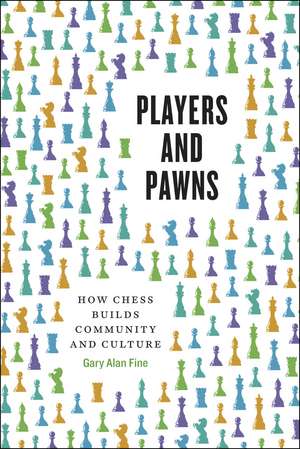
Players and Pawns: How Chess Builds Community and Culture
Autor Gary Alan Fineen Limba Engleză Paperback – 21 apr 2019
A chess match seems as solitary an endeavor as there is in sports: two minds, on their own, in fierce opposition. In contrast, Gary Alan Fine argues that chess is a social duet: two players in silent dialogue who always take each other into account in their play. Surrounding that one-on-one contest is a community life that can be nearly as dramatic and intense as the across-the-board confrontation. Fine has spent years immersed in the communities of amateur and professional chess players, and with Players and Pawns he takes readers deep inside them, revealing a complex, brilliant, feisty world of commitment and conflict. Within their community, chess players find both support and challenges, all amid a shared interest in and love of the long-standing traditions of the game, traditions that help chess players build a communal identity.
Full of idiosyncratic characters and dramatic gameplay, Players and Pawns is a celebration of the fascinating world of serious chess.
Full of idiosyncratic characters and dramatic gameplay, Players and Pawns is a celebration of the fascinating world of serious chess.
Preț: 198.59 lei
Puncte Express: 298
Carte tipărită la comandă
Livrare economică 30 noiembrie-14 decembrie
Livrare prin curier în România Termenul estimat este afișat lângă disponibilitate.
Transport gratuit de la 400.00 lei Plată online sau ramburs, în funcție de opțiunile comenzii.
Retur gratuit în 14 zile Comandă securizată și suport în română.
Specificații
ISBN-13: 9780226639864
ISBN-10: 022663986X
Pagini: 288
Ilustrații: 4 halftones
Dimensiuni: 152 x 229 x 23 mm
Greutate: 0.4 kg
Editura: University of Chicago Press
Colecția University of Chicago Press
ISBN-10: 022663986X
Pagini: 288
Ilustrații: 4 halftones
Dimensiuni: 152 x 229 x 23 mm
Greutate: 0.4 kg
Editura: University of Chicago Press
Colecția University of Chicago Press
V-ar putea interesa
-
 -13%Preț: 281.34 lei322.03 lei
 -
 On the Fireline: Living and Dying with Wildland FirefightersMatthew DesmondPreț: 260.23 lei
 -
 In the Open: Diary of a Homeless AlcoholicTimothy E. Donohue-8%Preț: 610.59 lei663.68 lei
 -
 Preț: 261.76 lei
 -
 Preț: 333.77 lei
 -
 Preț: 227.85 lei
 -
 After Pomp and Circumstance: High School Reunion as an Autobiographical OccasionVered Vinitzky-SeroussiPreț: 212.35 lei
 -
 The Sociology of MarxHenri LefebvrePreț: 291.37 lei
 -
 -18%Preț: 1297.01 lei1581.73 lei
 -
 KitchensGary Alan FinePreț: 240.96 lei
 -
 Morel Tales – The Culture of MushroomingGary Alan Fine-23%Preț: 430.75 lei559.41 lei
 -
 Manufacturing Tales: Sex and Money in Contemporary LegendsGary Alan FinePreț: 181.27 lei
 -
 English Local GovernmentBeatrice Potter WebbPreț: 191.21 lei
 -
 -18%Preț: 787.57 lei960.45 lei
 -
 SociologyCharles Hughes-18%Preț: 811.74 lei989.93 lei
 -
 Preț: 69.79 lei
 -
 Preț: 161.27 lei
Notă biografică
Gary Alan Fine is professor of sociology at Northwestern University and the author of numerous books.
Cuprins
Prologue: A Tournament Revealed
Introduction: First Moves
Chapter One: The Mind, the Body, and the Soul of Chess
Chapter Two: Doing Chess
Chapter Three: Temporal Tapestries
Chapter Four: Shared Pasts and Sticky Culture
Chapter Five: The Worlds of Chess
Chapter Six: Status Games and Soft Community
Chapter Seven: Chess in the World
Conclusion: Piece Work
Acknowledgments
Notes
Index
Introduction: First Moves
Chapter One: The Mind, the Body, and the Soul of Chess
Chapter Two: Doing Chess
Chapter Three: Temporal Tapestries
Chapter Four: Shared Pasts and Sticky Culture
Chapter Five: The Worlds of Chess
Chapter Six: Status Games and Soft Community
Chapter Seven: Chess in the World
Conclusion: Piece Work
Acknowledgments
Notes
Index
Recenzii
"Fine demonstrates above all that chess is not an individualized activity, but rather a communal one. The logic of chess is not impersonal, but embodied and social. It is not merely a game, but an important part of the way that many people make their lives together. It is a significant and masterful achievement."
"Whether you are a casual player or a grandmaster you will find something of interest in this book, which takes a bemused look at the extensive activity that goes into making chess communities. Even if you have never played chess, you will still learn a lot about social life from this book, the best yet by this prolific author."
“A traditional ethnography, Players and Pawns combines rigor with a wry lightness of touch. Even those for whom chess has always seemed a bizarre mixture of obsession, paranoia, and sublime mastery, will see it revealed as a wondrously diverse landscape of contrasting temperaments, climates, and folkways.”
“A rich account of community norms, values, boundaries, status systems, and organization.”
“Players and Pawns would make an excellent addition to a game studies course at either the undergraduate or graduate level. . . .That said, the concepts Fine develops are useful to folklorists working with other subcultural groups, and the book should be of interest far beyond game studies.”