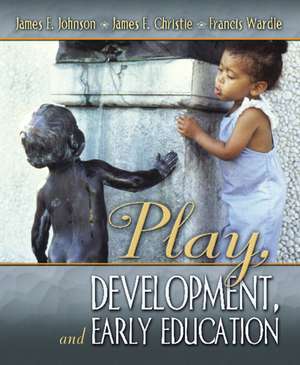
Play, Development and Early Education
Autor James E. Johnson, James F. Christie, Francis Wardleen Limba Engleză Paperback – 30 sep 2004
Helps teachers and soon-to-be teachers learn how play as a form of communication can be adapted to the classroom. "Play, Development, and Early Education, " challenges the reader to discover what play is and how to incorporate it into a curriculum for children from toddlerhood through the primary grades. Utilizing three major ideas the quality of play in early childhood, play as a means of self-expression, and play as a channel of communication to achieving social sense the authors examine the beliefs, perspectives, and theories relating to play and what effects culture, media and technology have on play. In addition, the text addresses the role of parents in supporting and elaborating play, the direct connections between research and play practice, and the value of play in relation to the total development (cognitive, affective, emotional, social, and physical) of all children. Play, Early childhood, child development. Appropriate for teachers and other professionals that work with children from toddler through primary grades. Also appropriate for those studying to work in the field of early childhood education. "
Preț: 924.84 lei
Preț vechi: 1201.09 lei
-23%
163.40€ • 188.18$ • 141.45£
Carte tipărită la comandă
Livrare economică 11-25 mai
Specificații
ISBN-10: 0205394795
Pagini: 448
Dimensiuni: 189 x 234 x 20 mm
Greutate: 0.69 kg
Ediția:New.
Editura: Pearson
Locul publicării:Upper Saddle River, United States
V-ar putea interesa
-
 Reconceptualizing Leadership in the Early YearsRory McDowall Clark-30%Preț: 172.97 lei247.85 lei
 -
 Exploring Play for Early Childhood StudiesMandy AndrewsPreț: 296.25 lei
 -
 Maria Montessori: A Critical Introduction to Key Themes and DebatesDr Marion O'Donnell-22%Preț: 230.96 lei294.97 lei
 -
 Preț: 373.91 lei
 -
 Theories of ChildhoodCarol Garhart MooneyPreț: 173.19 lei
Descriere
Play is the universal language of childhood. In order to converse with new generations of children, today's teachers must prepare themselves and learn how this form of communication can be adapted to the classroom. Play, Development, and Early Education, challenges the reader to discover what play is and how to incorporate it into a curriculum for children from toddlerhood through the primary grades. Utilizing three major ideas—the quality of play in early childhood, play as a means of self-expression, and play as a channel of communication to achieving social sense—the authors examine the beliefs, perspectives, and theories relating to play and what effects culture, media and technology have on play. In addition, the text addresses the role of parents in supporting and elaborating play, the direct connections between research and play practice, and the value of play in relation to the total development (cognitive, affective, emotional, social, and physical) of all children.
Cuprins
1. Beliefs About Play.
History and Images of Children and Play.Multiple Perspectives on Play.Defining Play.Current Issues and Trends.2. Theories of Play.
Classical TheoriesModern TheoriesPostmodern TheoriesImplications for Teachers II. PLAY AND DEVELOPMENT.
3. Play, Development, and Assessment: Birth to Eight Years.
Play Development: An Overview.Development of Motor Play.Development of Object Play.Development of Symbolic Play.Development of Social Play.Play Development from Six to Eight.Play Assessment.4. Diversity and Individual Differences in Play.
Gender Differences.Physical Play.Personality and Play.Race and Ethnicity.5. Play's Role in Development.
Play and Development: Basic Observations.Brain Development and Play.Cultural Learning and Play.Language and Literacy Dimension.Feature: School Readiness: Educational Value of Play.Social Dimension.Feature: What good is play? Communicating the value of play to parents. Emotional Dimension.6. Play Contexts: Physical Environment, Social Ecology, and Culture.
Cultural-Contextual Approaches to Play.Physical Environment and Play.Social Ecology and Play.Play and Culture.Educational Applications. III. PLAY AND EDUCATION.
7. Play's Role in Education.
The value of educational play.Types of Educational Play.Barriers to educational play.8. Enriching Classroom Play: Materials and Curriculum.
Relationship between play materials and development.Characteristics of play materials.Types of Play Materials.9. Enriching Classroom Play: Teaching Strategies and Facilitation Techniques.
Providing Adequate Time for Play.Preparatory Experiences.Teacher Involvement in Play.Linking Play with Instruction.10. Play for Children with Special Needs and Circumstance.
Play and Special Education.Play Therapy.Child Life Programs.11. Popular Culture, Media, and Technology.
Popular Culture.Play and the Media.Technology.12. Outdoor Play.
History of Playgrounds.Purpose of outdoor play.Different kinds of playgrounds.Playground design.Age-related playgrounds.Safety.ADA Accessibility.Role of the teacher in the playground.Outdoor play advocacy.
Textul de pe ultima copertă
Play, Development, and Early Education challenges the reader to discover what play is and how to incorporate it into a curriculum for children from toddlerhood through the primary grades. The nature of play as a mode for learning is examined through three core ideas: the quality of play in early childhood, play as a means of self-expression, and play as a channel of communication to achieving social sense. In addition, the text addresses the role of parents in supporting and elaborating play, the direct connections between research and play practice, and the value of play in relation to the total development (cognitive, affective, emotional, social, and physical) of all children.
Praise for Play, Development, and Early Education
“To say that I am impressed with this text would be making an understatement of the year. We in early childhood education have needed such a text for a long time.”
Dr. Ramona E. Patterson, South Louisiana Community College
“The authors have written an extensive account showing the scope and depth of children's play including the current trends, research, and informed opinions on the importance of childhood play.”
Regina C.M. Williams, Central Ohio Technical College
About the authors
James E. Johnson is Professor of Early Childhood Education at The Pennsylvania State University. His scholarly activities center around children's play, early childhood programs, and the educational role of the family. He has authored textbooks on early childhood programs and play.
James F. Christie is Professor of Curriculum and Instruction at Arizona State University. His research interests include children's play and early literacy development. He has co-authored two other textbooks with Allyn & Bacon on early literacy.
Francis Wardle studied play in Guatemala and Brazil, and is an international expert on outdoor play for young children. Currently Dr. Wardle teaches at Red Rocks Community College and the University of Phoenix—Colorado Campus, consults for Head Start, and writes both books, including an introductory early childhood education textbook for Allyn & Bacon, and articles for a variety of national publications.
Caracteristici
- The most easy-to-follow, conversational play text on the market!
- Special features in each chapter allow students (and professors) to explore different types of play ideas and key topics.
- An in-depth discussion addresses the classical, modern, and postmodern play theories, such as Practice Theory, Social Learning Theory, and Chaos Theory (Ch. 2).
- Focus Questions corresponding with major outcomes listed at the beginning of each chapter assist the instructor in developing lesson plans.
- Chapter Projects give students the opportunity to think about chapter content and explore different situations and solutions.