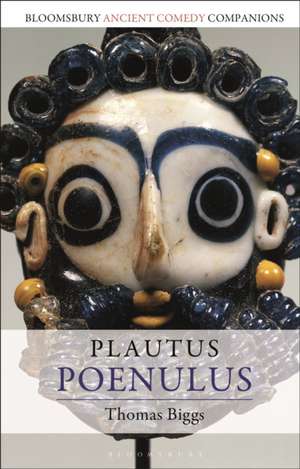
Plautus: Poenulus: Bloomsbury Ancient Comedy Companions
Autor Thomas Biggsen Limba Engleză Hardback – 9 iul 2026
historical significance. Performed in the long shadow of Rome's struggle with
Hannibal's Carthage, this play stages the restoration of a Carthaginian family
divided through enslavement. Set against the backdrop of a Greece marked by
comedic expectations and the geography of contemporary imperial conquest,
Poenulus presents a tale of Carthaginian heartbreak and heartache to a postwar
Roman audience. The comedy's remarkable diversity prompts audience
interaction with a wide range of socio-cultural topics relevant to Plautus' time.
Engaging weighty matters through song, slapstick, puns, and spectacle, Poenulus
may appear to defang, but its bite is deep.
This book offers an innovative understanding of Poenulus' place in Roman history
and literary culture, helping readers to appreciate the play itself, the complex
nature of Plautine authorship, and the cultures of performance in Republican
Rome. Most of the book explores the play as a performance, from its unique and
strikingly self-aware prologue to the actors' call for applause in the final line.
The longest chapter examines the play's afterlives in the Renaissance and early
modern period, including little-known revivals and adaptations in Ferrara, Rome,
and Cambridge. Over the centuries, people have found in Poenulus a script well
suited to active learning in the Latin classroom, a text capable of supporting
new political ideologies, and a dramatized vision of the world that accorded
with processes of racialization in Europe as reengagement with the classical past
coincided with the expansion of the slave trade and the objectification of Black
Africans. That one play has been seen to support and subvert the same outlooks
and practices is a testament to its complexity and to the enduring power of all Plautine verse from the third century BCE to the present.
Din seria Bloomsbury Ancient Comedy Companions
- 16%
 Preț: 131.46 lei
 - 15%
 Preț: 166.00 lei
 - 21%
 Preț: 163.07 lei
 - 21%
 Preț: 162.91 lei
 - 9%
 Preț: 135.81 lei
 - 21%
 Preț: 155.69 lei
 - 26%
 Preț: 170.04 lei
 - 26%
 Preț: 168.98 lei
 - 16%
 Preț: 135.81 lei
 - 29%
 Preț: 163.34 lei
 - 27%
 Preț: 469.24 lei
 - 17%
 Preț: 163.48 lei
 - 16%
 Preț: 128.54 lei
 - 26%
 Preț: 142.39 lei
 - 30%
 Preț: 469.24 lei
 - nou
 Preț: 469.64 lei
 - 30%
 Preț: 502.83 lei
Preț: 514.67 lei
Preț vechi: 733.01 lei
-30%
Puncte Express: 772
Carte disponibilă
Livrare economică 30 octombrie-13 noiembrie
Livrare prin curier în România Termenul estimat este afișat lângă disponibilitate.
Transport gratuit pentru acest produs Plată online sau ramburs, în funcție de opțiunile comenzii.
Retur gratuit în 14 zile Comandă securizată și suport în română.
Specificații
ISBN-13: 9781350379060
ISBN-10: 1350379069
Pagini: 224
Ilustrații: 11 bw illus
Dimensiuni: 140 x 218 x 16 mm
Greutate: 0.38 kg
Editura: Bloomsbury Publishing
Colecția Bloomsbury Academic
Seria Bloomsbury Ancient Comedy Companions
Locul publicării:London, United Kingdom
ISBN-10: 1350379069
Pagini: 224
Ilustrații: 11 bw illus
Dimensiuni: 140 x 218 x 16 mm
Greutate: 0.38 kg
Editura: Bloomsbury Publishing
Colecția Bloomsbury Academic
Seria Bloomsbury Ancient Comedy Companions
Locul publicării:London, United Kingdom
Cuprins
Acknowledgements
Preface
Illustrations
1. Introduction
2. Prologue
3. Plots, Plots, and Characters
4. Hanno(s)
5. Reception: Ferrara, Rome, Cambridge
Epilogue
Bibliography
Notes
Index
Preface
Illustrations
1. Introduction
2. Prologue
3. Plots, Plots, and Characters
4. Hanno(s)
5. Reception: Ferrara, Rome, Cambridge
Epilogue
Bibliography
Notes
Index
Recenzii
With extraordinary learning, wit, and sensitivity, Tom Biggs finally brings Plautus and his Poenulus into the 21st century. An indispensable tool for teaching and researching one of the most enlightening Latin literary texts on the complex socio-cultural dynamics of the ancient Mediterranean world.
In engaging and accessible prose, Tom Biggs introduces the reader to Plautus' Poenulus, covering stagecraft, literary themes, socio-historical contexts, and the play's long afterlife. His most exciting accomplishment is his innovative accounting for Punic materials in his analysis of "The Little Carthaginian." This book is a must-read.
In engaging and accessible prose, Tom Biggs introduces the reader to Plautus' Poenulus, covering stagecraft, literary themes, socio-historical contexts, and the play's long afterlife. His most exciting accomplishment is his innovative accounting for Punic materials in his analysis of "The Little Carthaginian." This book is a must-read.