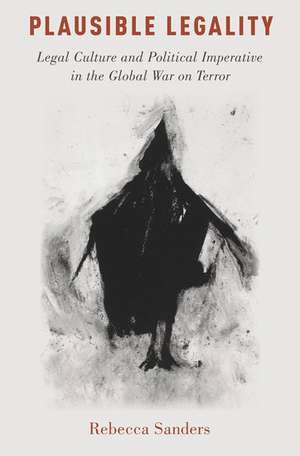
Plausible Legality: Legal Culture and Political Imperative in the Global War on Terror: Oxford Studies in Culture and Politics
Autor Rebecca Sandersen Limba Engleză Hardback – 27 sep 2018
Din seria Oxford Studies in Culture and Politics
-
 Preț: 251.46 lei
 - 11%
 Preț: 314.92 lei
 - 17%
 Preț: 198.91 lei
 - 16%
 Preț: 187.65 lei
 - 21%
 Preț: 200.93 lei
 - 30%
 Preț: 525.52 lei
 - 15%
 Preț: 150.23 lei
 - 16%
 Preț: 161.46 lei
 - 16%
 Preț: 145.00 lei
 -
 Preț: 145.10 lei
 - 13%
 Preț: 299.78 lei
 - 21%
 Preț: 286.64 lei
 - 11%
 Preț: 331.76 lei
 - 11%
 Preț: 323.89 lei
 - 17%
 Preț: 302.65 lei
 -
 Preț: 324.83 lei
 - 21%
 Preț: 300.82 lei
 - 21%
 Preț: 285.61 lei
 - 28%
 Preț: 202.45 lei
 -
 Preț: 249.64 lei
 - 32%
 Preț: 522.88 lei
 - 32%
 Preț: 517.72 lei
 -
 Preț: 250.45 lei
 - 13%
 Preț: 333.50 lei
 - 12%
 Preț: 292.78 lei
 -
 Preț: 217.50 lei
 - 14%
 Preț: 565.36 lei
Preț: 367.40 lei
Preț vechi: 453.20 lei
-19%
Puncte Express: 551
Carte tipărită la comandă
Livrare economică 19-25 noiembrie
Livrare prin curier în România Termenul estimat este afișat lângă disponibilitate.
Transport gratuit de la 400.00 lei Plată online sau ramburs, în funcție de opțiunile comenzii.
Retur gratuit în 14 zile Comandă securizată și suport în română.
Specificații
ISBN-13: 9780190870553
ISBN-10: 0190870559
Pagini: 248
Dimensiuni: 160 x 236 x 23 mm
Greutate: 0.45 kg
Editura: Oxford University Press
Colecția OUP USA
Seria Oxford Studies in Culture and Politics
Locul publicării:New York, United States
ISBN-10: 0190870559
Pagini: 248
Dimensiuni: 160 x 236 x 23 mm
Greutate: 0.45 kg
Editura: Oxford University Press
Colecția OUP USA
Seria Oxford Studies in Culture and Politics
Locul publicării:New York, United States
Recenzii
Plausible Legality is well written, accessible and engaging. It is also wide-ranging in terms of the academic and theoretical literature it draws on to inform its argument... Sanders's argument in Plausible legality is novel and thought-provoking. It should stimulate conversations in classrooms and in the fields of human rights, international relations and American politics about the role of law and lawyers in the construction-and perhaps, one day, dismantling-of the imperial presidency
Sanders has written a fresh and illuminating analysis of U.S. policies in the 'war on terror' that have at times been at odds with international human rights or humanitarian law. She argues that those policies have been shaped by both perceived security imperatives and limits established by national and international law. Sanders assesses three major policy areas-torture, due process, and domestic surveillance-and brings them within a unified analytical framework. Anyone interested in U.S. policy in the post-9/11 era, or in the nexus of law and policy, should pay attention.
This is a powerful and provocative book on international law and politics. Sanders shows the power of international law as it is put to use in practice by American government officials to justify killing and torture. She sees legal justification as evidence of a pervasive legal culture that values international commitments. Sanders' great contribution is to show that law's permissive constraint can enable state violence just as easily as it can limit it. This book charts a path through global politics and law that should be followed by a great many scholars and students.
In Plausible Legality, Rebecca Sanders offers a meticulous analysis of how governments have sought to legitimize infringements of international human rights and humanitarian law since 9/11. She makes a compelling argument that legal cultures are central to these effots, and have stubborn and lasting effects. Sanders' work is essential reading for scholars working in international relations and international human rights law, since it raises important and pressing questions on the on-going struggle to defend human rights and shield them from the excesses of state power.
Sanders has written a fresh and illuminating analysis of U.S. policies in the 'war on terror' that have at times been at odds with international human rights or humanitarian law. She argues that those policies have been shaped by both perceived security imperatives and limits established by national and international law. Sanders assesses three major policy areas-torture, due process, and domestic surveillance-and brings them within a unified analytical framework. Anyone interested in U.S. policy in the post-9/11 era, or in the nexus of law and policy, should pay attention.
This is a powerful and provocative book on international law and politics. Sanders shows the power of international law as it is put to use in practice by American government officials to justify killing and torture. She sees legal justification as evidence of a pervasive legal culture that values international commitments. Sanders' great contribution is to show that law's permissive constraint can enable state violence just as easily as it can limit it. This book charts a path through global politics and law that should be followed by a great many scholars and students.
In Plausible Legality, Rebecca Sanders offers a meticulous analysis of how governments have sought to legitimize infringements of international human rights and humanitarian law since 9/11. She makes a compelling argument that legal cultures are central to these effots, and have stubborn and lasting effects. Sanders' work is essential reading for scholars working in international relations and international human rights law, since it raises important and pressing questions on the on-going struggle to defend human rights and shield them from the excesses of state power.
Notă biografică
Rebecca Sanders is an Assistant Professor of Political Science at the University of Cincinnati, where she teaches and researches at the intersection of international law, international security, and international human rights.
Cuprins
- Chapter 1: The Politics of Plausible Legality
- Chapter 2: Permissive Constraint: Law, Power, and Legal Culture
- Chapter 3: Torture
- Chapter 4: Deprivations of Life and Liberty: Detention, Trial, and Targeted Killing Policy
- Chapter 5: Surveillance
- Chapter 6: The Fate of Human Rights in the Global War on Terror