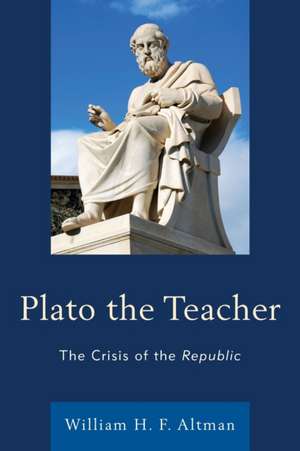
Plato the Teacher: The Crisis of the Republic
Autor William H. F. Altmanen Limba Engleză Paperback – 10 iun 2013
| Toate formatele și edițiile | Preț | Express |
|---|---|---|
| Paperback (1) | 387.42 lei 6-8 săpt. | |
| Bloomsbury Publishing – 10 iun 2013 | 387.42 lei 6-8 săpt. | |
| Hardback (1) | 847.24 lei 6-8 săpt. | |
| Bloomsbury Publishing – 9 feb 2012 | 847.24 lei 6-8 săpt. |
Preț: 387.42 lei
Preț vechi: 565.12 lei
-31%
Puncte Express: 581
Preț estimativ în valută:
68.49€ • 81.66$ • 59.40£
68.49€ • 81.66$ • 59.40£
Carte tipărită la comandă
Livrare economică 17-31 martie
Specificații
ISBN-13: 9780739184417
ISBN-10: 0739184415
Pagini: 489
Dimensiuni: 151 x 225 x 30 mm
Greutate: 0.79 kg
Editura: Bloomsbury Publishing
Colecția Lexington Books
Locul publicării:New York, United States
ISBN-10: 0739184415
Pagini: 489
Dimensiuni: 151 x 225 x 30 mm
Greutate: 0.79 kg
Editura: Bloomsbury Publishing
Colecția Lexington Books
Locul publicării:New York, United States
Cuprins
An Introduction to Plato's Republic: Inside and Outside the Text 1
Part 1 The First Words of Plato's ???? te?/a
Chapter 1: ?at?ß??
Chapter 2: ????
Chapter 3: µet? G?a??????
Chapter 4: µet? G?a??????
Chapter 5: t?? ???st????
Part 2 Challenges
Chapter 6: Cephalus and the Meaning of Life
Chapter 7: Polemarchus Meets Appearance and Reality
Chapter 8: Thrasymachus and the City of Good Men Only
Chapter 9: Glaucon's Challenge to Socrates
Chapter 10: The Challenge of Adeimantus to Plato
Part 3 The Shorter Way
Chapter 11: Introduction to Methodology
Chapter 12: Methodology II: Hypotheses
Chapter 13: Methodology III: Images
Chapter 14: Looking Out for Number One
Chapter 15: Making Friends with Thrasymachus
Part 4 The Longer Way
Chapter 16: The Speech to the Guardians
Chapter 17: Justice and the Good on the Divided Line
Chapter 18: The Idea of the Good and Plato's Theory of Forms
Chapter 19: An Intellectual History of the Return
Chapter 20: Whistling a Tune on the Way Down
Part 5 The Firestick
Part 1 The First Words of Plato's ???? te?/a
Chapter 1: ?at?ß??
Chapter 2: ????
Chapter 3: µet? G?a??????
Chapter 4: µet? G?a??????
Chapter 5: t?? ???st????
Part 2 Challenges
Chapter 6: Cephalus and the Meaning of Life
Chapter 7: Polemarchus Meets Appearance and Reality
Chapter 8: Thrasymachus and the City of Good Men Only
Chapter 9: Glaucon's Challenge to Socrates
Chapter 10: The Challenge of Adeimantus to Plato
Part 3 The Shorter Way
Chapter 11: Introduction to Methodology
Chapter 12: Methodology II: Hypotheses
Chapter 13: Methodology III: Images
Chapter 14: Looking Out for Number One
Chapter 15: Making Friends with Thrasymachus
Part 4 The Longer Way
Chapter 16: The Speech to the Guardians
Chapter 17: Justice and the Good on the Divided Line
Chapter 18: The Idea of the Good and Plato's Theory of Forms
Chapter 19: An Intellectual History of the Return
Chapter 20: Whistling a Tune on the Way Down
Part 5 The Firestick
Recenzii
Plato the Teacher constitutes a major contribution to Plato studies and is striking in its profundity and originality. For Altman, Plato is first and foremost an educator, constructing his corpus as a whole and the Republic in particular so as to maximize their pedagogic punch. An educator can only be an altruist, and, for Altman, Plato's altruism forms the very core of the Republic, whose essential ethical teaching for us all is found in Socrates' directive to the philosopher-kings: 'You must go down.' Plato the Teacher abounds in startlingly fresh readings of passages that have grown stale, and is infused with clarity, erudition, and passion.
How Plato's dialogues ought to be arranged and, accordingly, how they are to be read, has provoked much debate. Some scholars believe that identifying their chronology of composition (the order in which they were written) is crucial to understanding Plato's philosophical development; others believe their dramatic order is of paramount importance. High school teacher Altman opts for a different yet altogether refreshing approach, advocating a paideutic scheme that focuses on the order in which Plato intended his dialogues to be taught. As its title would suggest, Altman's book is, most immediately, an exegesis of Republic; however, its broader purpose is to show that Republic, or more specifically the allegory of the cave, occupies a central position in a complex philosophical curriculum. In his effort to defend this provocative thesis, Altman is impressively successful. His scholarship is impeccable, his familiarity with the Platonic corpus thorough, and his reading of individual passages meticulous. Given its high level of erudition and frequent reference to the original Greek, this book will appeal mainly to scholars; nevertheless, it is a book with which all students of Plato will want to become familiar. Summing Up: Highly recommended.
William H. F. Altman's Plato the Teacher presses the question of Plato's pedagogical purpose further than any other modern scholar, and as a result offers a strikingly original and compelling interpretation of the Platonic corpus. . . .[H]is work is. . .implicitly an alternative to the various ways that scholars have written about Plato on education. . . .Altman's book blazes a different trail - it offers a Platonic philosophy of education based primarily on how Plato educates his readers, both ancient and modern. [His] engagement with the voluminous scholarship on Republic is impressive. . . .Altman's passion for studying Plato is evident throughout the work.
I have never read anyone who has attempted to identify Plato quite so fully and so audaciously with the modern democratic spirit as does Altman. His book is impassioned and deeply personal. Flashes of brilliance and insight abound in it, and its vivid, folksy, self-consciously American eloquence is wonderfully engaging.
Guided by Cicero, as Plato's 'best student,' Plato the Teacher reads the Republic and specifically its allegory of the cave as an exemplar of Plato's student-centered pedagogy about justice, addressed to those both inside and outside the text. Sensitive to the dialogue's language and context, provocative in its freshness, originality, and depth of engagement with the text and its many interpreters, and thoroughly Platonist in its insistence on a transcendent Idea of the Good beyond Being, Plato the Teacher makes a signal philosophical, ethical, and political contribution to the study of Plato.
We have here the seemingly impossible: a reading of the Republic that is highly original, because not easily classifiable under any of the interpretative approaches current today, while also representing a return to classic two-world Platonism. This old/new Plato will doubtless provoke needed reexamination and debate among all readers of this inexhaustible dialogue.
How Plato's dialogues ought to be arranged and, accordingly, how they are to be read, has provoked much debate. Some scholars believe that identifying their chronology of composition (the order in which they were written) is crucial to understanding Plato's philosophical development; others believe their dramatic order is of paramount importance. High school teacher Altman opts for a different yet altogether refreshing approach, advocating a paideutic scheme that focuses on the order in which Plato intended his dialogues to be taught. As its title would suggest, Altman's book is, most immediately, an exegesis of Republic; however, its broader purpose is to show that Republic, or more specifically the allegory of the cave, occupies a central position in a complex philosophical curriculum. In his effort to defend this provocative thesis, Altman is impressively successful. His scholarship is impeccable, his familiarity with the Platonic corpus thorough, and his reading of individual passages meticulous. Given its high level of erudition and frequent reference to the original Greek, this book will appeal mainly to scholars; nevertheless, it is a book with which all students of Plato will want to become familiar. Summing Up: Highly recommended.
William H. F. Altman's Plato the Teacher presses the question of Plato's pedagogical purpose further than any other modern scholar, and as a result offers a strikingly original and compelling interpretation of the Platonic corpus. . . .[H]is work is. . .implicitly an alternative to the various ways that scholars have written about Plato on education. . . .Altman's book blazes a different trail - it offers a Platonic philosophy of education based primarily on how Plato educates his readers, both ancient and modern. [His] engagement with the voluminous scholarship on Republic is impressive. . . .Altman's passion for studying Plato is evident throughout the work.
I have never read anyone who has attempted to identify Plato quite so fully and so audaciously with the modern democratic spirit as does Altman. His book is impassioned and deeply personal. Flashes of brilliance and insight abound in it, and its vivid, folksy, self-consciously American eloquence is wonderfully engaging.
Guided by Cicero, as Plato's 'best student,' Plato the Teacher reads the Republic and specifically its allegory of the cave as an exemplar of Plato's student-centered pedagogy about justice, addressed to those both inside and outside the text. Sensitive to the dialogue's language and context, provocative in its freshness, originality, and depth of engagement with the text and its many interpreters, and thoroughly Platonist in its insistence on a transcendent Idea of the Good beyond Being, Plato the Teacher makes a signal philosophical, ethical, and political contribution to the study of Plato.
We have here the seemingly impossible: a reading of the Republic that is highly original, because not easily classifiable under any of the interpretative approaches current today, while also representing a return to classic two-world Platonism. This old/new Plato will doubtless provoke needed reexamination and debate among all readers of this inexhaustible dialogue.