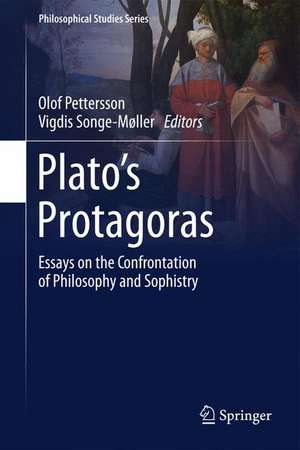
Plato's Protagoras
Editat de Olof Pettersson, Vigdis Songe-Mølleren Limba Engleză Hardback – 15 dec 2016
While many of the contributing authors argue for a sharp distinction between sophistry and philosophy, this is contested by others. Readers may consider the distinctions between philosophy and traditional forms of poetry and sophistry through these papers. Questions for readers' attention include: To what extent is Socrates’ preferred modeof discourse, and his short questions and answers, superior to Protagoras’ method of sophistic teaching? And why does Plato make Socrates and Protagoras reverse positions as it comes to virtue and its teachability?
This book will appeal to graduates and researchers with an interest in the origins of philosophy, classical philosophy and historical philosophy.
Preț: 673.98 lei
Preț vechi: 792.92 lei
-15%
Puncte Express: 1011
Preț estimativ în valută:
119.21€ • 141.35$ • 103.86£
119.21€ • 141.35$ • 103.86£
Carte tipărită la comandă
Livrare economică 25 martie-08 aprilie
Specificații
ISBN-13: 9783319455839
ISBN-10: 3319455834
Pagini: 244
Ilustrații: VI, 235 p.
Dimensiuni: 160 x 241 x 19 mm
Greutate: 0.54 kg
Ediția:1st edition 2017
Editura: Springer
Locul publicării:Cham, Switzerland
ISBN-10: 3319455834
Pagini: 244
Ilustrații: VI, 235 p.
Dimensiuni: 160 x 241 x 19 mm
Greutate: 0.54 kg
Ediția:1st edition 2017
Editura: Springer
Locul publicării:Cham, Switzerland
V-ar putea interesa
-
 Aristotle & Xenophon on Democracy and OligarchyJ. M. MoorePreț: 242.24 lei
 -
 A Free Will – Origins of the Notion in Ancient ThoughtMichael Frede-23%Preț: 480.39 lei623.88 lei
 -
 The Genesis of Plato's Thought: Second EditionRussell TuttlePreț: 454.97 lei
 -
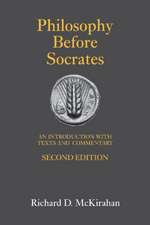 Philosophy Before Socrates: An Introduction with Texts and CommentaryRichard D. McKirahan-10%Preț: 171.92 lei191.80 lei
 -
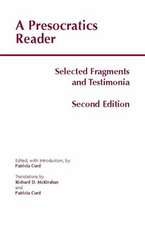 A Presocratics Reader: Selected Fragments and TestimoniaPatricia Curd-12%Preț: 108.90 lei124.41 lei
 -
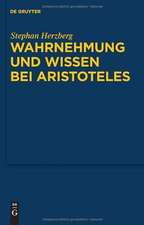 -23%Preț: 1213.65 lei1576.18 lei
 -
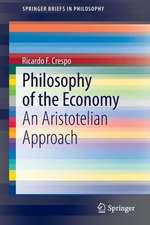 Philosophy of the Economy: An Aristotelian ApproachRicardo F. CrespoPreț: 366.40 lei
 -
 Preț: 365.82 lei
 -
 -15%Preț: 463.77 lei545.61 lei
 -
 Platonic Legislations: An Essay on Legal Critique in Ancient GreeceDavid Lloyd DusenburyPreț: 396.83 lei
 -
 Hegels StaatsideeJulius LöwensteinPreț: 402.52 lei
 -
 Dialog und Dialektik: Zur Struktur des Platonischen DialogsHermann GundertPreț: 399.02 lei
 -
 -15%Preț: 559.97 lei658.80 lei
 -
 PHILOSOPHIE ET ECRITUREPalù Chiara-19%Preț: 612.73 lei756.45 lei
 -
 Preț: 480.24 lei
 -
 Collected Studies on Francisco Suarez Sj (1548 1617)John P. Doyle-23%Preț: 479.65 lei622.92 lei
Cuprins
Introduction.- Chapter 1. Hallvard Fossheim: "The Question of Methodology in Plato's Protagoras".- Chapter 2. Knut Ågotnes: “Socrates’ Sophisticated Attack on Protagoras”.- Chapter 3. Hayden W. Ausland: “The Treatment of Virtue in Plato’s Protagoras”.- Chapter 4. Jens Kristian Larsen: “By What Is the Soul Nourished? On the Art of the Physician of Souls in Plato’s Protagoras”.- Chapter 5. Vivil Valvik Haraldsen: “Is Pleasure Any Good? Weakness of Will and the Art of Measurement in Plato's Protagoras”.- Chapter 6. Cynthia Freeland: “The Science of Measuring Pleasure and Pain".- Chapter 7. Gro Rørstadbotten: "Turning Towards Philosophy. A reading of the Protagoras 309a1-314e2".- Chapter 8. Marina McCoy: “The Protagoras, Writing and the Comedy of Aporia".- Chapter 9. Vigdis Songe-Møller: “Socrates’ Irony: A Voice from Nowhere? On voice (phone), topos, and atopos in Plato's Protagoras".- Chapter 10. Olof Pettersson: “Dangerous Voices: On Written and Spoken Discourse in Plato’s Protagoras".- Chapter 11. Kristin Sampson: "Visible and Audible Movement in the Protagoras".- Chapter 12. Paul Woodruff: "Why Did Protagoras Use Poetry in Education?".
Notă biografică
Olof Pettersson is postdoctoral fellow at the Department of Philosophy, University of Bergen. Besides his dissertation on Plato’s notion of appetite, he is the author of several articles on Plato and is published in a range of international journals. His focus of research is ancient philosophy with a particular interest in Plato’s notion of non-argumentative means of influence and their linguistic underpinnings. Currently he works on a project on Plato’s critique of language.
Vigdis Songe-Møller is professor emerita at the Department of Philosophy, University of Bergen. She is author of Philosophy Without Women. The Birth of Sexism in Western Thought and two volumes on pre-Socratic philosophy. Her focus of research has been feminist interpretations of ancient Green texts, especially by Hesiod, Anaximander, Parmenides, and Plato. She leads the research project Poetry and Philosophy. Poetical and Argumentative Elements of Plato's Philosophy.
Vigdis Songe-Møller is professor emerita at the Department of Philosophy, University of Bergen. She is author of Philosophy Without Women. The Birth of Sexism in Western Thought and two volumes on pre-Socratic philosophy. Her focus of research has been feminist interpretations of ancient Green texts, especially by Hesiod, Anaximander, Parmenides, and Plato. She leads the research project Poetry and Philosophy. Poetical and Argumentative Elements of Plato's Philosophy.
Textul de pe ultima copertă
This book presents a thorough study and an up to date anthology of Plato’s Protagoras. International authors' papers contribute to the task of understanding how Plato introduced and negotiated a new type of intellectual practice – called philosophy – and the strategies that this involved. They explore Plato’s dialogue, looking at questions of how philosophy and sophistry relate, both on a methodological and on a thematic level.
While many of the contributing authors argue for a sharp distinction between sophistry and philosophy, this is contested by others. Readers may consider the distinctions between philosophy and traditional forms of poetry and sophistry through these papers. Questions for readers' attention include: To what extent is Socrates’ preferred mode of discourse, and his short questions and answers, superior to Protagoras’ method of sophistic teaching? And why does Plato make Socrates and Protagoras reverse positions as it comes to virtue and its teachability?
This book will appeal to graduates and researchers with an interest in the origins of philosophy, classical philosophy and historical philosophy.
While many of the contributing authors argue for a sharp distinction between sophistry and philosophy, this is contested by others. Readers may consider the distinctions between philosophy and traditional forms of poetry and sophistry through these papers. Questions for readers' attention include: To what extent is Socrates’ preferred mode of discourse, and his short questions and answers, superior to Protagoras’ method of sophistic teaching? And why does Plato make Socrates and Protagoras reverse positions as it comes to virtue and its teachability?
This book will appeal to graduates and researchers with an interest in the origins of philosophy, classical philosophy and historical philosophy.
Caracteristici
Presents new approaches to Plato's Protagoras Explores distinctions between sophistry and philosophy in Plato Casts new light on philosophy and poetry in Plato